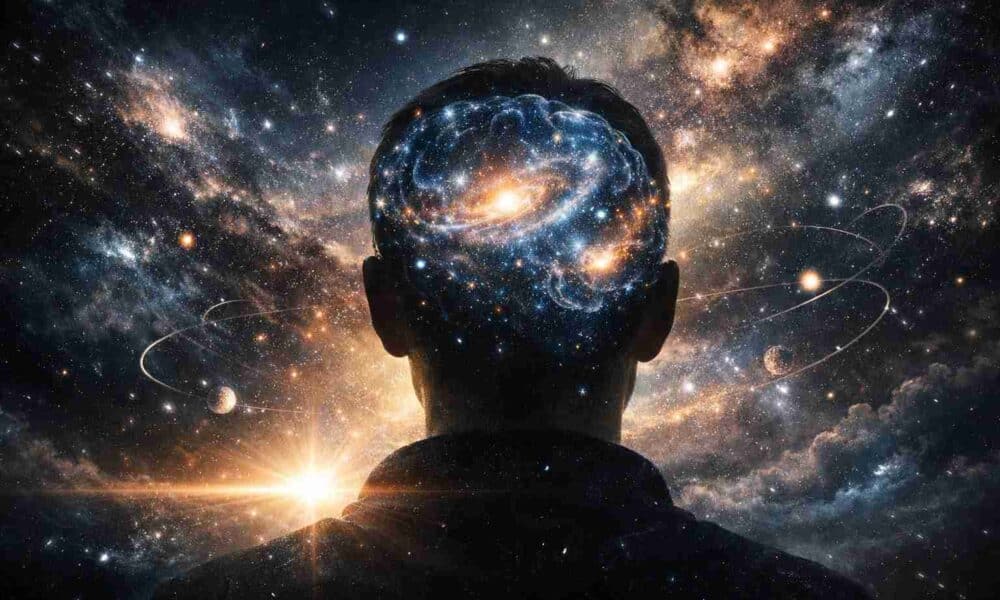
 It is time to stop dodging the question. Modern science, as powerful as it is, advances with a silent crutch: human consciousness. It presupposes it, uses it, depends on it — while pretending it can do without it.
For centuries, science has built its authority on a radical promise: to explain the world without recourse to the subject who observes it. Measure without feeling. Describe without interpreting. Calculate without consciousness. This ambition has produced spectacular results, but today it is approaching a limit that no equation can cross on its own.
For science does not observe reality from the outside. It interrogates it from a situated, embodied, conscious point of view. The observer is not a negligible detail of the system: they are part of it. Time is not universal, space is not fixed, and the act of measurement is never completely neutral. What 20th-century physics has quietly revealed, philosophy had intuited: reality is not independent of the way in which it is understood.
Consciousness is precisely that: the place where the world becomes intelligible. Without it, there are no facts, no laws, no science. And yet, this consciousness remains the great absence in scientific models. We map the brain, measure neural activity, simulate intelligence, but we carefully avoid the central question: why is there a lived experience rather than a simple mechanism?
Science can tell how a thought forms, but it is mute on what it means to think. It can explain perception, but not the intimate evidence of existing. It can predict behaviors, but not account for meaning. This is not a technical shortcoming: it is a conceptual boundary.
By pushing this boundary further, science finds itself facing a mirror. It discovers that consciousness is not a secondary phenomenon, but the very condition of all knowledge. This realization unsettles, because it compels relinquishing the illusion of absolute objectivity. It reminds us that science is not a divine gaze laid upon the world, but a human, rigorous, admirable — and profoundly situated — construction.
To oppose science and consciousness is therefore an intellectual error. One without the other is incomplete. Science without consciousness becomes cold, technical, blind to meaning. Consciousness without science becomes vague, speculative, detached from reality. Their meeting is not a compromise: it is a necessity.
The question is no longer whether science will one day explain consciousness as it explains a force or a particle.
The real question is more troubling: is science ready to admit that it cannot understand itself without interrogating the consciousness that produces it?
Thus, science has taught us that time can dilate and space can bend. It still has a more intimate revolution to accomplish: to admit that understanding the world without understanding the one who thinks it is an unfinished ambition.
Perhaps then we will discover that the greatest scientific frontier is not at the edge of the universe, but at the heart of the very consciousness that seeks to explain it.
Imed Derouiche
Expert in energy, hydrogen and digital transition