My name is Walid (name changed), I’m 42 years old. I’m Tunisian, married, a father of three, and I have been living in Libya for almost six years. If I came here, it wasn’t because I had a Libyan dream, nor because I longed for an expatriate life. I came because, at a moment, in Tunisia, the numbers began to speak louder than anything else.
End-of-months had become walls. Daily expenses took the form of silent threats. Food, schooling, medicines, the small emergencies of ordinary life, everything ended up weighing heavier than my salary. I worked, but I wasn’t advancing. I earned a living, without managing to secure that of my loved ones.
So I did what many men do in silence when they feel there isn’t enough space to fail. I left.
I told myself it would be temporary. A few years of sacrifice, perhaps. The time to put the accounts in order, to take a breath, to ensure the essentials for my wife and children left in Tunisia. The time to build something sturdier than anxiety.
I believed I was leaving to save the balance of my home. I now realize that economic exile never saves without causing damage.
A departure born of necessity, not a life project
I come from Kairouan. There, I had already worked in several fields, especially in technical maintenance and electrical installations. I have always been among those who accept long days, travel, unforeseen events, physical fatigue, as long as there is work and a salary at the end. But gradually, a truth asserted itself: in Tunisia, I was keeping the emergency afloat, not the future.
When the Libyan opportunity presented itself, I did not look at it as an adventure. I saw it as an exit.
You leave for Libya differently than you would depart for Europe or the Gulf. There is no bright mirage, no socially valorizing narrative. There is something more bare, harsher, almost more honest. You go there because it’s close, because you have contacts, because you know someone who knows someone, because the boundaries of the possible have narrowed and you still have to carry on.
I arrived with a small suitcase, a bit of savings, and that inner discipline that one develops when you know you aren’t allowed to be disappointed too quickly.
My work in Libya and what others don’t see
Today, I work in Tripoli as a senior technician in electro-mechanical maintenance for a private company that operates on professional buildings, air conditioning installations, generator sets, and technical equipment. The work is demanding. You must be available, rigorous, mobile. The days start early. They sometimes end late. You must handle breakdowns, emergencies, travel, client demands, and the pressure of deadlines. It isn’t an office job. It’s a trade where the body, the brain, and the nerves work together.
I earn about 5,200 Libyan dinars per month, which today amounts to a little under 2,400 Tunisian dinars.
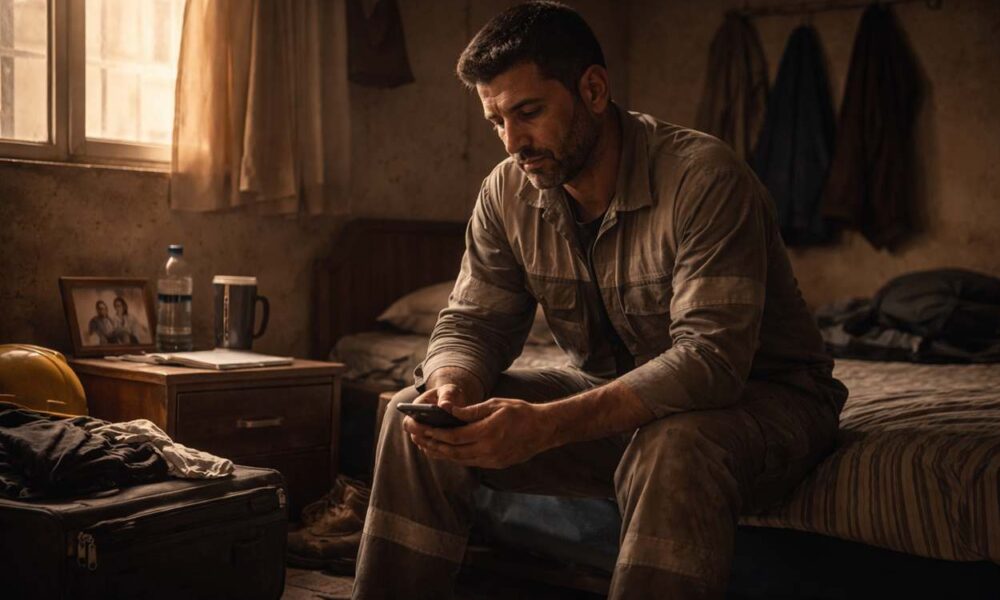
My employer covers shared housing with other workers, the travel between home and work sites, the formalities related to my stay, as well as basic medical coverage. Without this, I probably wouldn’t have lasted so long. If I had to pay for separate housing, a vehicle, or all the administrative costs on my own, the equation would crumble.
But what is called “being housed” does not mean living comfortably. It means sleeping in a functional space, with no real privacy, with that minimum of stability that allows me to keep working the next day. It isn’t a life. It’s a survival arrangement.
What I spend here, to be able to send there
Even with some of the expenses covered, you still have to live.