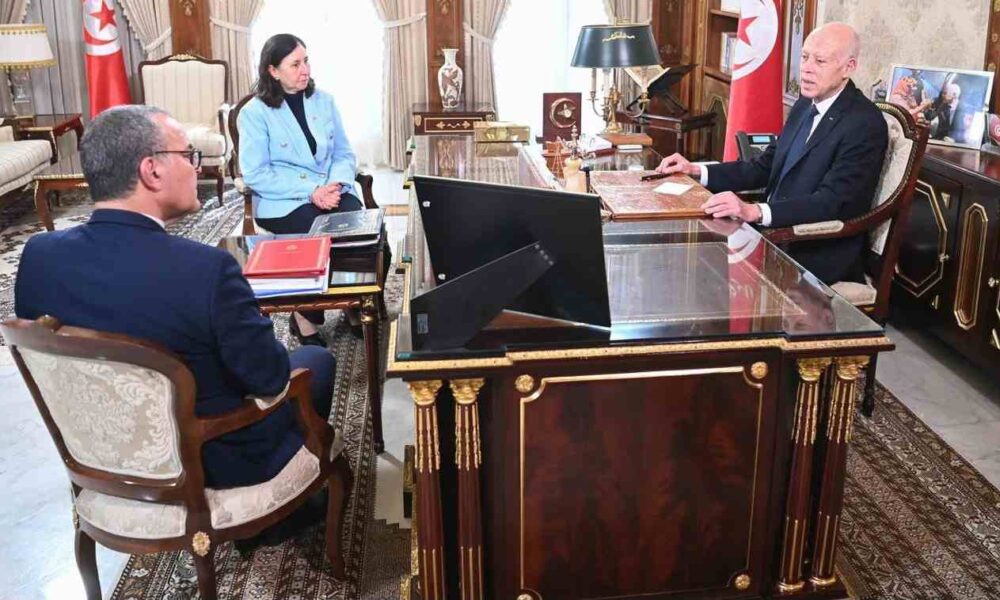
The President of the Republic, Kais Saied, received in the afternoon of Monday March 10 at the Carthage Palace the head of government Sarra Zaafrani Zenzri as well as the Minister of Economy and Planning Samir Abdelhafidh.
This meeting was devoted to examining the preliminary draft of the development plan 2026-2030, which, according to the head of state, should rest on a different approach from previous plans in Tunisia.
A plan based on the expectations of citizens
During this meeting, the President of the Republic stressed that the future development plan must be directly derived from the will of the citizens, relying on their expectations and concrete demands.
Unlike the methods used in the past, where orientations were defined mainly at the central level, the objective stated is to bring proposals up from local structures. In this framework, the institutional system based on local, regional and regional/district councils, up to the National Council of Regions and Districts, should constitute the space in which the projects proposed by the citizens themselves will be developed and gathered.
The central role of the State in the social sectors
The President of the Republic also revisited what he regards as the fundamental role of the State in the social sphere, notably in several essential sectors.
He specifically mentioned education, health, public transport, and the right to decent housing, noting that these sectors have been progressively weakened over the years.
The head of state also denounced the existence of phenomena of corruption in several state-owned enterprises and public institutions, stating that some structures would have been weakened to reduce their value before being sold off at low prices.
The right to work and to fair wages
During this exchange, Kais Saied also pressed the right to work under dignified conditions and with fair remuneration.
He stated that efforts would continue to realize what he described as a natural and constitutional right, despite the difficulties facing the country.
The President also recalled that the fair distribution of wealth is a central objective of public policies.
Kais Saied also recalled that Tunisia has numerous resources, but the economic choices made in the past have sometimes been marked by injustices or policies deemed inequitable, or even by the implementation of certain external recommendations or pressures.
Figures that must translate into daily life
Finally, the head of state emphasized one essential point: economic indicators and statistics, however important they may be, must translate concretely into the daily life of citizens.
He stated that development results should not remain confined to conferences or briefings, but should be perceptible in all regions of the country, through real improvements in living conditions.