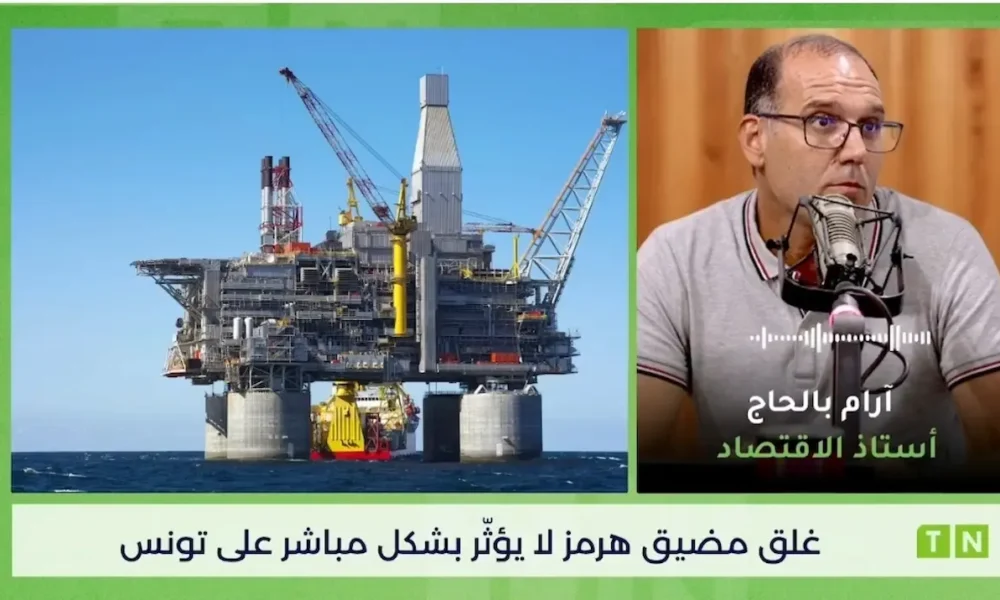
The economist Aram Belhaj stated, on Wednesday, March 11, 2026, that the potential closure of the Strait of Hormuz in the context of the Middle East war would not have a direct impact on Tunisia. In an interview granted to Tunisie Numérique, he explained that the majority of oil imported by Tunisia comes from Azerbaijan, transiting through the Turkey before arriving via the Mediterranean Sea, while natural gas is mainly imported from Algeria.
According to him, several oil-exporting countries will benefit from the current rise in crude prices on international markets, notably Algeria, in the context of geopolitical tensions shaking the region.
Tunisia exposed to fluctuations of the global market
However, Aram Belhaj stressed that Tunisia will not be entirely spared by this crisis. Indeed, about one-quarter of the world’s oil supplies transit through the Strait of Hormuz, meaning that any disruption to shipping traffic will affect international markets.
As Tunisia is an open economy, it remains closely linked to developments in global markets. Thus, even if Tunisian imports do not pass directly through Hormuz, disruption of oil transportation to other strategic routes, such as the Suez Canal or the Mediterranean, could have indirect repercussions on the country.
Rising oil prices, the main risk for Tunisia
For the economist, the main danger for Tunisia lies in the rise in oil prices on international markets. Currently, the barrel price is between 92 and 95 dollars, while the supply contracts Tunisia signs are generally short-term, which quickly exposes the country to market fluctuations.
This situation could have significant consequences on the state budget, notably the subsidy fund (subsidies).
A more uncertain investment climate
Aram Belhaj also mentioned another risk related to the crisis: the deterioration of the international investment climate. According to him, military escalation could affect the confidence of foreign investors, whether European (French, Italian, German) or from Gulf countries such as Qatar. Such a situation could lead to a decline in investments and an economic slowdown.
A strong energy dependence
The economist recalled that Tunisia’s energy imports come mainly from Algeria (41%), followed by Russia (24%), Azerbaijan (7%), Italy (7%), and Libya (2%). In this context, any disruption of energy markets in Algeria or Russia could have a major impact on Tunisian supply.
A critical scenario for public finances
According to Aram Belhaj, the duration of the war in Iran will be decisive for the evolution of oil markets. Several reports mention the possibility that the price per barrel could reach $150 if the conflict prolongs and widens.
Such a scenario would be particularly critical for Tunisia, whose 2026 finance law was drafted based on an estimated barrel price of $63.3. Yet current prices already exceed this level by about $30.
The economist notes that an increase of one dollar in the price of a barrel costs about 164 million dinars to the state budget.
Difficult choices for the government
Facing this situation, several options are available to the Tunisian government:
- increase the subsidies budget to maintain fuel prices,
- combine higher subsidies with higher pump prices,
- or, in case of a record surge in international prices, significantly revise fuel prices.
According to Aram Belhaj, the magnitude of the impact will basically depend on the duration and intensity of the conflict in the Middle East, which could profoundly influence the balance of global energy markets.