Tunisia’s summer stone fruit production is expected to reach about 263 thousand tonnes during the 2025-2026 season, up from nearly 252 thousand tonnes in the previous season, a rise of 4.6%.
According to data obtained by the TAP agency from the Interprofessional Grouping of Fruits, this progression is mainly due to the increase in peach production, which concerns most varieties and several production hubs, notably Sidi Bouzid, Ben Arous and Manouba.
An increase driven by peaches
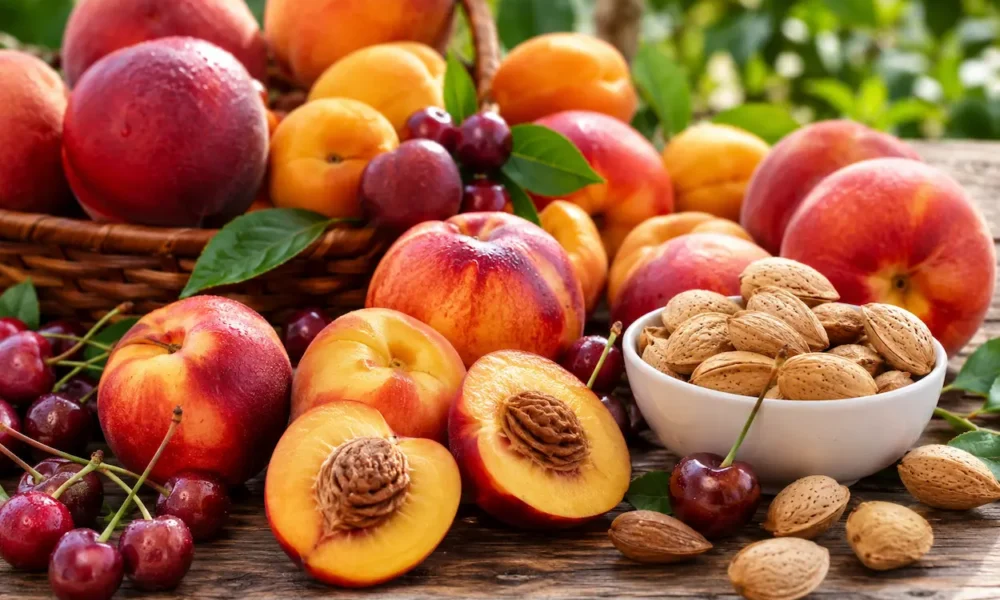
Preliminary estimates indicate that peach and nectarine production should take first place this season, with 138.5 thousand tonnes, compared with about 123 thousand tonnes last season, a rise of 12.6%.
This production is distributed among 48.7 thousand tonnes of early peaches, 68.6 thousand tonnes of peaches of the season, 19.6 thousand tonnes of late peaches and 1,600 tonnes of nectarines.
Decline of certain varieties due to climate
While total production is up, some varieties register declines to varying degrees. This situation is attributed to climate changes, which gradually influence the pace of production and the degree of fruit maturity.
The total area devoted to summer stone fruits also experienced a slight decline of 3%, to reach 191,635 hectares, from 197,562 hectares last season.
Apricots stable, almonds and cherries down
Apricot production is expected to remain stable, at 43.5 thousand tonnes, the same level as last season. It is distributed between 29 thousand tonnes of early apricots and 14.5 thousand tonnes of seasonal apricots.
For dry almonds, production is estimated at 53.7 thousand tonnes, compared with 56.5 thousand tonnes in the previous season, which represents a 5% decrease.
Regarding the ‘aouina’, forecasts indicate production of 17.5 thousand tonnes, compared with 17.474 thousand tonnes last season, a slight increase of 2.9%.
By contrast, cherry production, locally called ‘habb el moulouk’, is expected to fall sharply by 27%, to only 7,000 tonnes compared with 9,600 tonnes last season.
As for the ‘boussaa’, production should remain nearly stable at 2,800 tonnes, versus 2,750 tonnes last year.
Kairouan leading producing regions
Geographically, data from the Interprofessional Fruit Grouping show significant disparities among governorates in terms of production volume and growth rates.
The governorate of Kairouan tops the national chart, with an estimated harvest of 39.353 thousand tonnes, showing slight stability compared with the previous season.
It is followed by Ben Arous, with 35.938 thousand tonnes, up 24%, then Sidi Bouzid, which is expected to produce 22.765 thousand tonnes, despite a 30.7% decrease in its surface area.
The governorate of Nabeul should, for its part, deliver a substantial production of 21.967 thousand tonnes, despite a slight decline of 7%.
Strong progress in Manouba and Kasserine
Some regions show notable growth. Manouba is expected to record a strong increase in its production, with a growth of 26%, to reach 26.090 thousand tonnes.
Kasserine also shows a positive evolution of 10%, with production estimated at 30.663 thousand tonnes.
Conversely, some regions experience a clear decline. Sfax records the largest drop, with production down 36%, to 6,363 tonnes. Mahdia also shows a decline of 18%, with an expected harvest of 7,311 tonnes.