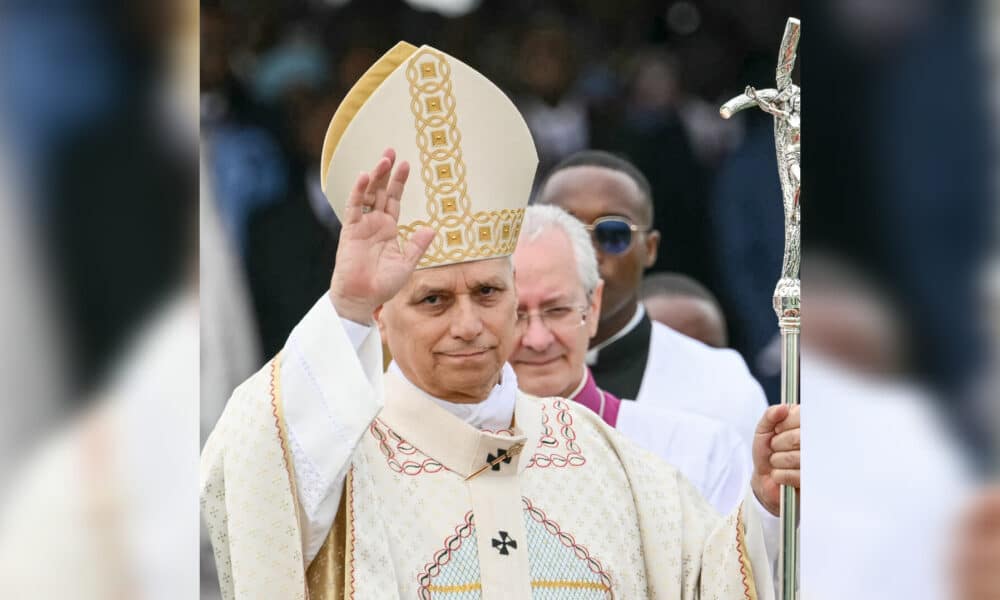
By choosing the name Leo XIV, American Cardinal Robert Prevost has entered a papal lineage rich in symbols. This choice notably echoes Leo XIII, the last pope to bear this name before him, who led the Catholic Church at the end of the 19th century, during a period of profound social, economic, and ideological upheaval.
Leo XIII was nicknamed the “Pope of the workers” and the “Pope of the people.” His pontificate occurred at a moment when the Industrial Revolution was upending Western societies, transforming the way people lived, worked, and thought. More than a century later, Leo XIV seems to want to place his action in the same perspective: that of a Church called to take a stand in the face of the major technological ruptures of his time.
The Industrial Revolution and the 19th-Century Social Crisis
In the 19th century, the Industrial Revolution was not merely a technical advance in the means of production. It constituted a major rupture with the old world. Machines gradually took a central place in society, sometimes more determining than that of the States themselves.
The countryside emptied in favor of industrial cities. Millions left traditional rural communities to join overcrowded urban centers, where living conditions were often very difficult. Workers labored long hours, without real legal protection, while women and children were massively employed in factories.
The new bourgeoisie, owner of the machines and the means of production, gained considerable influence. It possessed not only wealth but also a growing ability to shape social behaviors, ways of life, and even collective imaginations.
In this context, the Church watched with concern the emergence of a world in which man seemed progressively subjected to the logic of the machine. Factories had torn populations from their traditional community structures, weakened religious certainties and produced a working mass deprived of rights and recognition.
Leo XIII and the Birth of the Church’s Social Doctrine
It is in this climate that Leo XIII published, in May 1891, his famous encyclical Rerum Novarum, often translated as “Things New” or “The New Realities.” This text marked a turning point in the history of the Catholic Church.
Through this encyclical, the pope sought to place the Church in an intermediate position between liberal capitalism and communism. He denounced the excesses of a ruleless capitalism, defended the dignity of workers, called for the creation of workers’ organizations capable of protecting the most vulnerable, and asked the State to assume its social responsibilities.
Nevertheless, Leo XIII did not reject the principle of private property. He defended it, but by anchoring it in a moral and social vision, opposed to unlimited accumulation and exploitation of the weakest.
This stance laid the foundations of the Church’s social doctrine, a current that would durably influence contemporary Catholic thought. It also inspired, in the American Protestant world, movements close to the “Social Gospel,” a social reading of the Gospel focused on justice, workers, and human dignity.
A Century of Machines, Capitals and Empires
The 19th century was the century of the triumphant machine. Steamships, railways and large factories redesigned the world. In the United States, on the eve of the Civil War in 1861, nearly 50,000 kilometers of railway lines had been built. In Germany, the railway network approached 40,000 kilometers.
Industrialisation fostered mass production, but also increased exploitation of the workforce. Along the German railways, hundreds of thousands of workers were mobilized daily under arduous conditions. Cities grew rapidly, often without adequate sanitation infrastructure. Workers’ housing was cramped, poorly ventilated, and unsanitary. Epidemics, such as cholera or tuberculosis, found fertile ground there.
The industrial revolution also transformed the environment. Coal powered factories and locomotives, plunging many European cities into thick clouds of smoke. The waters became polluted and urban centers were overwhelmed by new sanitary problems, including the accumulation of waste related to horse-drawn transport.
Each invention opened a new field of expansion for capitalism. The appearance of the first motor vehicles, such as Karl Benz’s in 1886, contributed to the rise of petroleum and the emergence of new economic empires. The great industrialists sometimes became more powerful than sovereigns themselves, as with Alfred Krupp, whose wealth impressed even European leaders.
The “Spring of Nations” and the Return of the Church to the Social Debate
Faced with this brutal transformation, social and political resistances multiplied. In 1848, Marx and Engels published the Communist Manifesto, in a Europe swept by popular uprisings known as the “Spring of the Nations.”
These movements, often violent and poorly coordinated, touched a large part of the European continent. Political regimes nevertheless managed to contain the revolutionary wave in less than two years. The industrial machine then resumed its course, driven by a single logic: the accumulation of wealth.
This dynamic also fed the imperial ambitions of the great powers. In 1885, the Berlin Conference brought together 14 industrial powers to organize the sharing of Africa. African peoples were largely absent from these discussions, as if the continent were a land without inhabitants, offered to imperial competition.
In this world dominated by the machine, capital and colonial expansion, the Church sought to recover a social voice. Rerum Novarum was precisely this response: a call to place the human being at the center of a system that had seemed to reduce him to a working force.
Leo XIV in the Face of Artificial Intelligence
Today, Leo XIV finds himself confronted with another revolution: that of artificial intelligence. As the industrial machine did in the 19th century, AI is rapidly imposing itself in daily life, work, the economy, information, and even the perception of truth.
In his text titled Magnifica Humanitas, published on the occasion of the 135th anniversary of Rerum Novarum, Pope Leo XIV draws a parallel between the two eras. According to him, humanity enters an unstable, rapid, and deeply uncertain world, comparable to the one Leo XIII faced.
Artificial intelligence threatens certain jobs, transforms production relationships, and disrupts the very notion of truth through possibilities of manipulation, misinformation, and deepfakes. It also raises philosophical and spiritual concerns, sometimes giving the impression that humans seek to surpass their own limits, or even to substitute themselves for the divine.
Leo XIV evokes here the biblical image of Babel: a humanity driven by pride, seeking to reach the heavens before being dispersed. For the pope, the challenge of artificial intelligence is thus not only technical. It touches justice, truth, human dignity, and the very meaning of progress.
A Call to Regulate Technology
In this perspective, Leo XIV calls for a collective response to the rise of artificial intelligence. His message is not limited to a moral warning. It is part of the tradition of the Church’s social doctrine, inviting societies to frame technology before it escapes human control.
Like Leo XIII facing the industrial revolution, Leo XIV seeks to place humanity at the heart of the debate. The question is not to reject progress, but to prevent it from becoming an autonomous force, detached from the demands of justice, responsibility, and dignity.
The pope thus insists on the need to protect workers, defend truth, resist new forms of technological domination, and preserve the spiritual dimension of human existence.
Africa and Lampedusa, Two Strong Symbols
Leo XIV’s gaze also turns toward Africa, a continent where the Catholic Church is now experiencing strong growth. In the coming years, Africa could become one of the main centers of gravity of global Catholicism.
This symbolic choice also appears in the pope’s decision not to participate in the American celebrations of the 250th anniversary of independence. He would have preferred to go to Lampedusa, an Italian island in the Mediterranean that has become one of the main arrival and detention points for migrants from Africa.
With this gesture, Leo XIV aims to send a political and spiritual message. In a world dominated by technological, economic, and national powers, he chooses to stand with the most vulnerable: migrants, workers, the excluded, and marginalized populations.
From the industrial machine to artificial intelligence, the same challenge remains: to prevent progress from being built against humans. By taking up the name Leo again, the new pope seems to wish to remind that the Church, in times of rupture, still intends to act as the world’s moral conscience.