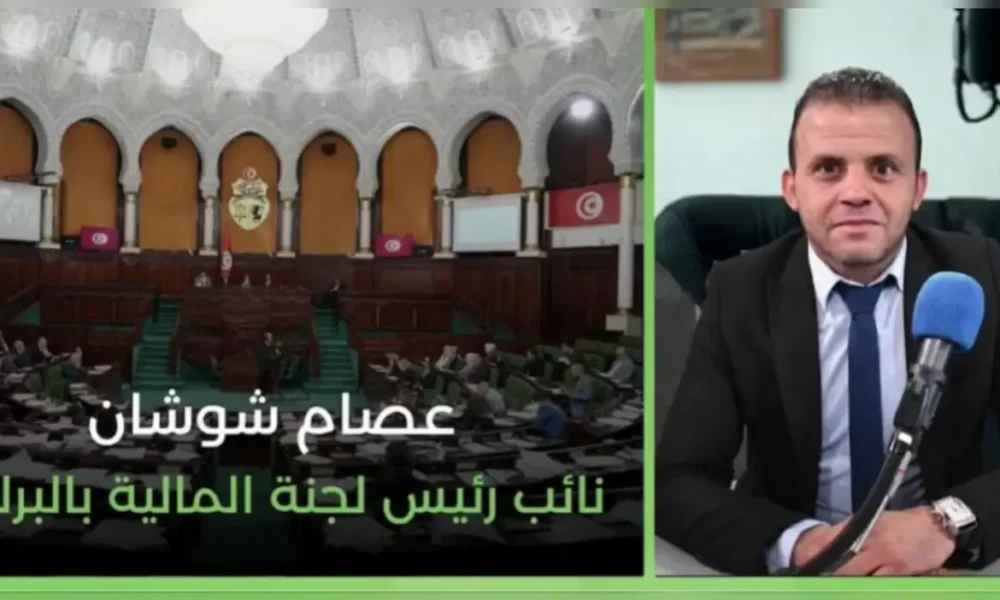
The member of the Assembly of the Representatives of the People (ARP), Issam Chouchen, stated, on Friday, August 28, 2026, that the check law had negative consequences on the national economy, claiming that it contributed to the increase in the volume of liquidity in circulation and to the development of the parallel market.
Guest on Diwan FM’s airwaves, the parliamentarian indicated that the amount of cash in circulation in Tunisia has surpassed 30 billion dinars, considering that the current regulation on checks has disrupted the normal functioning of economic activity.
A law adopted without an impact assessment, according to Issam Chouchen
Issam Chouchen criticized the conditions under which this law was drafted, stating that it was adopted without a thorough study of its consequences on the national economy.
According to him, this text “has blocked everything,” notably due to the heavy criminal dimension related to the check, which remains associated with the possibility of imprisonment.
The deputy also pointed out that the bill of exchange does not present the same effectiveness as the check, due to the difference in mechanisms and guarantees between the two payment methods.
The parallel market on the rise
For Issam Chouchen, the evolution of the cheque system has driven changes in economic behavior, with increased recourse to cash payments.
He believes this situation has contributed to the growth of the parallel market and calls for a comprehensive rethink of payment instruments to preserve economic dynamism.
Critiques on bottled water pricing
Furthermore, the deputy spoke on the issue of fixing bottled water prices, stating that this measure does not fully align with the mechanisms of a free market.
He explained that the Ministry of Commerce decided to fix the prices of a product facing a shortage due to increased demand and decreased stock availability.
According to him, if the objective was to rebalance the market, the state could have created a water production and bottling unit to directly offer the product at the announced prices.
Call for a ministerial council on water and electricity outages
The deputy finally called for the organization of a ministerial council dedicated to structural solutions to the problems affecting Tunisian citizens, notably the disruptions related to power and water outages.
Issam Chouchen stressed the need to adopt durable measures to address the daily difficulties of citizens and improve the continuity of essential public services.