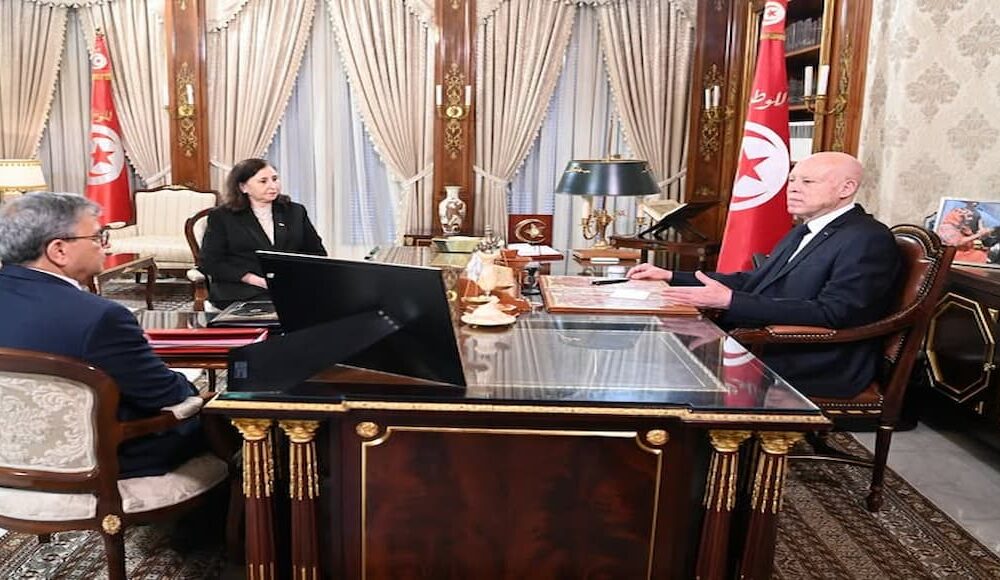
The Presidency of the Republic announced that the President of the Republic, Kaïs Saïed, had received, yesterday afternoon, September 23, at the Carthage Palace, the head of government, Sarra Zaafrani Zenzri, and the Governor of the Central Bank of Tunisia (BCT), Fethi Zouhair Nouri.
At the outset of this meeting, the head of state recalled the role of the Central Bank in supporting the national economy and its contribution to seeking solutions to ensure the anticipated financial balances. He stressed that the national duty imposes the achievement of justice, regarded as the natural and fundamental prerequisite for wealth creation and for a fair distribution of its fruits.
The President of the Republic also discussed the role of public banks in particular, highlighting that their creation aims to support the efforts of the State, alongside other banks, which are responsible for facilitating access to credit under favorable conditions and for complying with the Central Bank’s circulars.
Kaïs Saïed also recalled that the Tunisian Constitution guarantees the State’s commitment to the coexistence of the public and private sectors and provides for promoting their complementarity on the basis of social justice. He clarified that many public services are provided by the State, notably health, transport, education and social protection. He insisted that the social state should not be merely a slogan written in the Constitution, but must be a reality whose effects citizens feel in their daily lives and in all regions of the country.
Among the issues examined at length is the excessive rise in prices. In this regard, the head of state stressed the need to rationalize imports, while relentlessly pursuing the fight against corruption. He explained that corruption takes many forms and is not limited to passive or active bribery, but also includes fraud, obstruction to the functioning of services and public institutions, as well as the mistreatment of administrative officials in various sectors. According to him, these phenomena continue to worsen, and the national duty requires quickly and definitively putting an end to them.
The President of the Republic considered that the objective of these practices and of those who orchestrate them is to derail the revolutionary process undertaken by the people. He affirmed that, as long as the domestic front and the citizens remain aware of these objectives, the maneuvers to which a precise calendar has been set are doomed to fail.
He also denounced circles that, by various means, seek to convey the message that the revolution and the achievement of the people’s demands for employment, freedom, and national dignity would be nothing but an illusion, and that the situation prevailing before the revolution of December 17 was better. Yet, he recalled, the people lived then under the weight of injustice and corruption and had paid with their blood the price of its liberation. A people who chose to free themselves cannot let its determination be eroded by such maneuvers, whatever their origin.