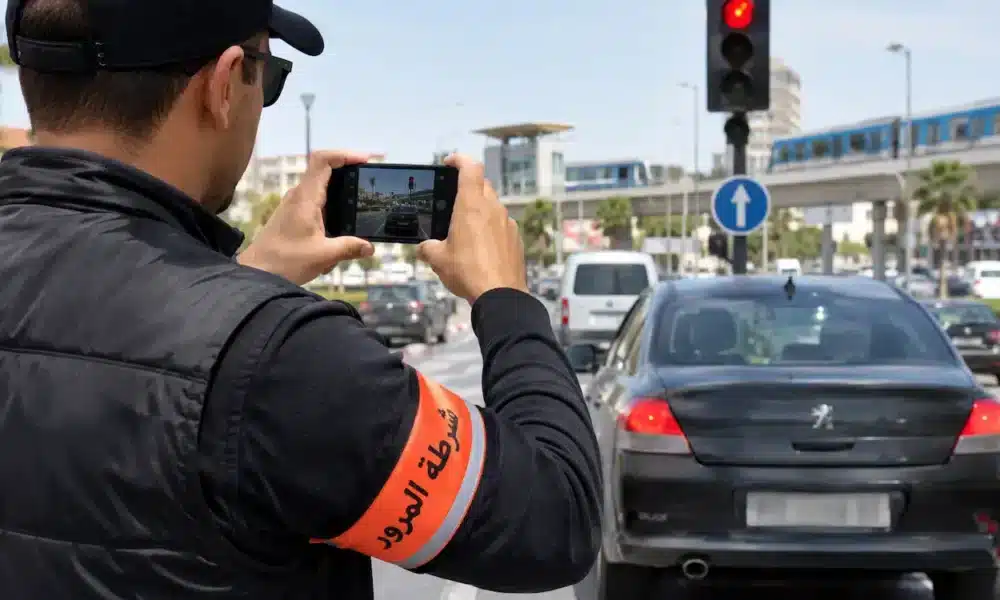
The traffic police have been experimenting for about a week with using plainclothes officers to observe and photograph traffic violations. This measure aims in particular to combat behaviors that disrupt traffic and to reinforce respect for the Highway Code, even in the absence of visible patrols.
The Essentials
- For about a week, the traffic police have begun using plainclothes officers to observe and photograph traffic violations.
- A patrol can consist of three or four officers, one of whom is in plain clothes and tasked with recording the violations.
- The violation can be photographed without the driver necessarily being arrested, especially when intercepting him would risk further disrupting traffic.
- The checks mainly focus on running red lights, using the metro lanes, and stopping in multiple lanes.
- The violations concern different modes of transport, including private cars, taxis, collective taxis, motorcycles, and certain vehicles belonging to public institutions.
- The traffic police are working with transport services on technical solutions aimed at preventing vehicle access to the metro lanes.
- This measure aims to counter the sense of impunity and to reinforce respect for the Highway Code, even in the absence of visible patrols.
The director of the Traffic Police Department, Colonel-Major Sami Rchiko, explained that this experiment is part of the regular assessment of the traffic situation and the search for new means to combat the growing number of violations.
Plainclothes Officers Within Patrols
He specified that these are not patrols entirely composed of plainclothes officers. A patrol can consist of three or four officers, one of whom can be in plain clothes and tasked with recording the infractions observed on the ground.
The plainclothes officer can, in particular, photograph the violation and report it without necessarily carrying out an immediate arrest of the driver. This procedure can be favored when stopping the vehicle risks worsening traffic jams or disrupting traffic further.
The photograph then serves as evidence to establish the violation, akin to offenses detected by fixed speed cameras, while preserving the right of the offender to contest the decision in accordance with the applicable legislation.
Offenses Recorded in Several Zones
According to Sami Rchiko, this measure also responds to the evolution of road behavior observed in recent years, with a rise in certain offenses and a sense of impunity among a portion of drivers.
Among the observed behaviors are running red lights, driving in lanes reserved for the metro, and stopping or parking in multiple lanes, practices that directly contribute to traffic congestion.
Operations have been conducted in several sectors, including El Omrane supérieur, rue d’Espagne and rue d’Angleterre, as well as at multiple intersections crossed by the metro lines, notably in the Ariana region.
Stopping in multiple lanes is particularly a source of traffic disruption. It is especially observed during loading or unloading of goods or during passenger pickup and drop-off.
Offenses Involve Different Modes of Transport
The observed behaviors do not concern only private cars. The traffic services also record offenses committed by taxis, collective transport vehicles, motorcycles, and, in some cases, vehicles belonging to public institutions.
The surroundings of schools are also considered sensitive zones. Some parents stop their vehicles in multiple lanes to drop off or pick up their children, which can cause significant disruptions, especially at school entry and exit times.
In response to vehicles circulating on the metro lanes, the traffic police, in cooperation with the relevant transport services, are studying technical solutions to physically prevent vehicles from accessing these spaces.
Towards Stronger Monitoring
The use of plainclothes officers is thus aimed at strengthening the capacity of the traffic services to detect offenses, even when drivers do not see a patrol nearby.
Through this approach, authorities also seek to change road users’ behavior and remind that adherence to the Highway Code must apply at all times, regardless of whether agents are visibly present.
This approach could, in the long term, be complemented by the development of automated monitoring systems and cameras designed to improve the tracking of offenses and the regulation of traffic.