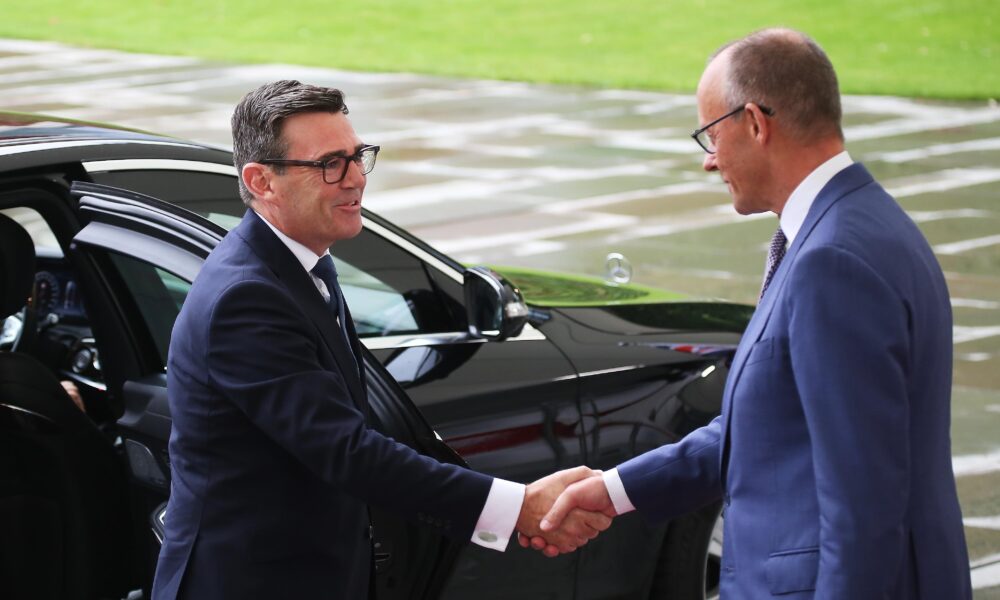
Ten years after the Brexit referendum, British Prime Minister Andy Burnham asserts that Russia interfered in the 2016 vote, though he has not provided public evidence demonstrating an influence on its outcome. His statements reopen the debate over Russian disinformation operations and their consequences for European democracies. London also references alleged links between Moscow and the German AfD, while a study published by the French Institute of International Relations (Ifri) shows that the United Kingdom and Germany have been strengthening their cooperation against Russian threats for several years. In parallel, Ukrainian strikes against Yandex data centers raise new questions about political bot networks, though no technical link to the AfD has been demonstrated.
Brexit: London acknowledges Russian interference ten years after the vote
In excerpts from the podcast The Rest Is Politics aired on Sunday, October 11, Andy Burnham revealed that, after arriving at Downing Street in July 2026, he asked whether Russia had intervened in the British referendum of June 23, 2016.
According to the prime minister, the response he received was affirmative. He says it is necessary to make this information public to raise awareness among European voters about foreign attempts to influence democratic processes.
The 2016 referendum ended with Brexit supporters winning, with about 52% of the votes against 48% for remaining in the European Union.
Burnham’s statement marks an evolution in the UK’s official position. Previous governments had claimed they did not possess evidence of Russian interference that managed to influence the outcome.
However, the prime minister did not disclose the intelligence on which his statement rests. He did not specify the scale of the identified operations, nor their potential impact on voters’ behavior.
The existence of an interference attempt and the demonstration of a decisive effect on the electoral result remain two separate questions.
Moscow has for several years rejected accusations of meddling in foreign elections.
As early as 2020, a parliamentary report denounced the absence of a thorough investigation
The British prime minister’s remarks bring into focus a report published on July 21, 2020 by the Intelligence and Security Committee (ISC), the parliamentary body responsible for overseeing intelligence and security matters.
At the time, lawmakers criticized authorities for not studying Russian intervention attempts in the referendum sufficiently.
The document notably flagged the activities of Russian state-backed media RT and Sputnik, as well as automated accounts and troll networks disseminating political content.
The committee also highlighted the lack of governmental assessment to measure the possible scope of these operations.
The Boris Johnson government had replied that it possessed no evidence of successful Russian interference and had deemed a retrospective evaluation unnecessary.
This response drew criticism: not having proof of decisive influence does not mean that every attempt at interference was ruled out, especially since no full investigation had been conducted.
What researchers found about Russian bots during the Brexit period
As early as 2017, several university teams studied the activity of suspicious accounts on Twitter, which has since become X.
Researchers at the University of Edinburgh identified 419 accounts linked to the Internet Research Agency (IRA), a Russian organization based in Saint Petersburg known for its digital influence operations.
These accounts spread messages about Brexit and other British political topics.
Other studies looked at broader networks, including thousands of automated accounts or those suspected of having ties to Russia.
But the studies did not all use the same criteria to identify a Russian account, an automated bot, or a user normally participating in political debate.
Their results cannot simply be added together to produce a total number of Russian bots active during the referendum.
A study published in December 2017 by the Oxford Internet Institute adds another nuance.
Its researchers observed that publicly identified Russian accounts represented a limited share of the discussions studied on Twitter. Russian media content was not massively shared compared with the overall set of publications analyzed.
The study did not exclude other activities on different platforms, but its results did not allow concluding that Russian operations determined the Brexit victory.
Ten years after the vote, the question of the real electoral impact of these campaigns remains distinct from their existence.
The German AfD: Burnham mentions presumed links with Russia
The British prime minister’s warnings do not concern only the UK’s past.
Burnham also mentioned his meeting with German Chancellor Friedrich Merz on October 8 in Berlin.
According to his account, Merz spoke to him about links between Moscow and the Alternative for Germany (AfD), the German far-right party.
The British prime minister mentioned the possibility of Russian funding for the party as well as the dissemination of Russian disinformation in the German political debate.
However, one must distinguish the reported statements from independently established facts.
The claim about AfD funding stems from Burnham’s remarks about his conversation with Merz. It does not, by itself, constitute proof of funding.
The AfD rejects accusations portraying it as a Kremlin political instrument. The party nonetheless advocates restoring energy relations with Moscow and opposes several aspects of German support for Ukraine.
Its electoral results and political ascent must be analyzed separately from suspicions of Russian interference.
Similarly, a potential decline in activity of AfD-favorable accounts on social media would not, on its own, prove a decrease in its electoral support.
A study by Ifri sheds light on the strategic rapprochement between London and Berlin
These statements come in a context of growing rapprochement between the United Kingdom and Germany, largely underway before the current AfD controversy.
In a study published in October 2026, titled A Security-Based Association: The post-Brexit Convergence between Germany and the United Kingdom, researcher Nicolai von Ondarza, a specialist in European affairs, analyzes this evolution.
According to this publication by the French Institute of International Relations (Ifri), Brexit had initially triggered a period of distancing between the two countries.
During the negotiations to leave the European Union, Berlin had prioritized the cohesion of the 27 member states over bilateral arrangements with London.
The situation gradually changed with Russia’s invasion of Ukraine in February 2022, followed by increasing uncertainties about American security guarantees.
Germany and the United Kingdom then strengthened their cooperation in the field of defense and European security.
Two major agreements signed in 2024 and 2025
This rapprochement rests on two essential steps.
The first is the signing of the Trinity House Defense Agreement on October 23, 2024. It provides for strengthened cooperation in the arms industry, support for Ukraine, drones, and several joint military projects.
The second is the Kensington Friendship Treaty, signed in July 2025 and ratified by the Bundestag in March 2026.
This treaty strengthens consultations between the German and British governments and provides, in particular, an additional bilateral assistance guarantee in the event of military aggression against either country, in addition to their commitments within NATO.
It also paves the way for in-depth dialogue on nuclear deterrence, security, and European defense capabilities.
Ifri notes that the two countries now share a major strategic objective: deterring Russia and militarily and financially supporting Ukraine.
Germany plays a significant role on NATO’s eastern flank in Lithuania, while the United Kingdom holds a comparable position in Estonia.
This partnership is also strengthening within the European framework, notably with France, within the E3 group.
The military and security cooperation between London and Berlin thus appears as a lasting transformation of their relationship after Brexit, not merely a reaction to the latest statements concerning the AfD.
The AfD and Reform UK: political uncertainties on the horizon for 2029
The Ifri study also draws attention to domestic political developments in the two countries.
It notes that the rise of the AfD in Germany and Reform UK in the United Kingdom creates uncertainties about the evolution of their partnership by 2029.
These movements advocate positions different from those of the governments in power on several European issues, notably relations with the European Union and Russia.
The author nonetheless argues that shared strategic interests could continue to support the German-British rapprochement, regardless of political changes.
He does not present the coming to power of these parties as a foregone conclusion, nor a breakdown of security cooperation as inevitable.
The Ifri note concerns geopolitical transformations and political uncertainties, not the identification of propaganda networks.
A new cooperation against cyberattacks and hybrid threats
Andy Burnham’s visit to Berlin on October 8, 2026, fits into this continuity.
The two governments announced a new security partnership focusing notably on sabotage, cyberattacks, and hybrid threats, particularly those attributed to Russia.
This cooperation should promote information sharing, coordinated responses, and the protection of critical infrastructures.
Hybrid operations can take various forms: cyberattacks against administrations, disruptions of infrastructure, disinformation campaigns, or clandestine actions.
The challenge for European democracies is to identify these interventions while distinguishing operations coordinated by a foreign power from political opinions freely expressed by citizens.
Yandex, “bots,” and the viral chart: a development to watch
A series of attacks against Russian IT infrastructures has revived the debate over the technical means that could be used in influence operations.
Between October 8 and 11, 2026, three data centers belonging to the Russian group Yandex were hit by drone attacks attributed to Ukraine.
In Sasovo, in the Ryazan region, a fire disrupted operations at a center hosting, according to available information, two of the three supercomputers used by Yandex for its AI developments.
In Kaluga, several modules were taken offline on October 9. In Vladimir, a new attack on October 11 led to the suspension of operations at the center.
Information reported by the trade press also points to the possible unavailability of all three of the group’s supercomputers. Their exact technical state has not been independently established.
A supposed drop in pro-AfD activity
On social networks, several posts draw a link between these strikes and a presumed decline in activity of AfD-favorable accounts, or even those supporting Donald Trump.
A graph published in German shows successive decreases of 30% and 56% in activity related to the German party.
But this document does not specify the platform observed, the data origin, or the criteria used to distinguish real accounts from bots.
Moreover, its timeline includes dates after its initial dissemination, undermining its credibility.
The German site Rohtext, which reviewed this post, notes the lack of verifiable methods and technical proof linking these figures to Yandex.
What Cloudflare measurements actually show
Screenshots from Cloudflare Radar show a sharp drop in certain traffic metrics originating from the AS13238 network, associated with Yandex.
These data, however, require careful interpretation.
Yandex operates a search engine, IT services, and indexing robots. A disruption to its infrastructure can thus affect ordinary digital activities.
A decline in Yandex’s automated traffic is not evidence of a disappearance of Russian political bots.
To establish a link to a potential AfD-favorable influence campaign, one would need to identify the involved accounts, measure their activity before and after the attacks, and demonstrate their technical dependence on the damaged data centers.
At this stage, these elements are not publicly available.
Strikes against Yandex therefore constitute military and technological information to monitor, but their potential impact on political propaganda networks remains an open hypothesis.
Ten years after Brexit, European democracies confront the question of interference
Andy Burnham’s statement places foreign influence operations at the center of European debate.
It also raises a question about governments’ capacity to detect these operations, publish their results, and measure their real political consequences.
The Brexit experience shows the difficulties of this approach: suspect digital activities were documented, but their effect on the electoral outcome was not established.
In Germany, the rise of the AfD and questions about possible Russian links make this issue particularly sensitive.
The Ifri study shows, in parallel, that London and Berlin have chosen to strengthen their strategic cooperation against Russian threats, regardless of current political controversies.
Finally, the strikes against Yandex facilities remind us that digital infrastructures occupy an increasing place in contemporary conflicts, without allowing to conclude that they host clandestine political operations.
Ten years after Brexit, London acknowledges Russian interference without publicly demonstrating its effect on the vote. The accusations concerning the AfD and the questions around Yandex open new avenues, but require the same verification principle: distinguish suspicions, documented operations, and genuinely demonstrated consequences.