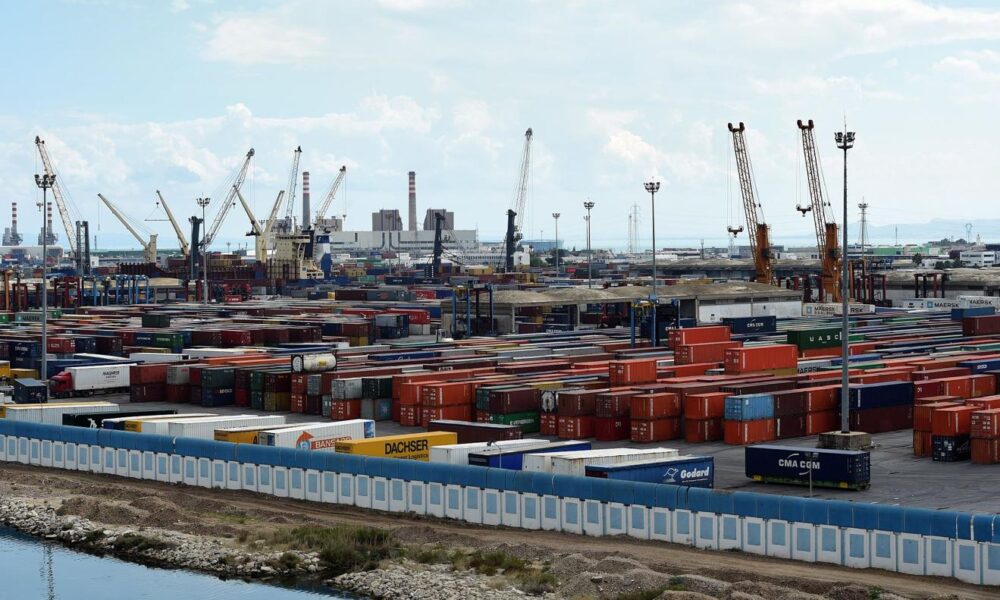
The Port of Radès is set to welcome three new port cranes between late November and early December 2026, according to the Tunisian Stevedoring and Handling Company (STAM).
Their arrival comes as Tunisian commercial ports recorded a 7.28% increase in their cargo traffic in the first half of 2026. But for the companies relying on Radès, the essential question remains about the outcomes: will these new pieces of equipment really reduce ship waiting times, container discharge delays, and logistics costs?
Essentials
- Three Konecranes Gottwald cranes are to arrive at the Port of Radès between late November and early December 2026.
- The Minister of Transport had announced, in April, the reception of new cranes as early as September. The exact link between the two timelines is not specified.
- Tunisian ports handled 14.80 million tonnes of goods and 280,691 TEU in the first half of 2026.
- Radès remains the country’s main container port, but storage and movement difficulties have been reported in recent years.
- The improvement will need to be measured after the new equipment is put into service.
Three cranes prepared in Antwerp to bolster Radès’ capacity
The Tunisian Stevedoring and Handling Company (STAM) announced the strengthening of its fleet with three port cranes of the Konecranes Gottwald brand, identified by the references C-20, C-21 and C-22.
According to information released by STAM and reported on October 10, the preparation of these units is completed at the Port of Antwerp, Belgium. Their transfer to Radès is planned for between late November and early December 2026.
These mobile port cranes are intended to strengthen loading and unloading capabilities and contribute to improving operational productivity. STAM’s stated objective is to reduce waiting and dwelling times for ships, while limiting logistics costs.
The exact date of commissioning of the equipment and the productivity gains expected in figures were not provided in this announcement.
On April 20, 2026, before the National Assembly, the Transport Minister, Rachid Amri, acknowledged that the obsolescence of some cranes was hampering Radès port productivity.
On that occasion, he announced the reception of new, state-of-the-art equipment as early as September 2026.
STAM’s latest communication now states a delivery of three cranes between late November and early December, roughly two to three months after the spring deadline.
However, the published information does not allow confirming with certainty that the April ministerial announcement referred to exactly the same three cranes C-20, C-21 and C-22. It would therefore be premature to attribute this delay to manufacturing, transport, or delivery delays.
Traffic at Tunisian ports grows in the first half of 2026
The announcement of the new cranes comes in the context of rising volumes in commercial shipping. According to data published by the Office of the Merchant Marine and Ports (OMMP), Tunisia’s commercial ports handled 14,795,463 tonnes of goods in the first half of 2026, up by 7.28% compared to the same period in 2025.
Tunisia’s commercial ports: key figures
First half 2026, change vs first half 2025
Goods traffic
14.80 Mt
+7.28 %
Container traffic
280 691 EVP
+9.87 %
General merchandise
4.77 Mt
+13.95 %
Ro-ro units
93 156
+7.55 %
Source : OMMP, first-half 2026 statistics.
Mt : millions of tonnes. EVP : twenty-foot equivalent unit, a benchmark for measuring container traffic.
Note: these figures concern all Tunisian commercial ports, not only Radès.
Radès concentrates nearly two-thirds of national container traffic
Radès port remains the main Tunisian platform for container traffic. Its operation therefore plays a central role in exchanges among importers, manufacturers, and exporters.
According to sector statistics from DynaLiners, cited in an August 2026 industry publication, Radès would have handled around 176,400 EVP in the first half, up from 166,500 EVP a year earlier, i.e., an increase of about 6%.
In the same statistical series, Radès would account for about 63% of national traffic, estimated at 278,000 EVP. For comparison, Sfax would have handled 57,800 EVP and Sousse 35,300 EVP, with a 20% growth for the latter.
Statistical note : the DynaLiners sector estimate, totaling about 278,000 EVP, slightly differs from the official OMMP total of 280,691 EVP. The 63% share is calculated in the DynaLiners series. These two series should not be presented as perfectly identical.
These estimates underscore Radès’ importance within the Tunisian port system. However, they do not by themselves allow assessing the speed of container processing or the quality of services provided to businesses.
A port historically facing congestion problems
Beyond ship unloading capacity, Radès port has faced for several years difficulties related to container storage and their evacuation to industrial and commercial zones.
In 2025, data presented by the employers’ organization CONECT and reported by the press indicated about 11,000 containers present in the port, with a maximum capacity reportedly of 12,000 containers. These figures illustrated a high occupancy level at the time.
However, this is a historical observation, and not a measure updated to October 2026. A rigorous comparison with the current situation would require a new stock and storage capacity assessment, established using the same methodology.
Congestion can have multiple origins: lack of equipment, prolonged immobilization of goods, inspection formalities, truck movement difficulties, and insufficient coordination among the various actors involved.
Investments already made, but other projects remain open
The strengthening of Radès’ equipment does not start with the three new cranes.
During a visit on April 22, 2026 to the container terminal and rolling equipment, the Transport Minister presented several acquisitions made by STAM, notably three reach stackers, additional handling equipment, and six port tractors.
The minister then noted an improvement in some operational indicators and stressed the permanent availability of the equipment. He also called for strengthening the staffing of gatekeepers to speed up the release of containers to clients.
Another project concerned the activation of smart gates to better organize vehicle flows at the port entrance and exit. The proper functioning of control scanners was also mentioned.
As early as April 20, the minister had stated that certain measures had helped halve the congestion of goods compared with previous years. This improvement was then presented as a result of the actions taken, but no detailed numerical series accompanied this statement to measure the evolution precisely.
There is thus a need for regular statistics on immobilized containers, average dwelling times, and equipment availability to assess progress over time.
Will three new cranes be enough to reduce delays?
The arrival of additional handling equipment constitutes a potentially significant improvement. It can increase the pace of loading and unloading, reduce the impact of breakdowns, and shorten ship immobilization times.
But a terminal’s productivity does not depend solely on cranes. After unloading, containers must be transferred to storage areas, subjected to necessary checks, and then picked up by transporters.
If these operations do not keep pace with the quay handling, the new cranes risk shifting the congestion point rather than eliminating it.
Five indicators to monitor after commissioning
- Handling cadence: the number of container moves performed per hour and per ship.
- Ship waiting time: the delay between arrival and the start of operations.
- Container dwelling time: the time elapsed between discharge and actual pickup.
- Equipment availability: the proportion of time during which cranes are actually operational.
- Truck passage time: the time needed to access the port, complete formalities, and exit.
At this stage, STAM has not published, with the announcement of these three cranes, a quantified objective to forecast reductions in each of these delays.
Another project concerns 4.1 hectares of yard space
The port’s modernization also includes other initiatives. In March 2026, the OMMP launched a prequalification procedure for the concession of about 4.1 hectares of yard space located near Radès’ industrial quay.
The project anticipates investments in storage and handling facilities designed in particular for non-food solid bulk and various non-unitized goods.
This operation is distinct from the acquisition of the three cranes announced by STAM. It nonetheless illustrates the need to improve several components of the port system to sustainably strengthen its performance.
What concrete benefits for Tunisian businesses?
For importers, manufacturers, and distributors, a reduction in port delays could improve the availability of raw materials and finished products, while limiting certain costs linked to the immobilization of goods.
For exporters, better predictability of departures and arrivals would strengthen the reliability of supply chains, particularly in sectors working with European clients and subject to strict delivery calendars.
Reducing delays could also ease some costs related to storage, transport, and stock financing.
However, it would be premature to conclude that the arrival of the new cranes will automatically translate into lower consumer prices. Port fees represent only a portion of the costs borne by companies, alongside transport, taxes, financing charges, and commercial margins.
The real test will begin after the cranes arrive
The announced arrival of the three cranes between late November and early December 2026 marks a new milestone in the modernization of Radès port.
But their performance can only be evaluated after commissioning and based on comparable data: handling cadence, ship waiting times, container dwelling time, truck movement, and equipment availability.
The challenge therefore goes beyond the installation of new equipment. It concerns the entire organization of the logistics chain, from the ship’s arrival to the final delivery of goods.
For Tunisian businesses, the success of this investment will not be measured by the number of cranes installed, but by the actual time saved to import or export goods through the Port of Radès.