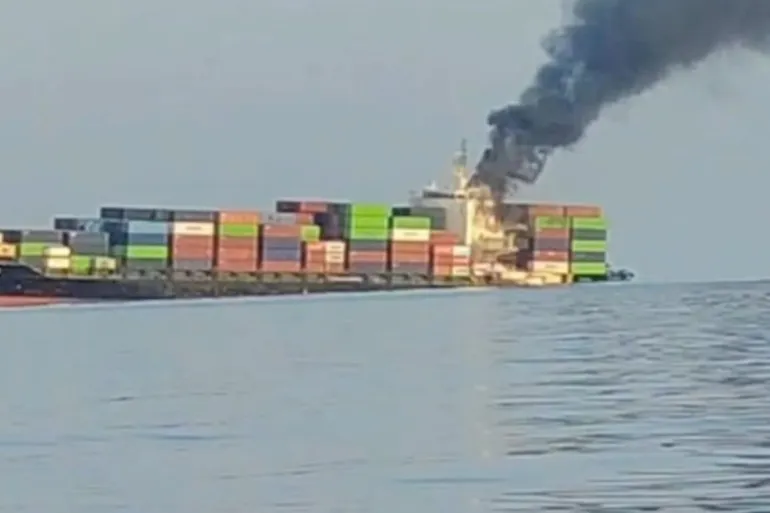
The GFS Pride, a Singapore-flagged container ship, sank in the Strait of Hormuz after having been damaged and ravaged by a fire.
The Maritime and Port Authority of Singapore confirmed on Wednesday, October 14, 2026, that the vessel had been struck on October 13 and that its 21 crew members had all been evacuated, with no injuries.
Iran asserts that the vessel struck a sea mine while taking an unauthorized passage. This explanation has not been independently verified.
The Essentials
The GFS Pride is a Singapore-flagged vessel measuring 222 meters in length, built in 2008, with a capacity of 2,824 EVP. Struck on October 13, it caught fire and sank. Twenty-one crew members are safe. The possibility of a mine is advanced by the Islamic Revolutionary Guard Corps, while Singapore cites an unidentified projectile.
A 222-meter container ship, operated from the United Arab Emirates
Built in 2008, the GFS Pride measured about 222 meters long and 30 meters wide. Registered under the Singapore flag, it carried the maritime identification number IMO 9349045. Its nominal capacity stood at 2,824 EVP, the “twenty-foot equivalent unit,” a unit used in shipping to compare the loading capacities of container ships.
The vessel was managed by GFS Ship Management FZE, a company based in the United Arab Emirates, according to Reuters. The Singapore flag denotes its registry, and should not be confused with the nationality of its management company.
According to AIS data released by maritime tracking platforms, the vessel had departed Karachi, Pakistan, at the start of October, and showed Fujairah, United Arab Emirates, as its destination. A last position available on one of these services dates to October 3, in the Gulf of Oman. The absence of a more recent public position does not, on its own, allow concluding that its transmitter had been intentionally switched off.
Sea mine or projectile: two versions, one sinking confirmed
The Islamic Revolutionary Guard Corps Navy announced on Wednesday that the container ship had struck a sea mine in a southern zone of the strait that it deems an “unauthorized and dangerous” route. According to Iranian authorities, the explosion would have caused a fire followed by the sinking. Iranian media circulated images purportedly showing the burning vessel and drifting containers.
The statement from the Maritime and Port Authority of Singapore (MPA) presents a different framing: the GFS Pride would have been struck by a projectile of unknown origin as it passed on October 13. The MPA confirms the fire, the sinking, and the evacuation of the 21 sailors. It does not confirm that a mine was the cause of the disaster.
An NAVAREA IX navigational warning, issued on October 14, notes the sunken vessel and the presence of floating containers, about four nautical miles northwest of Ras Shaykh Masud, near the Omani coast. These objects pose an additional hazard to ships operating in the area.
The IRGC claim that the vessel carried more than 2,500 containers. That figure has not been confirmed by a publicly accessible cargo inventory. It should not be confused with the nominal capacity of 2,824 EVP, which measures volume units rather than the actual number of boxes aboard.
A new wave of attacks against commercial ships
Another Singapore-flagged container ship, the GFS Giselle, was struck on October 14 in the same strait. It sustained hull damage but managed to reach a safe anchorage under its own power. Its 22 crew members are also safe, according to Singapore authorities.
These incidents fit into a sharp uptick in attacks. According to maritime data reported by the Financial Times, six ships were targeted on Sunday, October 11 alone, and 24 vessels have come under attack in the preceding two weeks. Tankers, refined-product carriers and container ships are affected.
Since spring, Tehran has sought to impose fixed routes and prior authorization from its navy to traverse the passage. On May 30, the Iranian military command renewed this requirement and warned ships that do not comply with these rules. Singapore condemned the latest attacks on commercial shipping, which it regards as violations of international law.
The Strait of Hormuz is a major corridor between the Persian Gulf and the Indian Ocean. Before the war that began on February 28, 2026, roughly one-fifth of global flows of oil and liquefied natural gas passed through it. The sinking of the GFS Pride serves as a reminder that risks no longer affect only tankers: they also threaten containerized cargo, its crews, and Gulf trade routes.