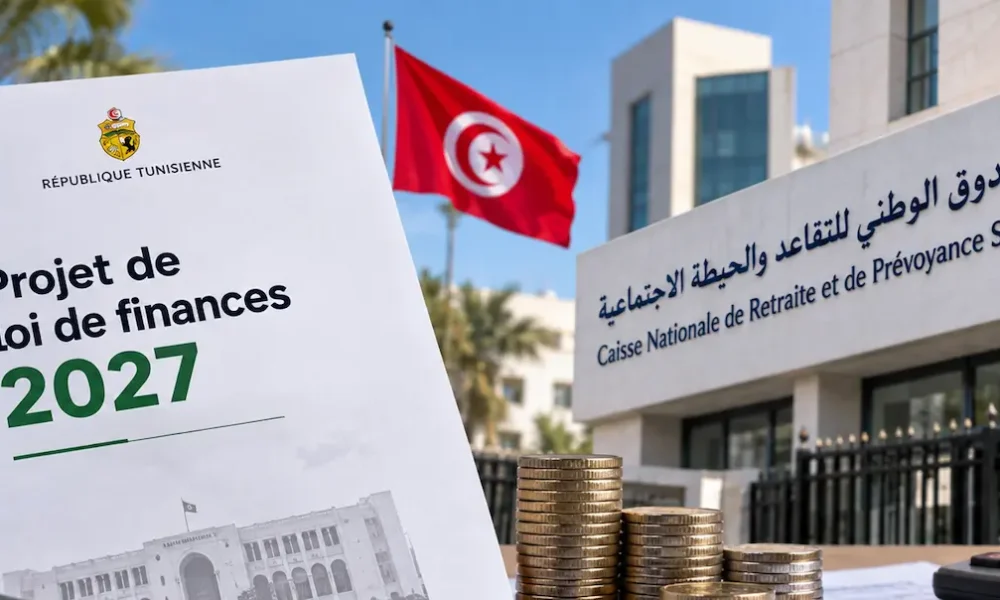
The proposed 2027 budget bill introduces new financing mechanisms aimed at facilitating project creation, supporting small businesses and startups, and encouraging beneficiaries of the statuses of “student-entrepreneur” and “learner-entrepreneur”.
The proposal, which was sent to Parliament within constitutional deadlines on October 15, after its adoption by the Council of Ministers, includes several provisions intended to strengthen the equity of startups.
A ten-million-dinar financing line for startups
Article 13 provides for the creation of a financing line of 10 million dinars, mobilized from the resources of the National Employment Fund, in order to grant interest-free participatory loans to promoters of companies that have earned the “Startup” label.
According to the document of which the Tunis Afrique Presse (TAP) has obtained a copy, these loans will be used exclusively to strengthen the equity capital of the concerned companies, during the period from January 1, 2027 to December 31, 2028.
The management of this financing line will be entrusted to the Bank for Financing of Small and Medium Enterprises (BFPME), within the framework of an agreement concluded with the ministries responsible for Finance and Employment, which will set the conditions and modalities of its implementation.
Small businesses: a declining coverage of social security contributions for three years
Within the framework of this 70-article project, the government also proposes measures to support small businesses during their startup phase.
Thus, Article 14 provides for the State to cover social security contributions under the legal social security regime, up to the level of the guaranteed minimum wage, for project promoters and small businesses created in 2027.
This coverage will extend over the first three years of activity, according to a decreasing rate:
- First year: 100% of the contributions concerned.
- Second year: 75%.
- Third year: 50%.
Funding for this scheme will be provided by the National Employment Fund, up to a cap of 5 million dinars, in accordance with a partnership agreement between the ministries in charge of Finance, Employment and Social Affairs.
A 10-million-dinar envelope for newly created small businesses
The same article also provides for another financing line of 10 million dinars, also drawn from the National Employment Fund.
This mechanism will allow loans on preferential terms to small businesses that have started activity within the last three years and that have benefited from the support of the National Agency for Employment and Self-Employment (ANETI).
The financings will be granted during the period from January 1, 2027 to December 31, 2028, in the form of working capital, in order to meet the liquidity needs of the concerned companies or to help them overcome conjunctural difficulties.
The management of this financing line will be entrusted to the Tunisian Bank of Solidarity (BTS).
Students and graduates of vocational training: 5 million dinars to encourage entrepreneurship
The budget bill also provides for a specific mechanism aimed at encouraging holders of the statuses of “student-entrepreneur” and “learner-entrepreneur”.
To this end, Article 16 proposes the creation of a financing line of 5 million dinars, funded by the resources of the National Employment Fund.
This envelope will be used to grant loans on preferential terms to students and graduates of vocational training centers who hold one of these two statuses and who carry project ideas.
The funding can be mobilized for the creation of projects across the various sectors of economic activity, during the period from January 1, 2027 to December 31, 2028.
The management of this mechanism will also be entrusted to the Tunisian Bank of Solidarity, as part of an agreement concluded with the ministries in charge of Finance and Employment.
All of these mechanisms are included in the 2027 Finance Bill. Their implementation remains contingent on the adoption of the corresponding provisions and on the establishment of the planned modalities.
(Source: TAP)