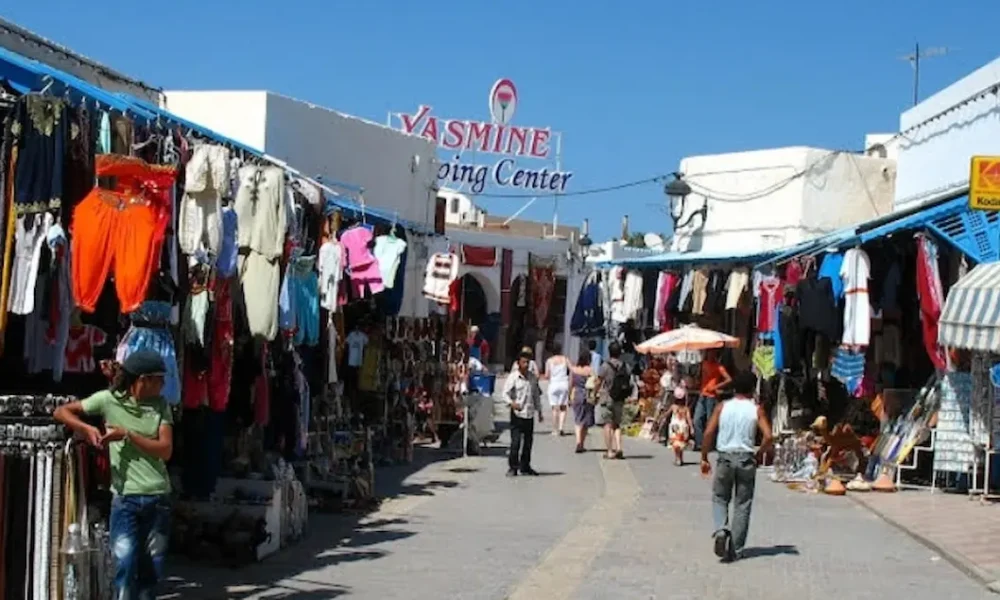
In the heart of Tunis, Spain Street is not just an informal souk. It is a laboratory where precarity, tribal solidarity, and the state’s tolerance have forged an economic asset that no one has been able to dislodge.
Every day, from 7 a.m. to 6 p.m., a street in central Tunis changes hands. Not before a notary, but in practice. About three hundred traders settle there, spread goods largely coming from the Algerian border, and transform a simple urban passage into a souk. At 6 p.m., everything disappears. The next day, everything starts again, in the same place, with the same faces.
This scenario is far from an accident. It follows a logic that economists and chroniclers of the economy often overlook. The street is not just a place of sale; it is a capital. The one who controls it holds access to passersby, hence to customers, without paying rent or a door fee.
A field study, a framework for interpretation
This logic is decoded in a policy paper from the Arab Institute of Business Leaders (IACE). The work rests on the Grounded Theory method, which consists in starting from the field rather than from preconceived hypotheses. About one hundred traders were interviewed, along with biographical interviews, questionnaires, and several months of observation, participant or not. The result rests on five P-words namely, precariat, kinship, proximity, power and possession.
From rural roots, a lineage, a strategy
The merchants come from the Sbiba region, in the Kasserine Governorate, in the center-west of the country. They belong to a single tribal formation, despite different family names. The policy paper sees in them the Assabiya dear to Ibn Khaldûn, that kinship solidarity which gives fragile groups an extraordinary bargaining power.
This cohesion unfolded in three phases. First the migration to the capital, where resources and clientele concentrate. Then the patient occupation of the street, at the cost of clashes with the police, the judiciary, the inhabitants and rival merchants of the popular neighborhoods. Finally the possession, which the study designates under the Arabic term Al Hawz: taking control of a public space and holding it over time, until that presence becomes a fait accompli.
The State, a silent partner