The notable decline in prices of red shrimp on the Tunisian market could find part of its explanation in a warning from Italy. According to revelations by Majdi Karbai, human rights activist and former Tunisian deputy for the Italian constituency, Italian authorities have called for considering the suspension of purchases of Tunisian red shrimp until the end of 2026, due to an excess of more than 41 % of the authorized fishing quota.
A situation that raises questions about its economic repercussions and about the mechanisms of control over Tunisian exports.
The Essentials
- 36 metric tons : the red shrimp quota allocated to Tunisia, according to the cited document.
- 50,960 kilograms : the quantities appearing in the capture certificates validated by the Tunisian authorities.
- 41.6 % : the excess calculated relative to the authorized quota.
- May 15, 2026 : the date on which the quota would have been exhausted.
- End of 2026 : the envisaged deadline for the suspension of purchases by Italian importers.
Italy Calls to Suspend Purchases of Tunisian Shrimps
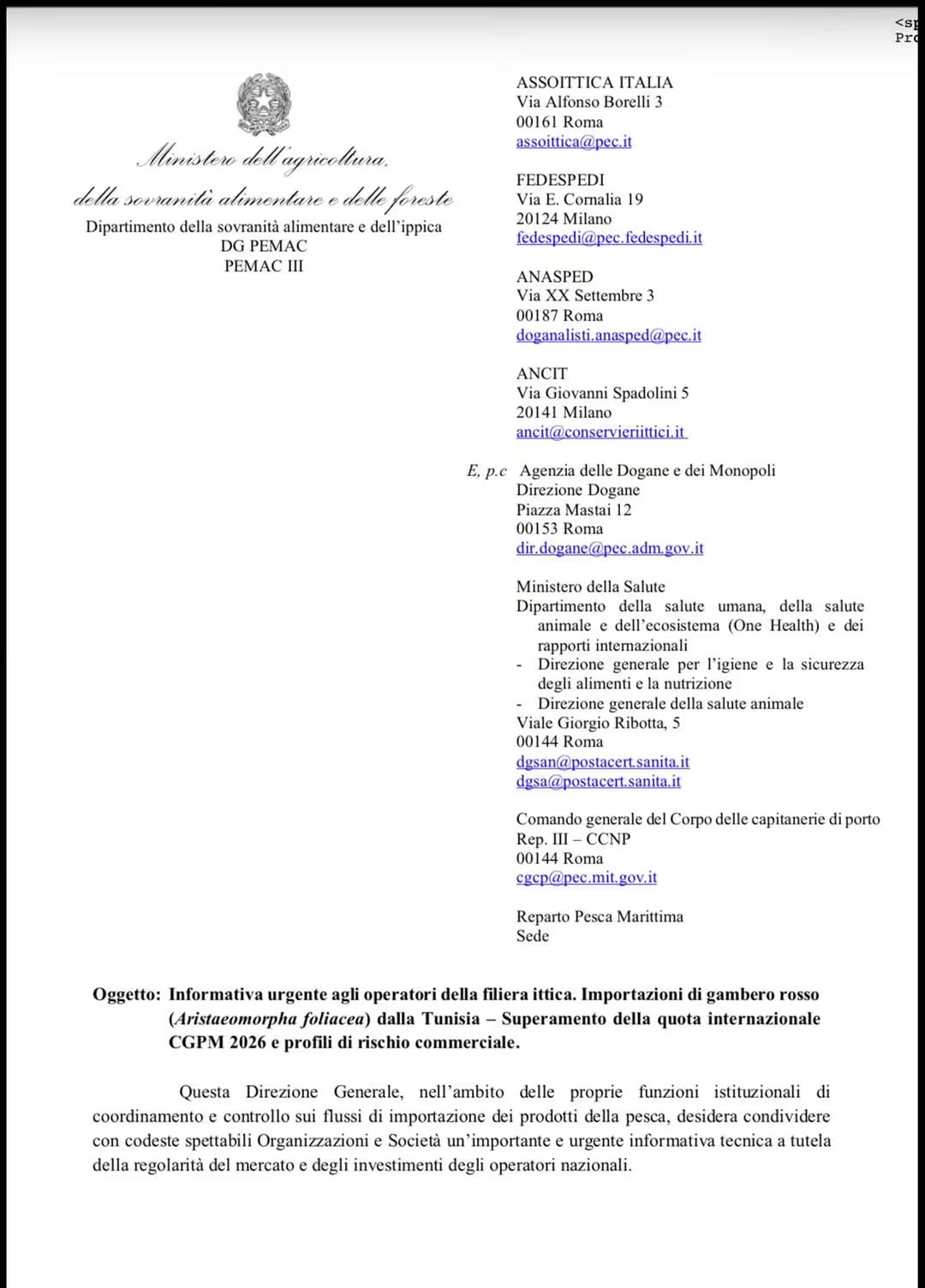
According to Majdi Karbai, the Directorate-General for Marine Fisheries of the Italian Ministry of Agriculture and Food Sovereignty has sent an urgent letter to import associations, freight forwarders and Italian customs authorities.
This correspondence calls for considering the suspension of all purchases of Tunisian red shrimp, of the species Aristaeomorpha foliacea, until the end of 2026.
The document, attributed to Director-General Graziella Romito, reports control operations conducted jointly with the European Commission through the CATCH platform, dedicated to monitoring catch certificates for fishery products.
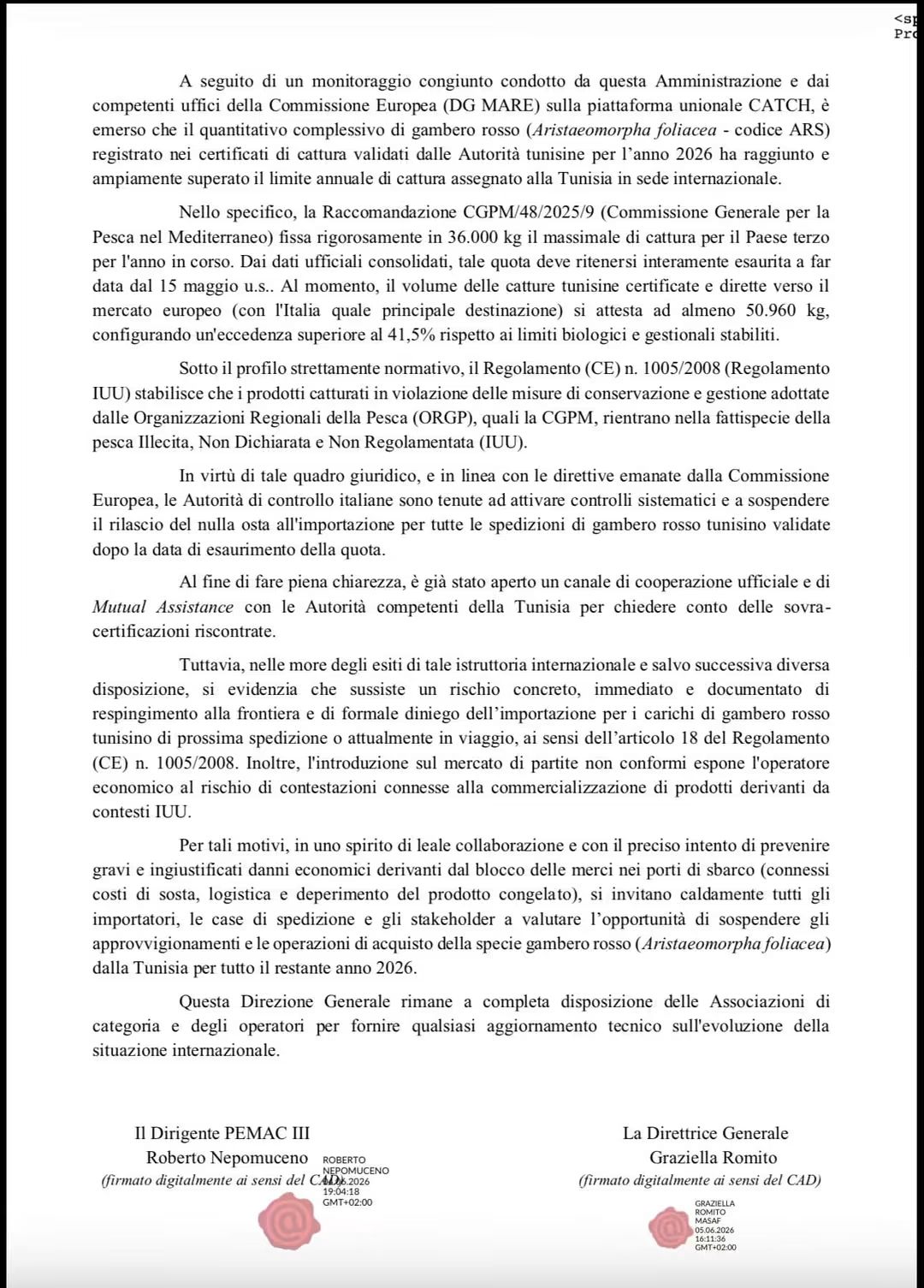
According to information relayed by the former deputy, these verifications would have revealed that the quantities declared in the fishing certificates validated by the Tunisian authorities reached at least 50,960 kilograms, while the quota allocated to Tunisia would not exceed 36,000 kilograms.
This ceiling would be fixed in accordance with Recommendation CGPM/48/2025/9 of the General Fisheries Commission for the Mediterranean.
The overrun would amount to 14,960 kilograms, almost 15 metric tons, representing 41.6 % of the authorized quota.
According to the same source, Tunisia would have exhausted its quota as of May 15, 2026.
A risk of refusals of shipments at European borders
The Italian correspondence, as presented by Majdi Karbai, relies on European Regulation No. 1005/2008 on the fight against illegal, unreported and unregulated fishing.
The Italian administration believes that catches made beyond the authorized quotas could constitute offences covered by this regulation.
It also warns of a concrete and immediate risk of shipments from Tunisia being refused at European borders.
The relevant services would have been invited to suspend import procedures for shipments whose capture certificates had been validated after the quota exhaustion date.
Meanwhile, Italian authorities would have engaged in official dialogue with their Tunisian counterparts to obtain clarifications on what they call the excessive issuance of capture certificates.
At this stage, the information released does not yet confirm the entry into force of a general ban on Italian imports of Tunisian red shrimp.
Could the price drop in Tunisia be linked to export difficulties?
This case arises in a context of falling prices for red shrimp on the Tunisian market, a development to which Majdi Karbai draws particular attention.
According to the former parliamentarian, Italy is the main destination for Tunisian exports of this species.
Under these conditions, potential restrictions on the Italian market could lead Tunisian exporters to move part of their goods onto the domestic market.
An increase in domestic supply would then be likely to exert downward pressure on prices, especially if the quantities originally destined for export had to be sold quickly on the local market.
This hypothesis could help explain the price decline, without establishing a direct causal link, due to a lack of detailed data on the volumes actually redirected to the Tunisian market and on price trends.
A prolonged disruption of exports could also have repercussions on the incomes of fishermen, traders and exporting companies.
Overrun of quotas: questions about control mechanisms
Beyond the potential economic consequences, Majdi Karbai raises questions about Tunisian procedures for monitoring catches and validating fishing certificates.
How could the declared quantities have exceeded by nearly 15 tons the limit allocated to Tunisia? What mechanisms exist to track catch evolution and prevent quota overruns?
The question also concerns the validation of certificates accompanying goods destined for European markets.
These questions call for clarifications from the competent authorities, particularly on the scope of quantities accounted for, the modalities of certification and the procedures for quota monitoring.
Nevertheless, it should be emphasized that the overrun mentioned does not, on its own, establish individual responsibility or irregularities attributable to a specific administration.
What consequences for Tunisian exports?
The possible suspension of Italian purchases could pose an additional challenge for Tunisian operators in the sector, especially those whose activities depend on European markets.
Consequences will depend in particular on the real scope of the restrictions, their duration and the possibilities for marketing on other markets.
This situation could also raise questions about the traceability of catches and the conditions for recognizing Tunisian certificates by European authorities.
For the time being, the information made public by Majdi Karbai remains to be cross-checked with the original administrative document and with any clarifications from Tunisian and Italian authorities.
The challenge now is to clarify the situation of quotas and concerned shipments, while determining whether the export difficulties mentioned have indeed contributed to the decline in prices observed on the Tunisian market.