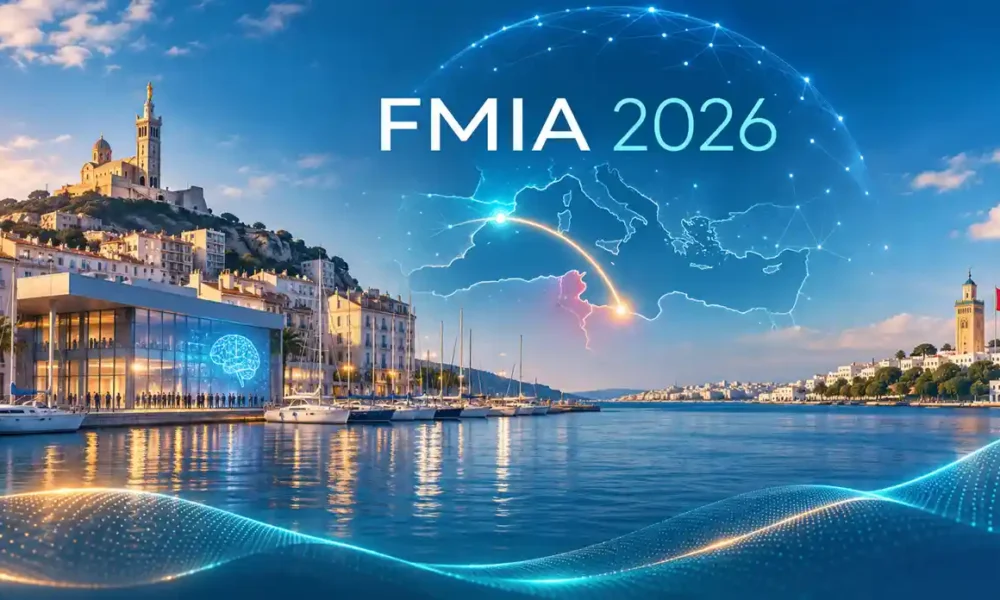
The Mediterranean Forum on Artificial Intelligence (FMIA) is holding its third edition this Thursday, November 5, 2026, at the Palais du Pharo in Marseille.
Around 700 public decision-makers, entrepreneurs, investors, researchers, international organizations, and civil society representatives from more than 20 countries are expected.
For Tunisia, which hosted the previous edition in 2025, the challenge goes far beyond mere presence at an international forum: it concerns access to networks, funding, markets and projects capable of transforming research into economic solutions.
The essentials
• The FMIA was launched in Marseille in 2024, then consolidated in Tunis in 2025.
• The Tunis edition gathered more than 3,000 participants, more than 500 startups and scale-ups, more than 100 speakers, and representatives from more than 15 countries.
• In 2026, the Forum focuses on four sectors: industry, health, agriculture and maritime, with four transversal themes: sovereignty and data, skills, frugal AI and ecological transition, inclusion and ethics.
• Tunisian actors, including the Pasteur Institute of Tunis, the National Institute for Marine Sciences and Technologies, and the Mahdia municipality, are taking part in the co-creation activities.
From Tunis to Marseille: a forum that aims to move from talks to projects
The FMIA was initiated in Marseille in 2024. Its second edition, organized in Tunis in November 2025, marked a scale-up. According to figures published by the organizers, it brought together more than 3,000 participants, more than 500 startups and scale-ups, more than 100 speakers, and delegations from more than 15 countries.
The 2026 edition carries a different ambition: no longer simply to discuss artificial intelligence, but to produce operational projects, partnerships across the two shores, funding opportunities, and recommendations aimed at public and private decision-makers. The program includes a strategic report on AI in the Mediterranean, workshops, B2B meetings, a business expo, a research prize, and co-creation journeys.
Why Tunisia Is Directly Involved
The FMIA schedule coincides with an important phase for Tunisia’s digital policy. The Presidency of the Government has presented the main lines of the National AI Strategy 2026-2030, with the objective of guiding AI development while respecting privacy and national sovereignty. The authorities notably highlight Tunisian academic competencies, the Startup Act, and the country’s position between Europe, Africa, and the Arab world.
The Forum’s sectoral priorities also overlap with several needs identified in Tunisia. Health, agriculture, and energy are among the sectors prioritized by Tunisian authorities in AI. FMIA adds industry and the maritime economy, two areas where Tunisia has export-oriented activities, infrastructure and research teams that could benefit from regional cooperation.
Tunisians in Concrete Challenges
Tunisia’s interest is not solely institutional. Among the organizations mobilized in FMIA 2026’s co-creation challenges are the Pasteur Institute of Tunis, the National Institute for Marine Sciences and Technologies, and the Mahdia municipality. The program brings together a total of 16 challenge bearers and 66 experts selected from researchers, companies, and institutions on both shores.
According to the organizers, the work should lead, depending on the maturity of each project, to a pilot, to commitments between partners, to a coalition, or to a roadmap accompanied by an experimentation protocol. It is on these deliverables that the Forum’s real value can be measured.
Funding and Scaling: The Second Challenge
FMIA is part of the Sila initiative, a France-Mediterranean program endowed with 2 million euros for 2025-2027 and deployed in Algeria, Egypt, Lebanon, Morocco, and Tunisia. Its aim is to strengthen the AI ecosystems on the southern shore, supporting structures and the links between research, entrepreneurship, and investment.
A program for AI startups notably foresees the selection of ten high-potential companies across the five involved countries. According to Sila, each can mobilize, depending on its needs, a catalog of expertise and technical services representing a service envelope of between 10,000 and 30,000 euros, with support covering technology, business development, intellectual property, and preparation for investment.
Sovereignty, talent, and market access
For Tunisia, three topics deserve particular attention. The first is data and sovereignty: having AI skills is not enough if companies and researchers do not have access to data, computing power, and regulatory frameworks compatible with their target markets.
The second concerns talent. FMIA dedicates a portion of its program to training and skills development. The challenge for Tunisia is twofold: to train more profiles capable of developing and integrating AI, but also to create enough opportunities to transform these skills into local companies, products, and jobs.
The third is market access. For a Tunisian startup or a research team, the domestic market may be too narrow to amortize certain technological investments. A Euro-Mediterranean space could allow testing a solution in Tunisia, adapting it to other regional realities, and then seeking commercial or industrial partners on multiple markets.
The success of FMIA will therefore not be measured by the number of conferences or participants. For Tunisia, the most useful indicators will be the number of Tunisian projects supported, research or industrial partnerships actually concluded, funding mobilized, access to new markets, and the ability of Forum-derived projects to move from prototype to real-world use.
Having hosted the 2025 edition, Tunisia has secured a place in this Mediterranean dynamic. The objective of the 2026 edition is now to convert this visibility into projects, skills, and measurable economic opportunities.