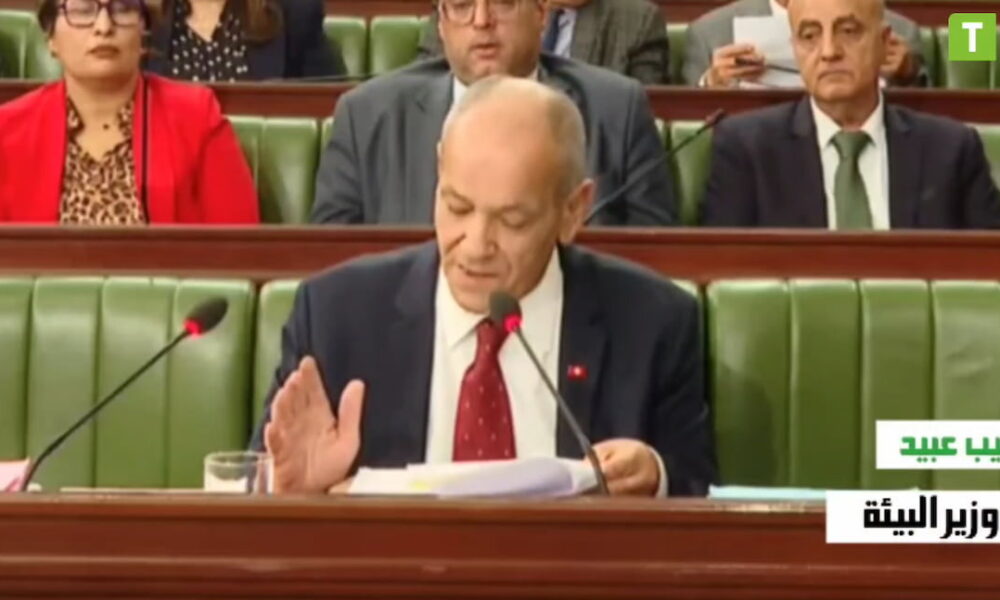
The Minister of the Environment, Habib Obeid, presented on Wednesday, November 4, 2026, the budget project for his department and the priorities of the mission for 2027. The ministry’s and the agencies under its umbrella appropriations amount to approximately 531.241 million dinars.
Region-specific priorities
The commission of productive sectors of the National Council of Regions and Districts, chaired by Aymen Obeidi, held a joint session with the commission of Industry, Commerce, Natural Resources, Energy and Environment of the Assembly of the Representatives of the People. The minister was accompanied by senior officials from his department.
Aymen Obeidi described a difficult environmental situation across all regions and questioned the reasons for the weak credits allocated to the ministry. He expressed the hope that the proceedings of the meeting would contribute to improving the situation.
The minister presented the orientations of the development plan 2026-2030, approved by both chambers. They provide, in particular, for the protection of the coast, the improvement of waste management and sanitation services, the application of the polluter-pays principle, the creation of marine reserves, the modernization of the regulatory framework, and the digitization of services. The plan also includes environmental orientations specific to each governorate.
In the first district, the priority is to extend sanitation to the cities and residential areas in the Medjerda basin. The second district plans to improve waste governance and sanitation services, while protecting the coast from erosion. In the third, the emphasis is on rationalizing water used for irrigation and valorizing treated water. Finally, in the fourth and fifth districts, priorities include the treatment of waste from polluting activities, notably phosphate and chemical industries, as well as the expansion of sanitation networks.
531.241 million dinars for the ministry and its agencies
According to data presented by Habib Obeid, the budget of the ministry and the agencies under its authority amounts to approximately 531.241 million dinars. The National Sanitation Office (ONAS) receives the largest share, with 428.840 million dinars. The funds allocated to the National Waste Management Agency amount to 27.750 million dinars, those of the National Environmental Protection Agency to 18.920 million, and those of the Coastal Protection and Development Agency to 13.850 million.
The Tunis International Centre for Environmental Technologies is to receive 6.474 million dinars and the National Gene Bank 2.018 million, to which 700,000 dinars transferred by the ministry are added. Intervention-type development expenditures allocated to non-administrative public establishments are estimated at 430.845 million dinars.
The mission comprises two sub-programmes, six objectives, 15 indicators and 13 activities. For 2027, it notably foresees rehabilitating sanitation facilities, extending services to unserved cities, and improving the quality of treated water to promote its reuse. The program also includes the creation of waste treatment and recovery units, the rehabilitation of illegal dumps, the elimination of black spots, the protection of the coast and biodiversity, the creation of a green belt, and the fight against industrial pollution.
MPs alert to delays and illegal dumps
The elected representatives welcomed the ongoing projects while deeming the budget limited in light of the importance of environmental issues. They called for the creation of wastewater treatment plants and household waste collection centers, and for reorganizing dumps to preserve agricultural land. They also asked for information on the digitization of the sector, the status of the National Gene Bank, and the interventions of the Pollution Control Fund.
The MPs asked why several wastewater treatment plant projects remained blocked despite available land. They also noted that neighborhoods, delegations and industrial zones are still not connected to the networks, and that some facilities are no longer suitable for population growth.
Regarding treated water, some MPs argued for its use in irrigation, watering of green spaces, and cleaning of sanitation networks, rather than using potable water. Others mentioned its use in construction and industrial activities, while calling for consideration of potential risks to agriculture.
The discussions also addressed the proliferation of illegal dumps and the burning of waste, as well as their health and environmental consequences. The MPs asked for details on the recycling strategy, the schedule for the generalization of waste valorization, and the measures planned to support investment in this field.
Regarding the coast, they called for revising Law No. 1847 of 2014, dated May 20, 2014, concerning the temporary occupation of the public maritime domain, and for preserving the public nature of beaches.
Waste valorization and the carbon market
The minister indicated that the strategy prioritizes waste valorization over burial in three landfills. New projects are planned for 2027, with support for private initiatives that could enable energy production from waste and replacement of coal. Some projects nonetheless face land-right difficulties, he noted.
The ministry also coordinates its actions with those of the Equipment and Housing and Agriculture, Hydraulic Resources and Fisheries in order to valorize demolition and construction waste, which could notably be used to develop agricultural roads. The minister also mentioned the 2030 horizon greenhouse gas emission reduction strategy and the steps aimed at mobilizing investments through the carbon market.
In response to the deputies, Habib Obeid assessed that some projects in the development plan exceeded the ministry’s capacities. Their inclusion in the budget, according to him, requires prior completion of studies and the agreement of the Ministry of Economy and Planning.
He announced that the Pollution Control Fund had allocated 12 million dinars to the National Waste Management Agency and 6 million to the ministry. He also indicated that land-right difficulties blocking sanitation projects were being addressed.
The minister noted that treated water not reused is discharged into wadis, sebkhas, or into the sea. It is currently used in hotels, stadiums, and airports. He also stated that a separate bill for sanitation levies was not possible, and that integrating them into the bill of the National Company for Water Exploitation and Distribution (SONEDE) would ensure payment.
Finally, Habib Obeid acknowledged the scale of the problem of industrial waste and mentioned a cooperation program with Germany and the Netherlands dedicated to coastal protection, threatened notably by climate change.