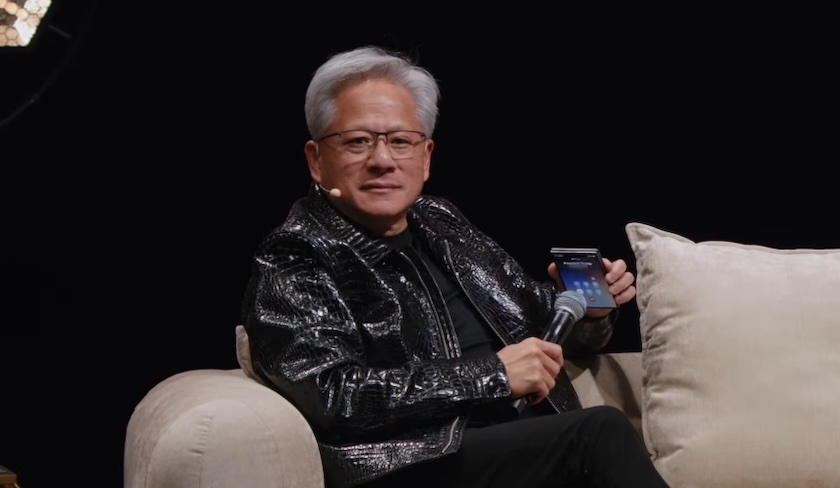
The head of Nvidia, one of the most important companies for artificial intelligence, acknowledged a marital infidelity. A few hours later, its board of directors announced an independent investigation into a possible foreign intelligence operation targeting its leader.
Why does this private affair also concern the American authorities? And what is actually established?
At the center of the case are Jensen Huang, founder and CEO of the American group, and a former executive of a data-center company based in Singapore, cited in press investigations.
The stake goes beyond their alleged relationship: it touches on technologies Washington wants to prevent from falling into the hands of certain Chinese actors.
Key Points
November 8, 2026: Nvidia announces an independent investigation into a possible targeting of its CEO by a foreign intelligence service.
Jensen Huang: the leader acknowledges an infidelity and offers his apologies. This confession is not a confession of espionage.
Official Nvidia position: its board has no reason to believe that trade secrets or American national security have been compromised.
What is Nvidia, and why is it talked about so much?
Nvidia is an American company specializing in electronic chips, the components that perform calculations inside computers. It first established itself in graphics cards used notably for video games.
Its graphics processors, called GPUs, can perform in parallel a very large number of operations. This capacity has become valuable for training and running AI systems: conversational assistants, translation tools, image analysis or scientific applications.
Large tech companies buy these chips and install them in data centers, vast facilities filled with servers. Nvidia has thus become a strategic supplier to the AI economy.
The scale of its activity gives a sense of the stakes. For its fiscal year 2026, closed January 25, 2026, Nvidia reported revenue of 215.9 billion dollars, up 65% from the previous year. These financial figures do not correspond to the full calendar year 2026.
Who is Jensen Huang, the implicated leader?
Jensen Huang co-founded Nvidia in 1993 and has led the company since its inception. He has guided its shift from the graphics-card market to the data-center infrastructure for AI. He thus holds a particularly important position in the group’s technological, commercial and strategic decisions.
It is this position that gives the case its economic and political dimension. A personal relationship does not automatically concern a company.
But when it involves a leader in contact with international customers and technologies subject to American restrictions, questions of privacy and security can become sensitive.
A businesswoman cited in intelligence suspicions
In late October, the New York Times reported, relying on information attributed to American officials, that Jensen Huang may have had a relationship with Alice Huang, former head of Megaspeed, a data-center company based in Singapore and a Nvidia customer.
 According to these revelations, American services suspect this businesswoman of having been recruited by Chinese intelligence and of transmitting information to it. The Financial Times also reported the existence of an intelligence document concerning these suspicions. These are allegations reported by the media, and not guilt established by a court ruling.
Megaspeed has also been the subject of a review by American authorities regarding a potential circumvention of export restrictions on AI chips to China. Again, the suspicions against the company do not show that it committed an offense, nor that Nvidia’s confidential information was handed over to Beijing.
Asked at the end of October, Nvidia had initially described Jensen Huang’s contacts with this executive as routine business interactions with a client. The Chinese Foreign Ministry rejected the reported accusations, calling them unfounded, according to ABC News.
What Jensen Huang acknowledged on November 8
In a message to employees and reported by Reuters and Axios, Jensen Huang acknowledged having been unfaithful to his wife. He apologized to his family and colleagues, saying he took responsibility for his actions.
This confession is a separate matter from the intelligence accusations. It does not constitute an admission of having spied for China, nor evidence that sensitive technology secrets were transmitted. The publicly available information does not also allow determining which sensitive intelligence might have been obtained.
Nvidia stated that its CEO would continue to lead the company and would cooperate with the investigations underway.
An independent investigation: what will it examine?
In an official statement published on Sunday, November 8, 2026, Nvidia’s board announced an independent investigation following reports of a possible foreign intelligence operation targeting Jensen Huang.
The review will be supervised by a committee of independent directors aided by external legal advisers. The objective is to study the information available and assess potential risks for the company and U.S. national security.
The board emphasizes that it has, at this stage, no reason to think that Nvidia’s secrets or U.S. national security have been compromised. It maintains its trust in Jensen Huang and his leadership team. An internal investigation should not be confused with an indictment or a conviction.
Why do the United States monitor chips sold to China?
The most advanced chips enable speeding up research and civil applications, but they can also be used for systems with military or intelligence uses. Washington thus regulates certain exports to limit Chinese actors’ access to technologies deemed sensitive.
That does not mean that all Nvidia chips are banned in China. Rules vary according to the performance of the components, the buyers and the authorizations. In January 2026, the U.S. Department of Commerce had, for example, planned a case-by-case review of license requests for the H200 chips and certain comparable products, under security conditions.
A company that legitimately purchases computer hardware in Singapore cannot necessarily re-export it to any client without complying with these rules. That is why potential resale chains, the identity of end customers, and the exchange of commercial information are subject to particular scrutiny.
The United States Congress Demands Explanations
Even before Nvidia’s announcement, three Republican committee leaders in the House of Representatives had sent a letter dated November 4, requesting Jensen Huang to participate in an off-the-record briefing on November 18, 2026.
According to Reuters, lawmakers Brian Mast, John Moolenaar and Eric Crawford want details on Nvidia’s security protocols and on potential risks to American technologies. A request for a hearing does not mean the leader has been found responsible for a violation of the law.
Donald Trump, questioned on Sunday, expressed his trust in Jensen Huang, while stating that he had not discussed the accusations with him directly, according to Reuters.
What risks does Nvidia face, and what remains unknown?
In the short term, the case raises governance questions: how does the board monitor leadership risks, what information must be protected, and what checks are necessary when intelligence services flag concerns?
For investors, uncertainty about Jensen Huang can also matter, given how closely he is tied to the group’s strategy. But it would be premature to attribute Nvidia’s stock moves to this alone: the AI sector is also grappling with questions about the cost of infrastructure and the profitability of investments.
The key questions remain open: were confidential information obtained? Were controls circumvented? Will the internal investigation help rule out the suspicions or reveal new elements? None of these questions can be settled with the public facts available as of November 9.
Thus the case shows why a company that sells computer chips can find itself at the center of international security concerns. It is not only the personal relations of its CEO that interest the American authorities, but the protection of technologies that have become strategic in the global competition around artificial intelligence.