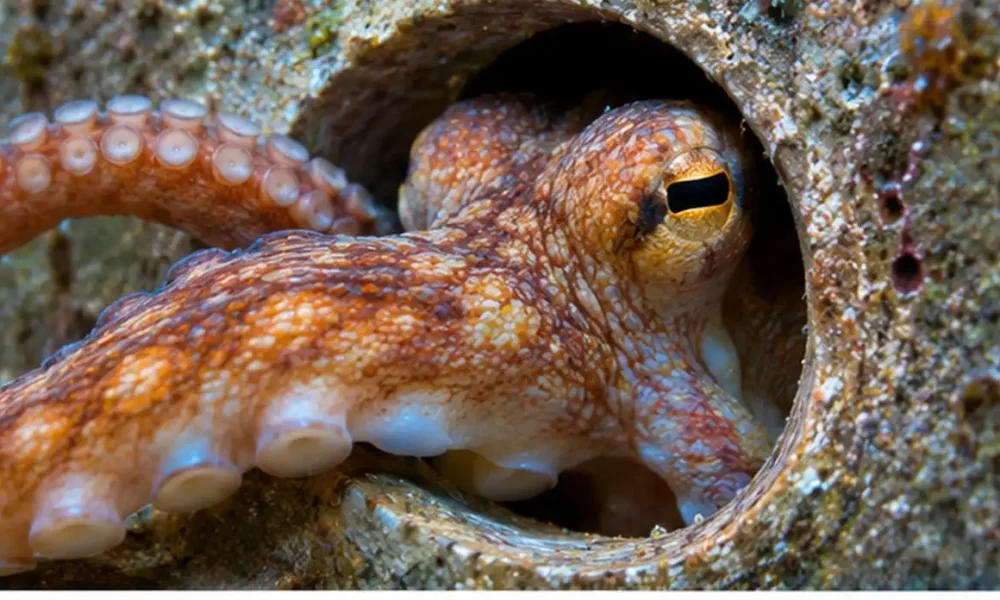
Did you know? An octopus can pass through a hole narrower than the distance between its two eyes. It is not only a question of flexibility: a study published on November 5, 2026 in the Journal of Experimental Biology reveals that this eight-armed animal adapts its technique to the size of the passage.
Researchers, among them Wenci Xin of the National University of Singapore, observed three juvenile common octopuses and four Maya octopuses. They discovered two ways to pass through an opening: one in three steps, the other in four.
The Essentials
In the studied common octopuses, the gap between the eyes ranged from 15 to 35 mm. Some crossed an opening as much as 5 mm narrower than this gap.
To achieve this, they modify the order in which they pass their arms, their head, and their body.
A hole narrower than the gap between the eyes
Lacking a rigid skeleton, the octopus nonetheless has a hard beak and a cartilaginous capsule that protects its brain. The researchers used the distance between its eyes to estimate the width of this capsule and size the openings of their experimental apparatus.
In two of the juvenile common octopuses, whose eyes were spaced 30 to 35 millimeters apart, the opening measured only 30 millimeters.
To pass through the passage, the animal therefore had to deform its body and coordinate its movements precisely.
How does it pass through? Three steps, sometimes four
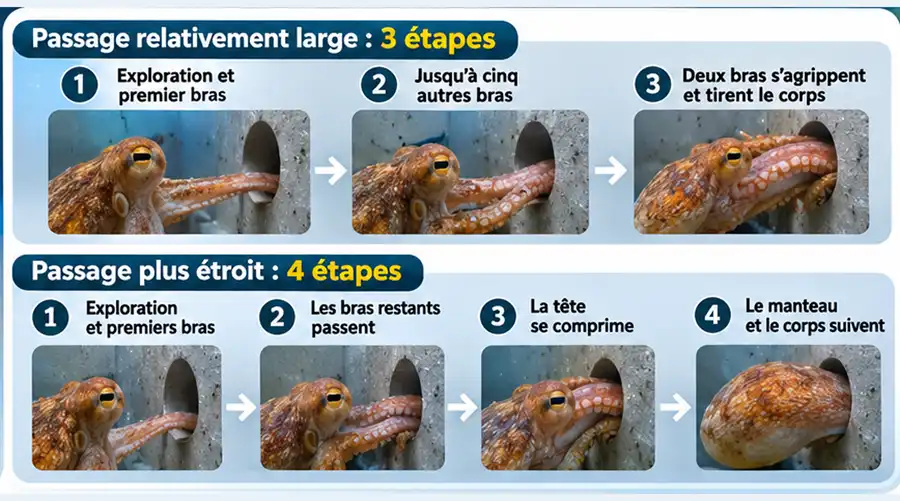
When the hole is relatively wide, the octopus follows a three-step sequence.
It first explores the opening with one arm, then gradually slides several other arms through. Two of those that crossed the wall grasp it with their suction cups and brace themselves to pull the rest of the animal through the passage.
When the opening becomes narrower, it adopts a four-step strategy: it passes the remaining arms first, then compresses and causes its head and mantle, the rounded part that houses several organs, to pass through separately.
In the reported observations, the maneuver lasted about twenty seconds on average. But the time required varied depending on the situations.
The Maya octopuses choose another solution
The four Maya octopuses (Octopus maya) did not show the same behavior. Faced with a single passage that was too narrow, they stayed away from it without even trying to pass. When given a choice between two openings, they first examined the smaller one, then took the larger.
These differences do not allow us to conclude that one species is more intelligent than another. The study involves a small number of animals, and the researchers consider several explanations, notably related to their morphology and habits.
An inspiration for rescue robots
This discovery also interests robotics. By reproducing the octopus’s flexibility and coordinated movements, engineers could design robots capable of slipping into hard-to-reach spaces, for example under rubble after an earthquake.
This remains a line of inquiry. But the octopus already demonstrates that a flexible body can cross an obstacle not only by changing its shape but also by changing its method.
Did you know? To pass through a tiny hole, the octopus does not merely compress itself: it adapts the order of its movements!