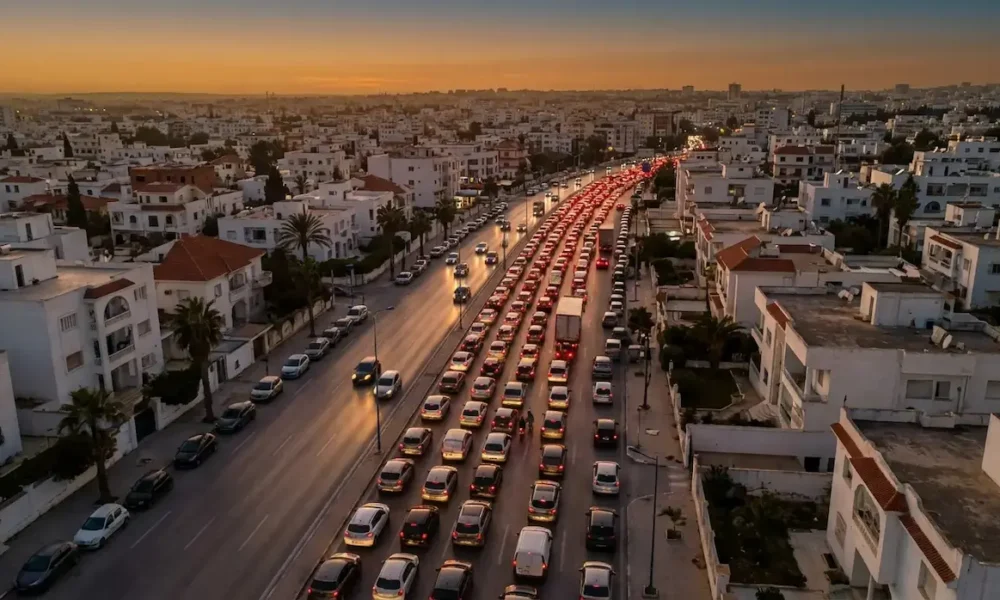
During rush hours, the heart of Tunis moves at the pace of a cautious cyclist. This slowness is not merely a daily inconvenience: according to available estimates, it costs up to 2% of the country’s GDP. Each traffic jam thus becomes an invisible line of spending, drawn from productivity, health, and the state budget.
The paradox is all the more striking because Tunisia has known better times. In the 1970s, public transport accounted for 70% of motorized mobility. Today, private vehicles concentrate 63%. In half a century, the country has shifted from a mass model to a model of motorized solitude, without its public finances ever truly choosing between the two.
This diagnosis, as well as the institutional response it entails, is set out in the country profile devoted to Tunisia by the MobiliseYourCity Global Monitor 2025. This international partnership, which brings together notably AFD, GIZ, Cerema and Codatu, has assisted the Tunisian Ministry of Transport in developing a national urban mobility policy. The document offers a rare reading: that of a sector where climate, budgetary and social stakes converge.
A City That Expands, A Fleet That Explodes
With 11.54 million inhabitants, of which 70% live in cities, Tunisia is heading toward an urbanization of three-quarters of its population by 2030. Yet the automobile fleet has grown by more than 55% between 2006 and 2015, surpassing 1.5 million vehicles.
The licenses for private taxis jumped by 89% between 2001 and 2015, those for collective taxis by 260%. Paratransit has, in its own way, filled the shortcomings of a public service historically underfunded, to the point that the State allocated to roads as much as to public transport.
The energy and environmental bill follows. Transport accounts for 30% of the country’s energy consumption, of which 94% is for road transport alone, distributed among private cars (49%), commercial vehicles (19%), freight (18%) and buses (15%).
It emits 7.27 million tonnes of CO2, or 0.62 tonnes per inhabitant, and weighs on 21% of greenhouse gas emissions. Air pollution, meanwhile, would cost between 2% and 10% of GDP.
The Forgotten Treasure of Walking