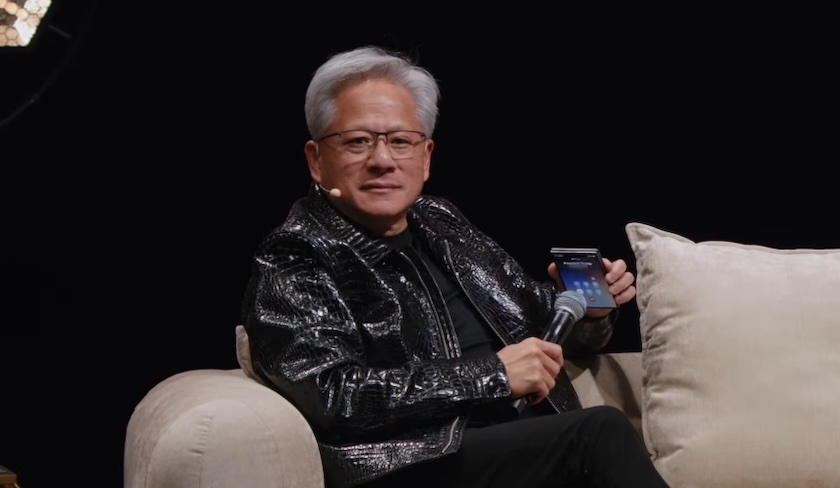
A major turning point for global artificial intelligence. Nvidia announced on Thursday, November 12, 2026, the immediate resignation of Jensen Huang, its co-founder and chief executive since 1993.
After 33 years at the helm of the chipmaker that has become central to AI, the executive also leaves his seat on the board of directors.
The CFO Collette Kress takes over as interim CEO, while the group must appoint a permanent successor.
The departure of the public face of Nvidia comes amid a climate of heightened tension, against a backdrop of revelations about his private life and press-reported suspicions surrounding a woman alleged to be involved in espionage for China. The alleged facts, the possible responsibility of the individuals involved, and the precise reasons for the resignation should be distinguished from the company’s official decisions.
Immediate resignation confirmed by Nvidia
In a statement published on November 12, Nvidia confirms that Jensen Huang has stepped down from his roles as president, chief executive, and director. The related U.S. securities filing states that the board accepted his resignation on November 11, 2026, effective immediately.
 The group named Colette Kress, previously the executive vice president and chief financial officer, to the post of interim chief executive officer. She also retains responsibility for finances until a new leader is designated. Nvidia said it would consider both internal candidates and external profiles.
Another governance change: Harvey C. Jones, a long-standing board member and former technology industry executive, becomes the first chairman of the board to be distinct from the company’s chief executive officer in its history. These appointments are also recorded in the official filing submitted to the Securities and Exchange Commission (SEC).
Why Jensen Huang’s succession matters so much
Founded in 1993, Nvidia was initially known for its graphics cards, before becoming a major player in the infrastructures necessary for artificial intelligence: specialized processors, interconnects, computing systems, and software enabling the training and deployment of large AI models.
Jensen Huang had played a central role in this transition, both in technological choices and in relationships with cloud service providers, model designers, and large groups that invest heavily in data centers.
His departure thus raises questions about strategic continuity, but it does not by itself imply that chip deliveries, contracts, or products will be interrupted. The new chair of the board has assured that the existing teams can continue the roadmap and the company’s commitments to its customers.
Who is Colette Kress, the interim boss?
Colette Kress joined Nvidia in September 2013. She has led the company’s finances for more than thirteen years and has accompanied much of its expansion into data centers and artificial intelligence. Before Nvidia, she spent nearly twenty-five years in the finance departments of major technology groups, notably at Cisco and Microsoft.
This knowledge of the organization and its partners constitutes a continuity element. But during the interim she will have to manage several matters simultaneously: investor expectations, governance questions, tensions around chip exports to China, and the substantial investments associated with AI.
Nvidia has not announced a date for appointing a permanent successor. The upcoming quarterly results, due on November 17, 2026 for the third quarter of its fiscal 2027 year, should constitute an early important public milestone for the new leadership team.
Espionage suspicions and personal revelations: what is established
According to information reported by Reuters, Jensen Huang was under heavy pressure after revelations about two alleged extramarital relationships, one of which involved a woman whom U.S. authorities suspected of working for Chinese intelligence.
Sources cited by the agency indicate that the board had met to review the situation before the resignation was announced. These elements are press information and unverified allegations. They do not demonstrate that a transfer of trade secrets occurred, nor that an espionage operation against Nvidia had been established. The company’s official statement does not disclose personal or disciplinary motives for the departure.
The issue of U.S. export controls on semiconductors to China adds a strategic dimension to the matter. It, however, merits a separate investigation: it would be incorrect to infer from a private relationship alone the existence of a violation of export rules.
Tunisie Numérique had already mentioned these revelations in Nvidia articles: its CEO acknowledges infidelity, an investigation opened into suspicions of Chinese espionage, and Suspicions of espionage: Trump comes to Nvidia’s boss’s aid. The resignation constitutes the next step in this case.
The stock market reacts, but the initial drop narrows
On Wall Street, Nvidia’s stock fell sharply at the opening of trading on Thursday, November 12, before narrowing its losses. The shares ended the day down 4.3%. It is important to distinguish this closing decline from the larger losses observed at the start of the session: they reflect different market moments.
Investors’ concerns center on the risk of a strategic shift after the founder-led leadership disappeared, in a sector where infrastructure spending is very high and where the future profitability of certain projects remains debated.
Nvidia’s importance in the AI value chain means that a governance crisis can affect confidence among markets and partners. But the magnitude and duration of these consequences remain uncertain: nothing at this stage allows us to say that orders from major customers have been cancelled.
What could change for AI companies
Companies building AI services depend not only on processors, but also on high-speed networks, development software, and the energy required to operate their data centers. Nvidia holds a significant place in several of these links.
Three questions will need to be watched going forward: the continuity of deliveries and the technology roadmap, the policy toward the United States and China, and the pace of investments by large firms in AI computing. These are monitoring points, not yet observed consequences.
The market does not rely on a single person, however: Nvidia has research teams, products already commercialized, and contractual commitments. The new leadership emphasizes this continuity, while competitors like AMD and Broadcom seek to strengthen their positions.
A first test on November 17
The publication of Nvidia’s quarterly results on November 17 will be an opportunity to question the interim leadership on activity prospects, demand for data-center processors, and the potential repercussions of the crisis on relationships with customers and partners.
For players in the digital sector, the question goes beyond the identity of the next chief. It concerns Nvidia’s ability to continue its technological development while restoring trust in its governance, in an industry that has become a major pillar of the global economy.