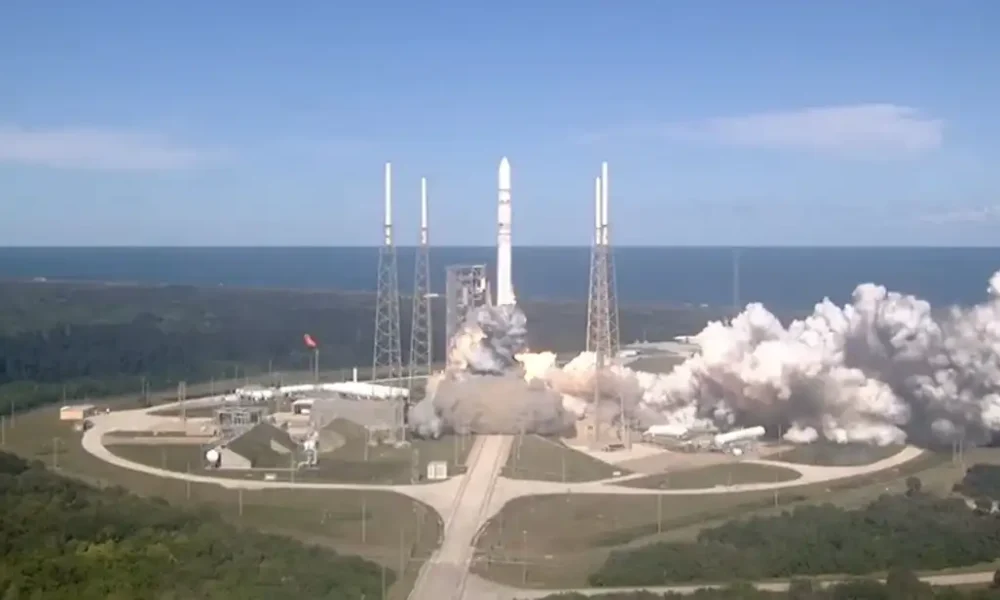
A blow to Amazon’s space ambitions. The American e-commerce giant lost 40 satellites intended for its future Amazon Leo internet network, after the failure of a Vulcan rocket launch, on Sunday November 15, 2026, from Cape Canaveral, Florida. The launcher encountered an anomaly about ten minutes after liftoff, preventing the cargo from reaching orbit.
This mission was to mark a major milestone in the deployment of Amazon Leo, formerly known as Project Kuiper, the project with which Amazon aims to compete with Starlink, SpaceX’s satellite Internet network.
The Essentials
40 satellites: the entire payload of the Amazon Leo LV-01 mission has been lost.
10 minutes: approximate time between liftoff and the anomaly reported by ULA.
38 launches: number of Vulcan missions ordered by Amazon from ULA.
November 23: earliest planned date for the next launch of 36 Amazon Leo satellites by Ariane 6.
A launch that ends in failure after ten minutes
The Vulcan rocket lifted off on Sunday at 12:40 PM Eastern Time, i.e., 18:40 in Tunisia, from Space Launch Complex 41 at Cape Canaveral.
But about ten minutes after liftoff, an anomaly interrupted the mission’s normal course. United Launch Alliance (ULA), the American company overseeing the launch, confirmed that the rocket had failed to place Amazon’s payload into the planned orbit.
The 40 satellites were declared lost. The precise cause of the incident had not yet been established at the time of the initial official statements. ULA said it would analyze the flight data to determine the origin of the failure.
This marks ULA’s first total mission failure since the company was formed in 2006. The company is a joint venture between two major American aerospace and defense groups, Boeing and Lockheed Martin.
Why these 40 satellites were particularly important
The mission, named Leo Vulcan 1 (LV-01), was to be the first launch operation of Amazon Leo aboard a Vulcan rocket.
With 40 satellites, it represented the largest batch ever prepared by Amazon for a single launch. Previous missions had carried smaller payloads, notably aboard Atlas V, Falcon 9, and Ariane 6 rockets.
The Vulcan rocket was to inaugurate, for Amazon, a new phase of deployment on a larger scale. This launch used a powerful configuration, equipped with six boosters and an optimized version of the Centaur V upper stage.
Amazon has ordered 38 Vulcan launches from ULA, which are to enable the deployment of more than 1,500 first-generation satellites. This partnership thus represents a major component of Amazon’s space timetable.
Sunday’s failure affects not only the loss of a batch of satellites: it could also disrupt upcoming launches entrusted to this same launcher, depending on the duration and conclusions of the technical investigation.
Amazon Leo: Starlink’s main rival
Amazon Leo aims to provide high-speed Internet connectivity through a constellation of satellites operating in low Earth orbit. The goal is notably to serve areas where terrestrial networks remain insufficient or difficult to deploy.
The program, initially launched under the name Project Kuiper, entered its commercial satellite deployment phase in April 2025.
According to Amazon, nearly 400 satellites had already been launched across 14 missions before Sunday’s failure. This new cargo of 40 satellites was to accelerate the network’s build-out.
The group also stated that it had completed the manufacture of its 1,000th satellite in early September 2026. This figure refers to satellites built, not the vehicles already in orbit.
Despite the announced industrial progress, Amazon Leo remains in a deployment phase and does not yet offer a widespread commercial public service. The company aims to offer its first services to customers in 2026.
Amazon facing Starlink: the real challenge
Starlink already operates a satellite Internet network in many countries. Amazon, for its part, must still multiply launches to expand its coverage and capacity. The availability of rockets, the success of missions, and the speed of deployment are therefore decisive challenges in this competition.
A serious setback for Boeing and Lockheed Martin as well
The failure also poses a problem for ULA, which is developing Vulcan as one of its main launchers for American commercial and governmental missions.
It was the fifth flight of Vulcan since its debut in 2024 and its first launch after several months of interruption, tied to technical reviews focusing in particular on certain launcher components.
An investigation will now determine what happened. In the meantime, it would be premature to attribute the accident to a motor, a booster, or the upper stage without official technical results.
The exact financial amount of the loss has not been made public. It potentially includes the cost of the satellites and the contractual and operational consequences of the failed launch, with no reliable estimate at this stage.
Amazon maintains its confidence, despite the failure
Amazon Leo acknowledged the inherent risks of space launches, particularly when it involves a first mission using a new rocket configuration.
Nevertheless, the company reaffirmed its trust in ULA, believing that its partner would draw lessons from this incident and continue the development of Vulcan.
The Amazon Leo program relies on several launch providers, among them ULA, Arianespace, Blue Origin, and SpaceX. This diversification aims to allow the group to continue deploying its constellation without depending on a single launcher.
Next date: Ariane 6 and 36 new satellites
Following this American failure, the next announced launch for Amazon Leo is to be performed by the European Ariane 6 rocket.
Arianespace plans to place 36 Amazon Leo satellites into orbit during mission LE-04, also designated VA271, from the Guiana Space Centre in Kourou.
Liftoff is planned for, at the earliest, November 23, 2026. This date remains conditional and the final window must be confirmed by Arianespace.
If this mission succeeds, it will bring the number of Amazon Leo satellites deployed by Arianespace since the start of their partnership to 136.
For Amazon, the challenge is now double: understand why the 40 satellites were lost and maintain a launch cadence sufficient to develop its future Internet service in the face of a competitor, Starlink, already firmly established.