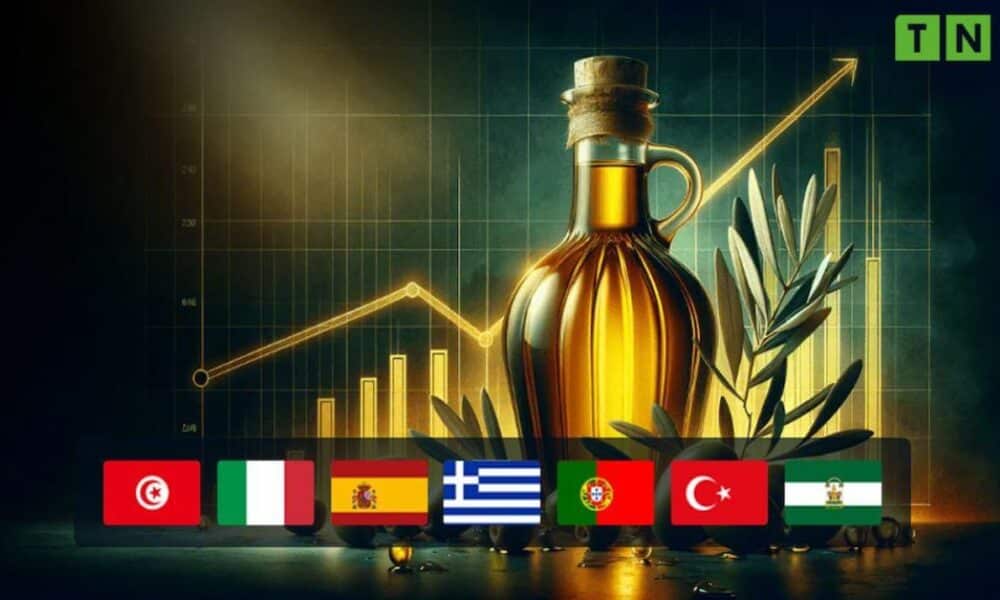
Olive oil remains a flagship product of global trade, with significant price gaps depending on the country and the categories marketed. The latest available data allow comparing the levels observed in Tunisia with those of several major European producing markets.
The data presented below come from the platform Oleista, specialized in wholesale buying and selling of olive oil. Prices are expressed in euros per kilogram and were consulted on November 20, 2026. Reference periods differ however depending on the markets.
Three olive oil categories to distinguish
Olive oil categories differ notably by their physico-chemical characteristics, their organoleptic quality and their level of acidity.
Extra virgin olive oil
- Production method: obtained directly from olives solely by mechanical processes.
- Quality: top category meeting specific chemical and sensory criteria.
- Acidity: less than or equal to 0.8%.
Virgin olive oil
- Production method: also obtained by mechanical processes.
- Quality: may exhibit certain sensory defects accepted within the limits corresponding to this category.
- Acidity: less than or equal to 2%.
Lampante olive oil
- Quality: oil that does not meet the criteria allowing direct consumption.
- Use: must notably undergo refining before it can be used in a product intended for consumption.
- Acidity: generally greater than 2%.
Average price observed in August 2026
The average price of olive oil during the 2025/2026 campaign recorded a decline of 5.7%. However, in October 2026, it rose by 10.1% compared to the same period of the previous campaign, rising from 12.60 DT/kg to 13.87 DT/kg, with variations by category ranging between 10.68 DT/kg and 17.40 DT/kg.
Content only available on Tunisia Numérique