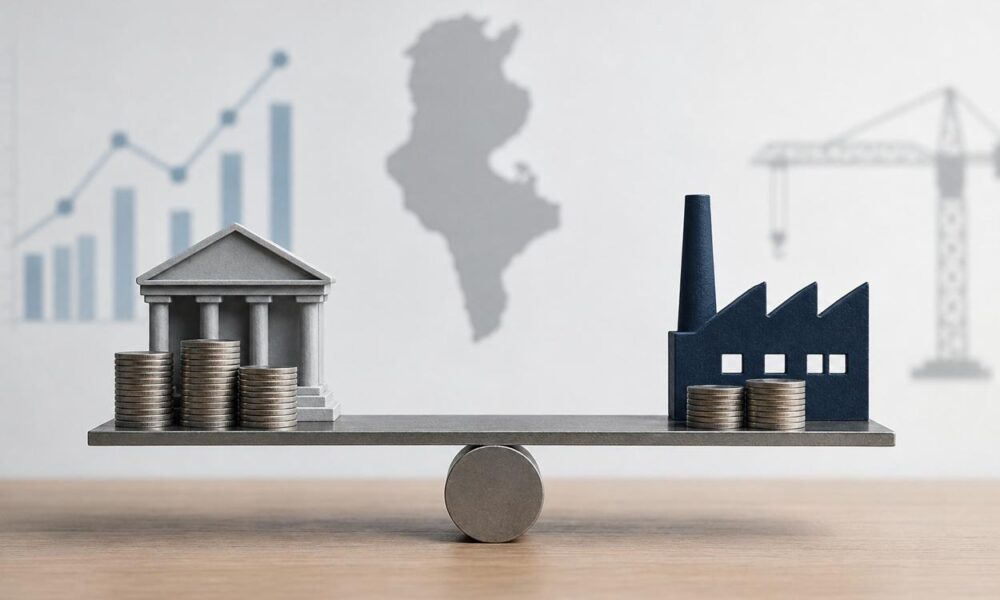
A dinar is spent only once. The one who goes to repay a debt will not build a dam, nor a solar power plant, nor an irrigation network. This simple truth, which every household knows, becomes a conundrum at the scale of a state. And Tunisia, according to the continent’s most recent figures, must now decide between honoring yesterday and preparing tomorrow.
This question takes on particular significance in a region where water is scarce and temperatures are rising. North Africa is among the areas most exposed to water stress on the planet, and every dinar devoted to debt service is a dinar that does not fund adaptation or the energy transition. For the general public, the stakes are very concrete: it touches tap water, crops, and tomorrow’s electricity bill.
It is the finding of the report “Dynamics of Development in Africa 2026: Managing Debt in Service of Transformation,” published jointly by the African Union Commission and the OECD Development Centre (AUC/OECD, 2026). Its chapter on North Africa allows Tunisia to be placed precisely and shows why its case matters far beyond its borders.
The model taxpayer
On the revenue collection front, Tunisia stands out clearly. Its tax-to-GDP ratio reaches 33.15%, a level comparable to OECD countries (33.8%), while the African average hovers around 16%. This capacity has allowed it to devote 15.6% of its GDP to infrastructure, health, and education between 2020 and 2023, against 6.8% on average across the continent. By comparison, Mauritania, with a tax-to-GDP ratio of 13.8%, devoted only 5.1%.
Yet debt weighs. In 2024, it accounted for 82.5% of Tunisian GDP, the second-highest ratio in the region behind Egypt (91.3%), for an continent-wide average of 64.9%. More importantly, Tunisia is the North African country where this ratio rose the most between 2021 and 2024, by 3.7 percentage points. The model taxpayer thus does not escape the pressure of debt.
A Debt More Domestic to Manage