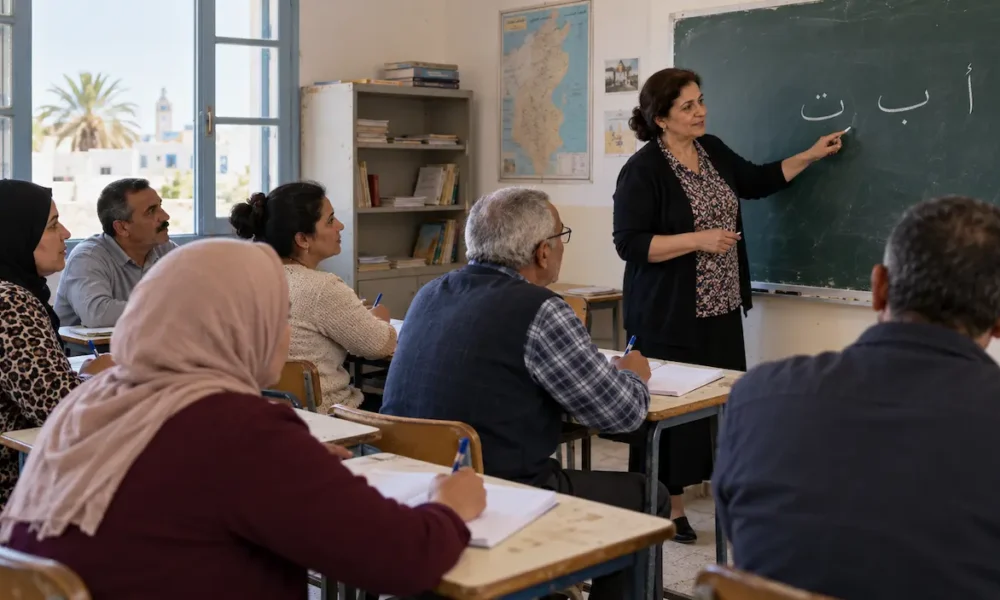
The Presidency of the Government indicated that the financial situation of adult education teachers has been improved by a decree setting their remuneration regime, due to the inability to align them with the grades of the corps of social education teachers.
This clarification appears in a response to two written questions from deputies of the Assembly of the Representatives of the People, published on the Parliament’s official site, regarding the regularization of these teachers’ situation.
A problematic alignment
According to the Presidency of the Government, regularizing the professional status of the participants in literacy and adult education would require aligning them with grades of the corps of teachers of social education, which corresponds to the missions entrusted to them. An option that, in its view, presents numerous difficulties, as the individuals are spread across varying ages, education levels, and specialties that are unequal.
It recalls the promulgation of Decree No. 544 of 2024, dated November 7, 2024, amending Government Decree No. 607 of 2018 regarding the remuneration regime for contractual teachers and instructors in the field of literacy and adult education under the Ministry of Social Affairs, a text that has improved their financial situation.
The Deputies’ Requests
In its written question, one of the two deputies argued that the contract workers in adult education have devoted many years to disseminating knowledge, but remain classified in categories that do not reflect their role in the fight against illiteracy. He requested regularization of their professional and administrative status, their integration into the legal framework of the civil service, and access to all of their professional and social rights. The second question concerned the measures taken to close this file.
A program of 945 centers
The Ministry of Social Affairs manages, through the National Center for Adult Education, the national program for adult education and literacy. It currently counts 945 lifelong-learning centers and 11 pilot centers spread across 11 governorates. It targets between 20 000 and 25 000 illiterate people per year, relying on more than 845 contract teachers and 114 tenured teachers.
According to data from the National Statistics Institute, the illiteracy rate has fallen to 17.3%.
In addition, Tunisia is moving toward broadening the notion of adult education, which includes, beyond reading and writing, the acquisition of life skills, health education, and professional and road safety education, in a lifelong learning approach aimed at social and economic integration.