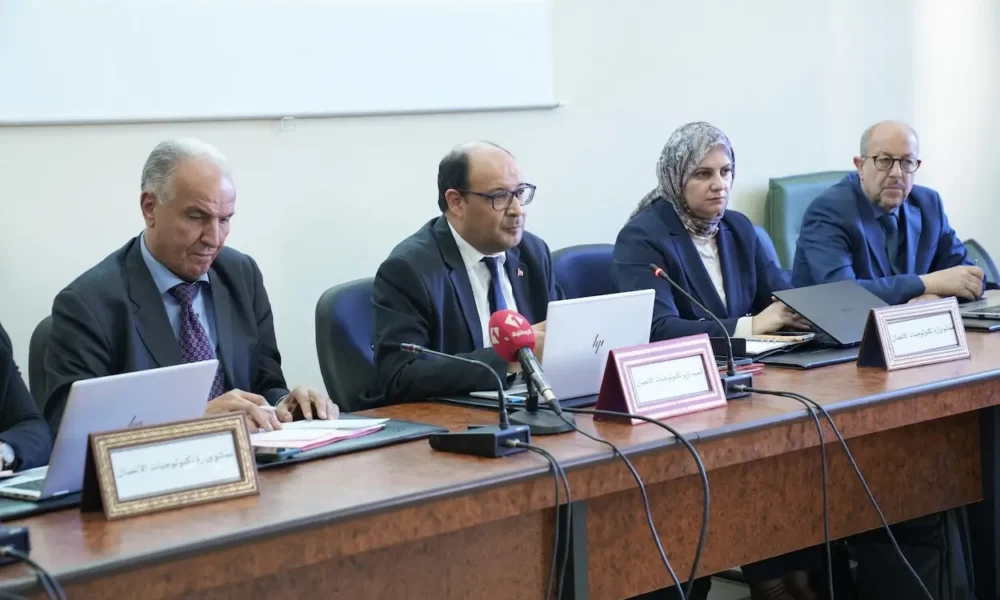
The Commission on the organization of the administration, its development, digitalization, governance and the fight against corruption held, on Friday, February 27, 2026, a session devoted to the hearing of the Minister of Communications Technologies. The exchanges focused on the digital transformation and interoperability projects, presented as one of the major axes of the State’s economic and social program.
The stated objective: to fight corruption, ensure the transparency of administrative transactions, simplify procedures, and bring services closer to citizens in all regions of the country.
A session chaired by Sami Raïes in the presence of several deputies
The meeting took place in the presence of Sami Raïes, president of the commission, Mourad El Khazami, vice-president, and Imed Eddine Sdeiri, rapporteur. Also participating were Faten Ennasibi and Saber El Masmoudi, members of the commission, as well as a substantial number of non-member deputies.
The president of the Assembly of the People’s Representatives, the dean Ibrahim Bouderbala, attended part of the session. He praised the programs and projects presented by the minister, while calling to accelerate their on-the-ground implementation and to better publicize them to citizens in order to strengthen their support and directly improve the quality of the services provided.
Digitization at the heart of the development plan 2026-2030
In opening, the minister outlined the strategic framework and national directions of digital transformation, which he described as a central axis of the development plan 2026-2030. He indicated that the State aims for a qualitative change in public services through a holistic, digitization-based approach, in order to restore the trust between citizens and institutions.
According to him, digitization is no longer just a technical choice, but a strategic necessity to enshrine transparency and combat all forms of corruption, while contributing to the improvement of the business climate, attracting investments and strengthening employment opportunities for young people.
192 projects under surveillance, with an average progress rate of 52%
The minister detailed the main ongoing programs and those planned for 2026. He specified that 192 projects are currently being monitored, with an average progress rate of 52%, distributed across several ministries and public bodies.
The achievements announced by the end of 2025
Among the projects completed by the end of 2025, the minister notably cited:
The unified portal of services
The houses of administrative services
The remote payment of vehicle vignette
The digital hospital, in its first phase
The electronic fiscal stamp
The national interoperability platform
The national platform for monitoring public projects
Current priorities: electronic invoicing and online tax identifier
The minister also mentioned the priority ongoing projects, including:
The generalization of electronic invoicing
The implementation of the online tax identifier
The health insurance information system
Bulletin No. 3
And other projects related to administrative services
Challenges related to cybersecurity and change management
In conclusion, the minister highlighted several obstacles to digitizing services, notably the increased risks related to cybersecurity and digital sovereignty, as well as resistance to change during the transition from paper to digital. He emphasized that digitization is an effective and necessary tool in the fight against corruption and bureaucracy.
He added that the realization of projects requires prerequisites, such as:
Strengthening human capital
Adapting the legal framework to the pace of technology
Spreading digital literacy among the general public
Responsible use of artificial intelligence
The deputies call to accelerate and reduce the digital divide
The deputies highlighted the strategic nature of digital transformation, calling for a general mobilization. They insisted on speeding up the digitization of the administration and on improving services directly linked to citizens, in order to reduce bureaucracy, simplify procedures and strengthen the fight against corruption, rent-seeking and tax evasion.
They also argued for equitable access, for both women and men and in all regions, to high-quality and affordable ICT services, in order to ensure social and financial inclusion and to limit the digital divide.
Several interventions pointed to the slowness of certain projects, including the digital identity, the Lebas health card, the national identity card and the biometric passport. Deputies also questioned the ministry on the progress of interoperability projects and on certain national platforms, notably the digital platform dedicated to recruiting higher-education graduates unemployed for a long duration.
Post and network coverage: difficulties reported on the ground
The session was also marked by questions regarding postal services: lack of human resources, a limited number of offices, peak crowds and delays in processing applications. Deputies called to reinforce mobile post offices and to rehabilitate or reopen several offices.
The weakness of network coverage in several areas was also raised, with requests for clarification on causes and planned solutions.
The minister announces measures and confirms the progressive entry into force of electronic invoicing
In response, the minister stated that efforts are underway to catch up on some difficulties, notably those related to the Post Office, due to staff shortages, with an orientation towards a gradual elimination of this deficit through recruitments.
Regarding network coverage, he mentioned interventions in the “white zones” by the ministry, as well as actions by the National Telecommunications Authority under contracts with operators, where coverage remains insufficient.
The minister also confirmed that several programs will enter the implementation phase during 2026. He indicated that the digital platform dedicated to recruiting higher-education graduates unemployed for a long duration is being prepared, in coordination with the Ministry of Employment and Vocational Training.
He finally stressed the need to move forward with digitizing services, including the adoption of electronic invoicing, even gradually, without cancellation or postponement. According to him, 2026 will mark “the true launch” of the complete digitization of the administration, within the framework of the unified national vision of digital transformation, integrated into the development plan 2026-2030, with defined objectives, priorities and a schedule.
A participatory approach with the deputies
In closing, the minister expressed his willingness to work in a participatory manner with the deputies, recalling that the fields of digital, artificial intelligence and cybersecurity evolve rapidly and require strengthened coordination among all stakeholders.