For years, Dubai sold much more than square meters. The emirate marketed a promise. That of an open, fast, tax-friendly, spectacular city, but above all protected. A place where fortunes circulated far from the region’s shocks, where real estate was valued as much for the stone as for the idea of security it embodied.
It is precisely this invisible capital that the war has just fissured. The Iranian strikes on critical infrastructure in the United Arab Emirates brutally reminded that Dubai is not an island off the Middle East. And when confidence is shaken in a city whose value rests so largely on mobile money, the question is no longer merely whether the market will slow. It becomes more serious: how far can it correct, and how long will it take to repair the damaged image of a “refuge” that underpinned its real estate premium?
A Market Already Fragile Before the War
The shock is all the more serious because it strikes a market already fragile even before the military escalation. In late May 2025, Fitch was already warning that Dubai’s residential real estate prices could fall by as much as 15% between the second half of 2025 and 2026, after several years of euphoria.
The engine of the anticipated reversal was clear: a massive wave of supply in the pipeline, with about 210,000 units expected, nearly twice the deliveries of the previous three years. This alert came even as the market was emerging from a dramatic boom cycle: residential prices had surged by about 60% between 2022 and the first quarter of 2025.
In other words, Dubai was already moving toward a classic vulnerability zone: lots of projects, lots of optimism, and the belief that foreign demand would continue absorbing almost everything. The war did not create this fragility. It hit it head-on.
A Heavy Dependence on Foreign Capital
This point is central, because Dubai’s real estate market is not only sensitive to local conditions. It depends deeply on external flows. Reuters notes that the post-Covid surge was fueled by visa reforms, attractive tax conditions, and the arrival of new foreign capital, notably after the war in Ukraine.
In 2024, real estate transactions reached a record level of 761 billion dirhams (207 billion U.S. dollars), evidence of the boom’s scale. But a boom powered by international buyers is, by definition, more volatile than a market driven largely by stable domestic demand.
Money coming from elsewhere arrives quickly, enthusiasm grows quickly, and it can depart just as quickly as the security narrative changes.
The Risk of the “Off-Plan” Model
The second weakness, more technical but just as decisive, lies in the heavy weight of off-plan sales. In 2025, 65% of Dubai’s real estate transactions were off-plan, meaning properties bought before delivery. This model works superbly when confidence is high: the investor bets on a desirable future, a neighborhood valued tomorrow, a steady flow of demand, and subsequent buyers already in place.
But when geopolitical confidence recedes, off-plan becomes a mechanism more fragile than the market for delivered properties. One no longer buys merely an apartment; one buys a scenario.
And when the scenario of stability becomes blurred, the entire financing chain, bookings, and resales tightens. Reuters notes that several developers, who used to move their projects in a matter of hours, are now facing much more hesitant demand.
Financial Markets Are Already Sending a Signal
Markets immediately sent an early warning. After trading resumed, Dubai’s benchmark index fell 4.7%, its steepest drop since May 2022, followed by a further 3.2%, driven in particular by the sector’s flagship names.
Shares of major developers like Emaar and Aldar fell by about 5% in the initial panic moves, while the bond market, essential for financing large projects, tightened sharply with spreads widening.
These signals do not yet amount to an outright real estate crash. But they show that the financial system for construction is already incorporating a heavier geopolitical risk premium. And in a market where real estate also relies on constant refinancing, that is never a trivial matter.
The Real Wound: Confidence
The deepest wound, however, lies elsewhere. It touches Dubai’s most precious asset: its image. Reuters succinctly captured this in its analysis of the emirate’s “safe haven” status. For decades, the city thrived on the tacit idea that it remained different, that the Middle East’s wars stopped at the gates of its economic narrative.
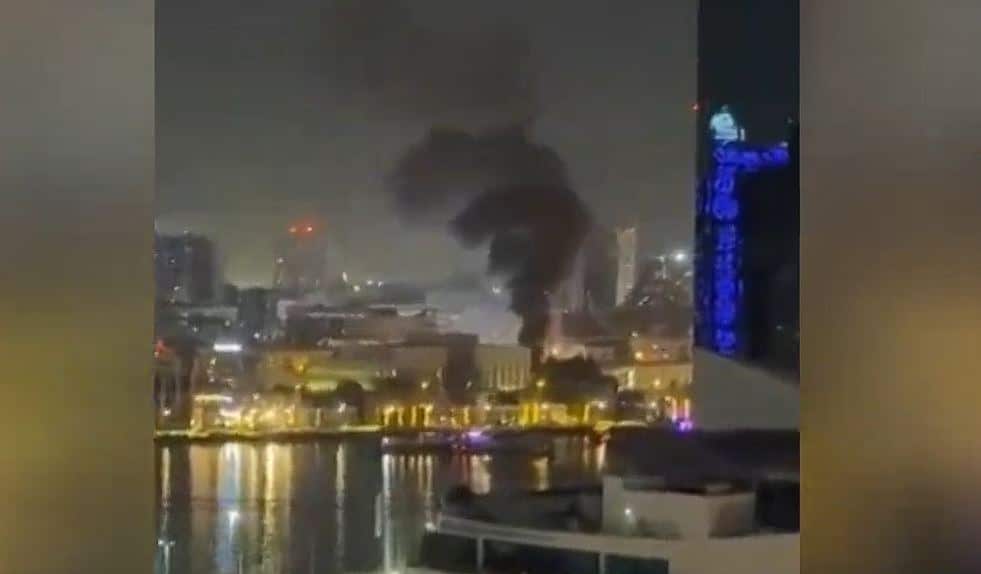
Yet the strikes, the damage to iconic areas, the disruptions at airports and ports, and the fire at Jebel Ali port have fissured this psychological boundary. Even if buildings are repaired, even if activity resumes, the precedent now exists. In prestige real estate, this memory matters as much as the concrete.
A very wealthy investor does not pay only for a marina view or a penthouse on Palm Jumeirah. He pays for the supposed tranquility of the surroundings that frame the asset.
Early Signs of Capital Flight
The most worrying is that this hit to confidence is not theoretical. Reuters reported in recent days that some Asian fortunes based in Dubai were already considering moving their assets closer to hubs deemed safer, such as Singapore or Hong Kong. It is not yet a mass exodus.
But in this kind of market, a movement does not have to be massive to become dangerous. It suffices that first movers act, that major wealth managers see an uptick in transfer requests, and that doubt takes hold. Dubai’s real estate long benefited from a virtuous circle: fortunes arriving, prices rising, a sense of invincibility, new arrivals.
The risk now is the reverse: early hesitations, wait-and-see, reassessment of regional risk, followed by a slowdown of a market that needs a triumphant narrative to stay stretched.
Historical Precedents: When Dubai Corrects
To measure the current risk, one must remember past crises. The most violent remains the 2008-2009 crisis. According to the Bank for International Settlements, Dubai’s real residential prices fell by nearly 40% during the Global Financial Crisis. It was not just a market accident.
It was the collision between an over-leveraged growth model, a real estate bubble, and a brutal reversal of global liquidity. The emirate then had to rethink part of its governance, consolidate some public developers, and try to curb the leverage excesses that had fueled the frenzy.
This crisis left a lasting lesson: in Dubai, when the cycle turns, it does not correct gently. It can fall sharply and quickly.
The Long Correction After 2014
But there was a second lesson, slower and perhaps more instructive for today. After the rebound in the early 2010s, the market began to falter again around the 2014 peak. Reuters and S&P documented a long correction tied to an oversupply and a persistent mismatch between supply and demand.
In 2019, S&P still estimated that residential prices could fall by another 5% to 10% in the year, while Reuters recalled that prices had already fallen 25% to 35% from the mid-2014 peak. In 2021, S&P even estimated that prices remained 40% to 50% below the previous 2014 peak, evidence that a correction in Dubai can be not only deep, but also extraordinarily long to absorb.
Again, the message is stern: a city can rebound, but not necessarily quickly regain its pre-crisis value, especially when overproduction meets weaker confidence.
The Covid Precedent
The Covid crisis offered another demonstration of this structural vulnerability. Reuters explained as early as 2020 that Dubai’s economy, though more diversified than that of many Gulf neighbors, remained heavily reliant on trade, tourism, services, and real estate already slowed by years of oversupply.
The pandemic then brutally reminded that a market fueled by expatriates, aviation, travel, and international investors can weaken quickly when the flow of people and capital slows. Admittedly, the emirate subsequently rebounded remarkably. But that rebound, again, relied on the return of global flows and on the restoration of an image of a safe and high-performing city.
It is precisely this image that the war has just re-tested.
A Security Premium Now Questioned
Thus, the idea that Dubai could “not regain its value” should not be framed as an excessive prophecy, but as an economically serious hypothesis. Not because the city would be doomed. Not because its market would automatically collapse.
But because part of its recent valuation rested on an intangible premium: the implicit certainty that Dubai was the place to shelter from regional turbulence while staying at the heart of business. If this security premium declines permanently, future valuations may not quickly regain the recent peaks, even in an economic rebound.
A market can rebound in volume, rekindle transactions, and regain activity. It does not automatically regain the same symbolic premium.
Growing International Competition
This is all the more true because Dubai faces not only a perception problem. It also faces a dynamic of regional and international competition. Reuters notes that Gulf aviation, another pillar of the model, is itself under pressure, with thousands of passengers moved and a reputation for seamless connectivity now more contested.
At the same time, other strongholds are advancing: Riyadh is transforming, Turkey is hardening its hubs, India is moving up in the world, Singapore remains a magnet for wealth. When absolute confidence cracks, even slightly, investors no longer compare only yields. They compare relative risks. And this is often how a sustained reassessment of real estate assets begins.
The Question Now Hovering Over the Market
Ultimately, the real question is not just about real estate. It is civilizational in the economic sense. Dubai was built as a response to regional disorder: a city where capital, talent, and families could believe in a near-contractual stability.
If this promise is now being questioned, then the real estate market will not only correct its oversupply. It will also rewrite its narrative. And in a city where value has always depended as much on imagination as on land, that may be the most costly form of correction.