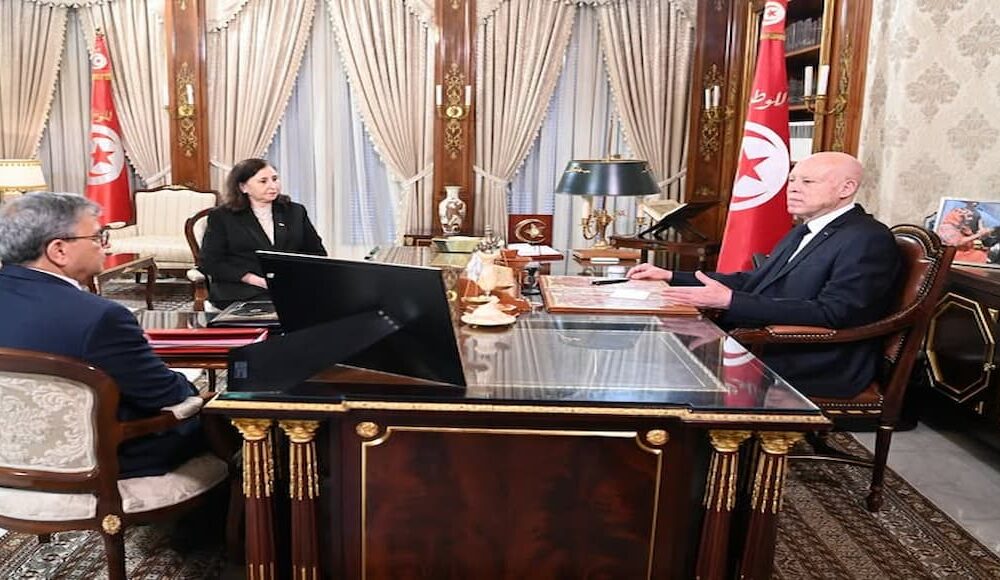
The President of the Republic, Kais Saied, called for “rationalizing imports” during a meeting held on Wednesday, September 23, 2026 at the Carthage Palace with the Prime Minister, Sarra Zaafrani Zenzri, and the Governor of the Central Bank of Tunisia (BCT), Fethi Zouhair Nouri.
At the heart of the discussions: prices, the role of banks, financing of the economy, corruption and the social function of the State.
Rationalization of imports at the heart of the discussions
According to the Presidency’s communiqué, the issue of the sharp rise in prices was extensively discussed during the meeting.
In this context, Kais Saied stressed the need to rationalize imports, while continuing the fight against corruption.
What role for the Central Bank?
The meeting also addressed the role of the Central Bank in supporting the national economy.
According to the Presidency, Kais Saied recalled that the BCT should contribute to finding solutions that achieve the financial equilibrium sought. He also reframed this mission within a broader conception, according to him, based on justice and a fair distribution of the fruits of wealth creation.
The Central Bank’s role in supporting the economy and achieving financial balances had already been discussed during a previous Carthage meeting that notably brought together Governor Fethi Zouhair Nouri.
Public banks urged to support the economy more
Kais Saied focused particularly on the public banks.
He stated that their vocation was to contribute to the State’s efforts. The president also called the other banks to facilitate access to credit under more favorable terms and to comply with the Central Bank’s circulars.
The communiqué, however, provides no details on new financing conditions, a potential reduction in the cost of credit, or specific banking schemes that might have been decided.
“The Social State” at the center of the presidential message
The head of state also spoke of the principle of coexistence and complementarity between the public and private sectors.
He cited several public services — health, transportation, education and social protection — to reaffirm his conception of the social role of the State.
Kais Saied insisted that the “Social State” should not remain merely a principle written in texts, but should be translated concretely into the daily lives of citizens.
This orientation aligns with recent positions of the Presidency on the social role of the State and the search for a balance between economic and social objectives. In a September 15 meeting devoted notably to the finance bill, the head of state had also emphasized employment, regional balance and national economic choices.
Prices and corruption: accusations to distinguish from announced measures
On corruption, Kais Saied said it does not only concern financial corruption or bribes. He also cited fraud, obstruction of the functioning of public services, and mistreatment of users of the administration.
The president further asserted that some of these practices aim to derail the political process that emerged from December 17. He mentioned the existence of “circles” that, in his view, would seek to convince Tunisians that the situation prior to the revolution was better.