Now that the debacle has been acknowledged and President Donald Trump is urgently seeking any exit, any door, to extinguish the fire he has lit in the Middle East and around the world, tongues are starting to loosen. The economic, political and diplomatic bill is steep. It will be necessary that the responsibilities for this catastrophe are located, that the culprits pay, starting with the instigator – the Israeli Prime Minister – and the Commander in Chief, Trump. For the latter the sanction will surely fall at the upcoming November elections. For Benjamin Netanyahu the punishment could fall a little sooner, at the October 2026 poll, for which his polls are very poor. The aides of the American president who gave these confidences to the New York Times testified for posterity. They do so also to avoid being crushed by investigative commissions that are sure to strike.
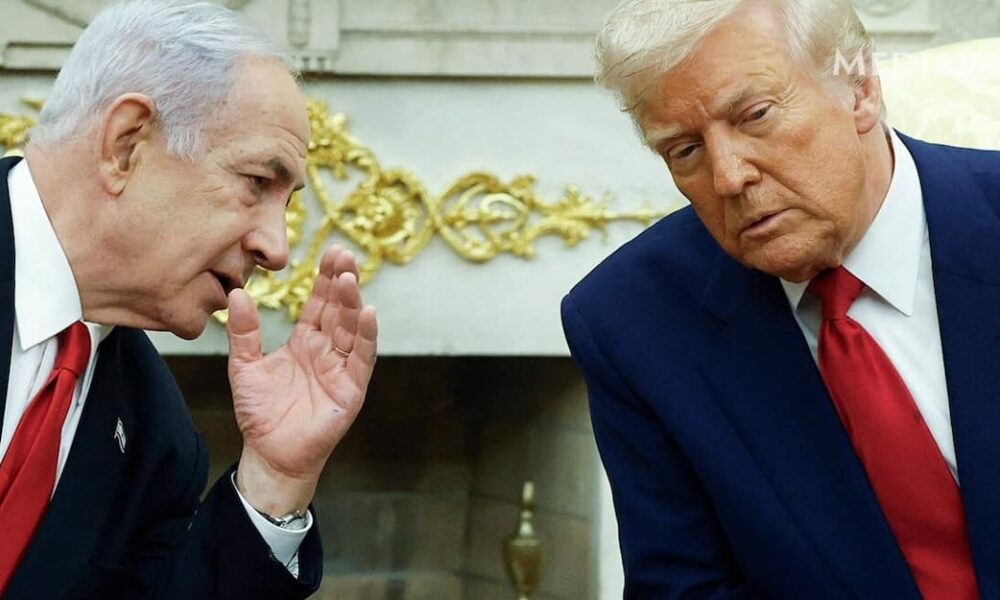
The New York newspaper recounted the course of the operation “Epic Fury” (epic fury). On the morning of February 11, Netanyahu was received at the White House in the utmost discretion and not just anywhere: the famous “Situation Room.” The Israeli prime minister is backed remotely by the head of Intelligence – the Mossad – and senior officials of the IDF. They submit to Trump their war plan. This small, leak-avoiding meeting did not involve Vice President J.D. Vance, who was visiting Azerbaijan.
Netanyahu gives to his sponsor what he wanted to hear: With a joint strike it would be possible to pulverize the Iranian ballistic program in a matter of weeks, but also to drive a regime change. Netanyahu pulls out a video to propose Reza Pahlavi, son of the last Shah of Iran, as the leader of the new Iranian Republic. To achieve this the Mossad would foment a popular uprising and a ground offensive by Kurdish fighters.
Very quickly convinced by this presentation and the apparent weakness of on-the-ground risks, Trump responds curtly: “That works for me”.
But the next day the American intelligence services alert him. Indeed, decapitating the regime and destroying its military capabilities do not pose a major problem for the U.S. Army, but the arguments around the popular uprising are judged “out of touch with reality.” In the face of Trump the CIA Director, John Ratcliffe, insists that the idea of a regime change is “farcical”…
“In other words, it’s blarney,” snapped Secretary of State Marco Rubio, who nonetheless will do nothing to slow the ardor of the American president. Worse: after the launch of the operation he spreads justifications to cover Trump and his administration. And he did so with a vehemence that stunned his world.
But the man who was perhaps the most convincing is the Secretary of Defense, the very hawkish Pete Hegseth, unlike the timidity of his generals. Vice President J.D. Vance sticks to his anti-interventionist line. He even expresses fears about regional chaos, a spike in fuel prices and a violation of the “America First” principle that they had sold to their voters.
Trump’s Chief of Staff, Susie Wiles, also fears the consequences of this venture on the midterm elections, even though she never publicly opposes the military. Conservative journalist and activist Tucker Carlson is also among those urging Trump not to wage war. He replied to them all, straight to the point: “Things always work out.”
Few dared to tell the president outright that war with Iran would be a disaster; General Dan Caine, the Army Chief of Staff, did. He explained that the Israelis are accustomed to exaggeration because without American support they cannot do much. And there is another thing: a conflict would burn through American interceptor missile stocks, already strained by Ukraine and Israel, and would open the way to the blockade of the Strait of Hormuz.
The “General” Trump swept all of that aside with a wave of the hand, convinced that he would do it quickly and with a minimum of low-cost bombs. He left the regime-change dossier to the Israelis and focused on the assassination of Ayatollah Ali Khamenei. Regarding the blocking of the Strait of Hormuz, he was convinced that the Iranian regime would be defeated before it had time to organize a response.
Moreover, one should not downplay the personal motivations of the Republican. He dreamed of bringing down the Iranian theocracy, which has haunted Americans since 1979. He saw himself as the president who would manage to demolish the mullahs’ power after 47 years of confrontation. He also thought this would be an opportunity to avenge assassination schemes targeting him personally since he had killed General Qassem Soleimani in 2020.
Encouraged by the stunning successes of the American army in Venezuela, he decided to repeat the feat in Iran. It accelerated toward the end of February when Tehran refused to let Washington meddle in its nuclear program by freely supplying fuel. Trump’s son-in-law, Jared Kushner, tells him that the Iranians reject any dialogue. At the same time the White House learns that Ayatollah Khamenei will take part in a meeting outside his bunker. A golden opportunity.
On February 26 last, the final meeting is convened in the “Situation Room.” The dice were already cast and no one tried to block the machine. Even J.D. Vance falters: “You know I think it’s a bad idea, but if you want to do it, I will support you.” The communications director, Steven Cheung, warns of political damage but also ends up bowing. General Caine wraps up the file by ensuring that the army will follow blindly.
“I think we must do it,” concludes Trump. The next afternoon, aboard the presidential plane Air Force One, he gives the grim green light: “The Epic Fury operation is approved. No cancellation. Good luck.” What a stroke of luck!