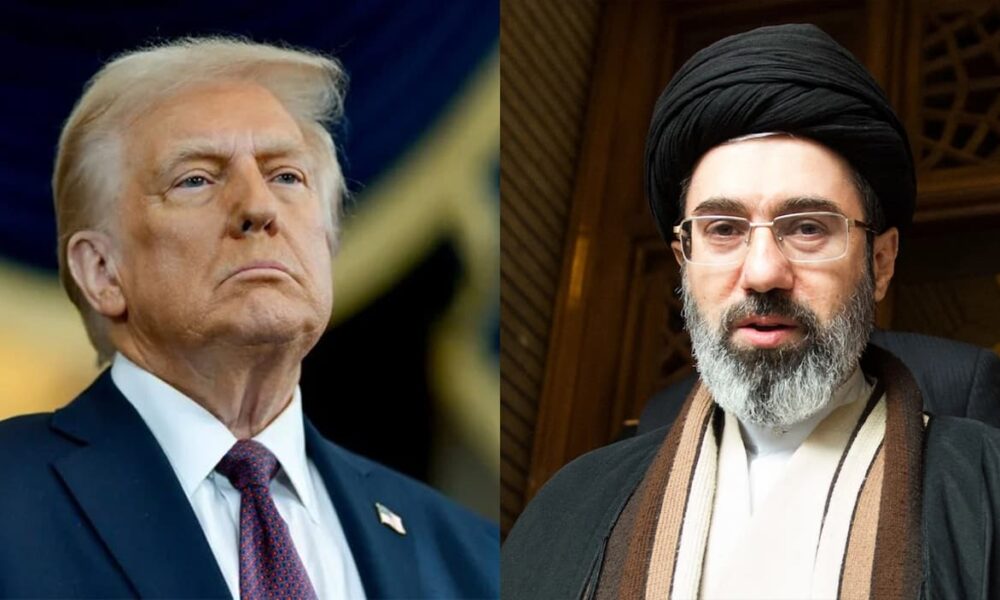
Donald Trump speaks of a possible end to military operations against Iran, while insisting that Tehran not acquire nuclear weapons. But on the ground, the Islamic Revolutionary Guard Corps claim to have shot down an American drone over the Hormuz Strait.
Between new threats, diplomatic mediation, and oil above $110 a barrel, the crisis remains unresolved this Tuesday, October 20, 2026.
The Essentials
Washington: Trump says the United States could end its involvement, but maintains the demand for a nuclear-free Iran. No new agreement has been announced.
Hormuz: Iran claims the destruction of an American MQ-9 drone, with no independent confirmation available at this stage.
Israel: Pete Hegseth met Benjamin Netanyahu on Monday, October 19, during an unannounced visit.
Mediation: Pakistan’s army chief, Asim Munir, is expected in Tehran on Tuesday.
Oil: Brent traded at $110.10 per barrel around 03:19 GMT, up 0.50%, according to Reuters.
Trump Talks About an End to the War, Without Relenting on His Demands
During a campaign rally held in Kansas on Monday, October 19, Donald Trump asserted that the United States could end its military engagement, while insisting on the necessity of preventing Iran from obtaining a nuclear weapon. The American president also claimed that U.S. forces had seriously weakened Tehran’s radars and air defenses. These statements about military damage have not been independently verified in the sources consulted.
He argued that the initial layers of the Iranian leadership had been eliminated and that roughly half of the “third-level” officials would also have been killed. According to his account, the remaining leaders would have demanded a halt to the strikes and guarantees for their security. These are the president’s statements, not findings established by an independent assessment. Trump also predicted an imminent end to the war and a historic drop in oil prices, without offering a timetable or an agreement with Tehran.
Iran Claims to Have Shot Down an MQ-9 Drone Over Hormuz
The Islamic Revolutionary Guard Corps announced on Tuesday morning that their air defenses had shot down an American MQ-9 drone over the Hormuz Strait. The statement, relayed by regional media, describes the aircraft as having been intercepted at dawn. At this stage, no independent confirmation of the loss of this aircraft has been established, and the American authorities have not confirmed the announcement in the sources consulted.
The claimed incident occurs in a region where attacks and threats against ships are multiplying. According to a note from maritime tracking company Kpler cited by Reuters, at least 18 ships have been attacked in two weeks in the area. Control of the sea lanes has become one of the main sticking points between Washington and Tehran.
Threats to Internet Cables and Conditions for Reopening the Strait
The spokesperson for the Revolutionary Guards, Hossein Mohebbi, stated that seven major undersea internet cables pass through the Hormuz Strait. He warned that Iran could reveal “new targets” and new weapons. This number is presented as an Iranian assertion: it does not constitute an independent technical inventory of the submarine links. No actual attack on these cables is reported in the corroborated information.
Tehran repeats that a durable reopening of Hormuz requires an agreement on its security conditions and its demands. Iranian Foreign Minister Abbas Araghchi reiterated on Monday that Iran’s proposal for reopening within seven days remained on the table. This seven-day period corresponds to the mechanism proposed by Iran, not a promise of a real reopening within the next seven days. Negotiations remain stalled.
Surprise Visit by Pete Hegseth to Benjamin Netanyahu
U.S. Secretary of Defense Pete Hegseth met Monday with Israeli Prime Minister Benjamin Netanyahu during an unannounced trip to Israel. The information, revealed by Axios, was confirmed to Reuters by a person familiar with the visit. The meeting took place at an air base in the south of the country, according to the Israeli military radio. The exact content of the discussions has not been officially released.
This meeting comes eight days before Israel’s parliamentary elections on October 27 and two weeks before the U.S. midterm elections on November 3. It raises questions about the military coordination of the two allies, but does not, in itself, constitute the announcement of a resumption of large-scale strikes.
Pakistan and Russia Seek to Preserve a Diplomatic Path
Pakistan’s army chief, Asim Munir, is expected in Tehran on Tuesday, October 20 for talks with Iranian officials. Islamabad has played the role of mediator between the United States and Iran since the talks that led to the June memorandum. The arrival and outcomes of this new visit were not yet confirmed at the time of checks.
The day before, Russian Foreign Minister Sergei Lavrov met with his Iranian counterparts in Tehran. His Iranian counterpart Abbas Araghchi highlighted the closeness of cooperation between the two countries. President Massoud Pezeshkian, for his part, attributed regional tensions to the presence of foreign troops and U.S. interventions. These positions reflect the Iranian stance; they do not indicate that a compromise with Washington has been found.
Brent at $110.10: The Crisis Also Reshapes the Energy Market
The oil market remains under pressure. On Tuesday, October 20, at 03:19 GMT, Brent crude stood at $110.10 per barrel, up 0.50%, according to Reuters. It had touched $110.70 during the previous session, a peak not seen since May 20. U.S. WTI for November delivery stood at $103.91 (+0.24%). These prices are quotes at a single moment, not closing prices. The strikes claimed by the Houthis against Saudi installations and maritime insecurity contribute to supply tensions.
According to an analysis in the Financial Times, the war is accelerating oil and gas investments in the Americas, notably in Argentina, Canada, and Venezuela. Buyers are seeking to diversify their sources in light of transport risks in the Middle East. In such a context, Trump’s announcements about an imminent drop in prices remain a political forecast, not an actual development.
Iran-Germany: The Crisis Extends to the Diplomatic Field
Iran summoned on Monday the German ambassador to Tehran, Axel Dittmann, in response to the summoning of its own ambassador to Berlin. Germany accuses actors linked to the Iranian apparatus of having prepared attacks against Jewish figures and supporters of Israel. Tehran rejects these accusations and calls them unfounded.
On October 15, a Hamburg court sentenced two men to eight and a half years and four and a half years in prison for their activities and preparations for attacks. The investigation targeted, in particular, plans directed against Josef Schuster, president of the Central Council of Jews in Germany, and Volker Beck, president of the German-Israeli Society, as well as a kosher shop in Berlin. German authorities attribute the directives received by the main convict to Iran’s Quds Force; the Iranian government denies any involvement.
A Conflict with Lasting Consequences, Even for Tunisia
In an analysis published Monday in Foreign Policy, Kenneth M. Pollack, vice president for policy at the Middle East Institute, argues that this war could permanently reshape geopolitical balances. He highlights the growing weight of drones and missiles, the vulnerabilities of major sea lanes, and the future role of external powers in the region. This is the author’s forward-looking analysis, not a scenario that has already occurred.
For Tunisia, a country that imports energy, maintaining high oil prices presents a risk for the energy bill, transportation costs, and, indirectly, some production costs.
The real extent will depend on the duration of the crisis, the volumes purchased, the actual prices, and national pricing mechanisms. No specific extra cost for Tunisia can be quantified from the available international data alone.
As Washington pursues a nuclear outcome, the main test remains the effective securing of Hormuz and the resumption of negotiations.