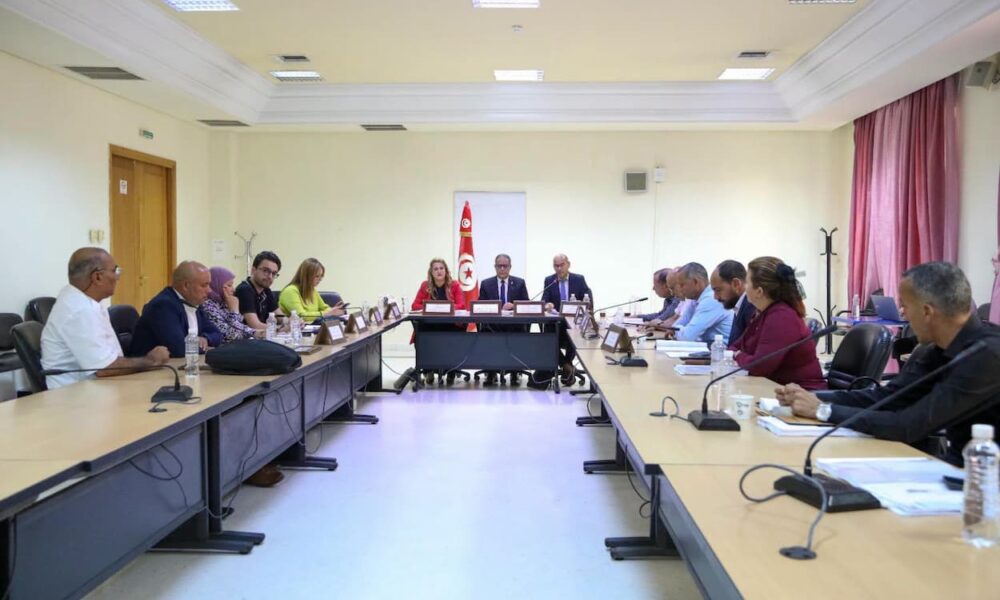
The Finance and Budget Commission of the National Council of Regions and Districts began, this Monday, October 19, 2026, examining the draft economic budget for 2027, focusing in particular on its orientations, assumptions, and main economic indicators.
During a session chaired by the Council’s President, Imed Derbali, and the Commission’s President, Ali Hssoumi Biouli, the deputies reviewed the main indicators and economic forecasts contained in the draft. They notably considered growth prospects, estimated at 3.1% in 2027, compared with 2.7% in 2026, as well as the increase in the investment rate relative to gross domestic product (GDP), which is expected to rise from 15.5% to 16.4%. Foreign direct investment, for its part, is expected to reach 4.8 billion dinars.
The deputies stressed the need to verify the realism of these forecasts and the conditions required for their realization. They also emphasized the importance of assessing the capacity of economic and financial policies to translate these objectives into tangible results in the areas of production, investment, and employment.
The discussions also focused on the coherence between the economic orientations of the economic budget draft and the objectives and priorities of the Development Plan 2026-2030, which provides a reference framework for the formulation of development policies and programs.
In this regard, participants stressed the need to translate these priorities into projects that meet the real needs of the regions and districts, while developing mechanisms to monitor their implementation and to evaluate their results. The aim is to improve the efficiency of public spending, strengthen transparency, and promote balanced territorial development.
With regard to financial balances, the commission raised the issue of reforming state-owned enterprises and establishments facing recurring financial difficulties, as well as the effectiveness of the funds and credits allocated to them. The deputies called for conditioning public financing on clearly defined reform programs with achievable targets, in order to improve their governance and performance, to strengthen their contribution to national production and economic growth, while preserving the sustainability of public finances.
The President of the Council, Imed Derbali, stressed the importance for the institution to fully assume its parliamentary responsibilities in examining the state’s economic and financial choices and to implement its constitutional and legal prerogatives, in accordance with its legislative and oversight mission.
He also stressed the need to coordinate efforts and act in a spirit of national responsibility within the framework of institutional relations with the Assembly of the People’s Representatives, while respecting the respective competences of the two parliamentary chambers.
Imed Derbali added that the examination of the economic budget draft required a thorough analysis of its assumptions and indicators, as well as verification of their realism. He also called for evaluating their expected impacts on investment, employment, economic activity, and citizens’ living conditions. Moreover, he stressed the importance of monitoring the outcomes of public policies and their ability to meet the economic, social, and development needs across the country’s different regions.
Finally, several deputies called for the provision of a detailed list of local, regional and national public projects included in the Development Plan 2026-2030. This approach would enable the National Council of Regions and Districts to fully assume its oversight role in monitoring the execution of the State Budget and the Plan’s development programs, as well as to formulate precise proposals tailored to the requirements of the next stage.