Serials broadcast during the Ramadan month continue to spark debate in Tunisia. Between entertainment and social responsibility, their content is regularly scrutinized by social science specialists, who question the implicit messages conveyed to the public, especially to young people.
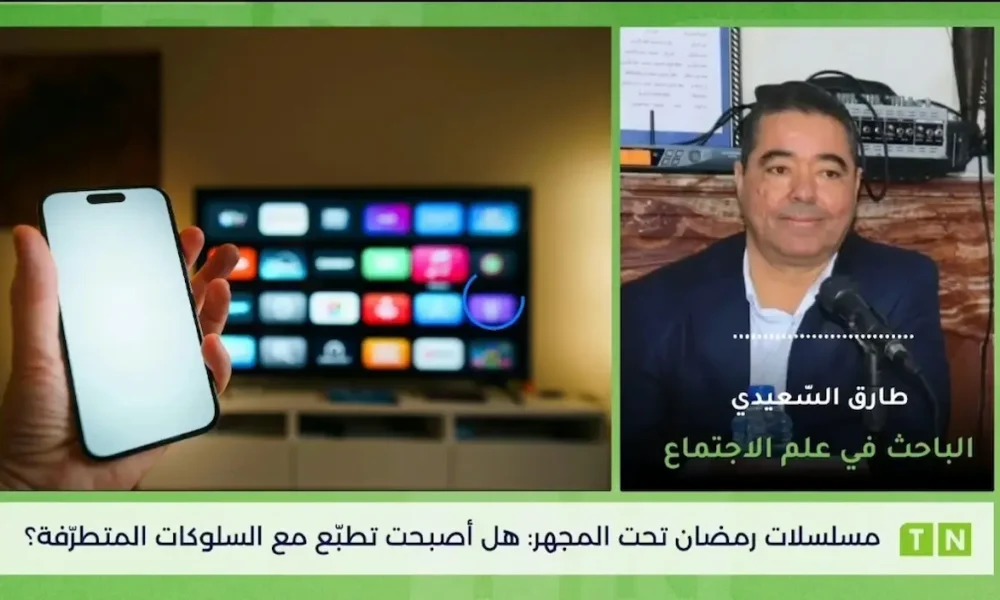
In a statement given to Tunisie Numérique this Wednesday, March 4, 2026, sociologist Tarek Saïdi delivered a critical analysis of the representations conveyed by certain Tunisian television productions broadcast during Ramadan, estimating that these works can have a significant impact on social perceptions, particularly among the younger generations.
The shift from an educational tool to a commercial logic
According to Tarek Saïdi, television no longer assumes today the role of a vector of positive socialization as theorized by sociologist Émile Durkheim.
“Television has been integrated into a logic of profit and loss, dominated by advertising, the pursuit of the sensational, and the race for the audience,” he explains.
In this context, it would no longer be a tool for education or awareness, but rather a symbolic system participating in the reproduction of the existing social order, strongly marked by the logics of the market and capitalism.
In other words, audiovisual contents would contribute to reproducing the dominant values related to social relations, social hierarchy, and the culture of consumption.
Shocking scenes that weaken the critical mind
The sociologist also believes that television tends to weaken the public’s critical capacities, notably through the accumulation of shocking or spectacular scenes.
The more violent or sensational the events are, the greater the chances of attracting a broad audience. This explains, according to him, the frequent presence in certain series of scenes of conflicts, scandals, betrayals, or extreme behaviors.
Among the examples mentioned are notably:
- physical or verbal violence
- shouting and constant arguments
- revelations of family secrets
- or certain behaviors such as smoking in private spaces or assaulting other characters.
These plot elements would contribute to strengthening the dramatic appeal of productions, but at the cost of a potential impact on social representations.
The risk of normalizing deviant behaviors
For Tarek Saïdi, repeated exposure to this type of scenes can lead to a progressive normalization of behaviors previously perceived as deviant.
Viewers, especially the young, may end up considering these attitudes – violence, infidelity, or excessive behaviors – as ordinary practices.
“The risk is to create new social representations where these behaviors become perceived as normal,” he notes.
Thus, television would indeed continue to participate in socialization, but in a distorted sense, which can undermine educational benchmarks.
A symbolic power shaping representations
The researcher recalls that television primarily functions as a system of symbols capable of restructuring collective imaginaries.
Today, he observes, audiovisual productions are part of a form of global standardization of content, where the same themes and the same scenes recur in many series around the world: violence, chaos, betrayal, or deviance.
This analysis aligns with that of philosopher Herbert Marcuse, notably in his work One-Dimensional Man, where he emphasizes the role of the media in weakening critical thought.
According to this approach, the symbolic power of images sometimes exceeds rational perception, especially because audiovisual productions deploy psychological and narrative techniques designed to capture the audience’s attention.
Between consumption and the creation of artificial needs
The sociologist also believes that these contents participate in integrating individuals into a permanent cycle of production and consumption.
Some series, for example, depict luxurious lifestyles or spectacular wealth, which can contribute to creating artificial needs.
Yet, he notes, fundamental human needs remain linked to essential elements such as:
- a decent housing
- healthy food
- and stable living conditions
The role of families and authorities
Facing these issues, Tarek Saïdi stresses the need for shared responsibility among families, producers, and public authorities.
He calls on parents to select the programs watched by their children, while inviting producers to adhere to ethical and professional standards, notably by introducing indications on the recommended age for viewing.
According to him, no Tunisian soap opera has yet systematically adopted an age-rating system, which constitutes a significant gap.
In this framework, the State could encourage private channels and production companies to adopt such measures to help families better supervise the audiovisual consumption of youths.
An increased challenge in the Internet era
Tarek Saïdi acknowledges, however, that regulation becomes more complex in the digital era.
With new technologies and widespread Internet access, it has become much more difficult to control young people’s exposure to audiovisual content.
Nonetheless, these same technologies could also serve as protective tools, by enabling the development of new mechanisms to sustain the protection of children and adolescents against potentially harmful content.