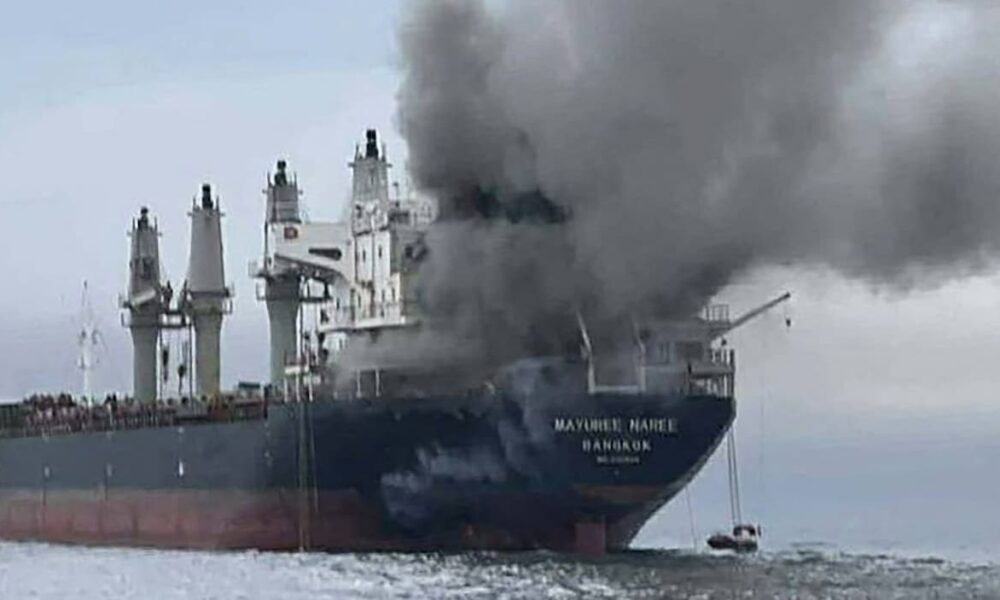
Maritime tensions persist around the Strait of Hormuz. Saturday, October 17 marked the 232nd day of the conflict that began on February 28 and the 123rd day since the signing, on June 17, of the memorandum of understanding between Washington and Tehran (the count including departure dates). On that same day, the Islamic Revolutionary Guard Corps announced the burning of two supertankers following presumed collisions with mines.
Early Sunday morning, a tugboat was hit by two projectiles off the coast of the United Arab Emirates. Washington nevertheless maintains that 97% of vessels attempting to pass have not been struck by Iranian projectiles.
Behind these figures, the United States and Iran continue to clash over navigation control and the future of Iran’s nuclear program.
Key facts
Two tankers: set ablaze after hitting mines, according to the Revolutionary Guards, with no independent verification.
About 2 million barrels: cargo reported for each of the two ships, according to Iranian official media.
97%: share of vessels that attempted to traverse Hormuz without being hit by an Iranian projectile, according to the U.S. Central Command (CENTCOM).
1 lightly injured: after an attack on a tug north-east of Khor Fakkan, according to UKMTO.
Two Supertankers in Flames: The Claims of the Revolutionary Guards
The Islamic Revolutionary Guard Corps (IRGC) Navy asserted on Saturday that two tankers had caught fire in the Strait of Hormuz after hitting naval mines. According to the official Iranian agency IRNA, each vessel was carrying about two million barrels of crude oil.
The Iranian authorities accuse the crews of disabling positioning and radar systems to take routes deemed unauthorized by Tehran. According to the same account, the second vessel would have remained immobilized after the explosion.
These details come from the Iranian side and have not been independently confirmed. Neither the names of the two tankers, nor their flags, nor their operators were disclosed in Reuters’ dispatch of October 17. No reliable tally regarding the crews, potential casualties, or marine pollution was available at the time.
The announcements come after several attacks on merchant ships in the region. On October 14, the container ship GFS Pride sank after an incident whose circumstances were subject to divergent versions. Iranian authorities cited a mine, while other maritime sources mentioned unidentified projectiles.
A Tug Hit Near Khor Fakkan: One Light Injury
In a Sunday alert dated October 18, the British maritime safety agency UK Maritime Trade Operations (UKMTO) said that a southbound tug had been struck by two projectiles of unknown origin northeast of Khor Fakkan, on the United Arab Emirates’ eastern coast.
The vessel sustained damage but was able to continue on its way. UKMTO also reported one light injury. The identities of the shooters and the nature of the projectiles were not established in the initial information relayed by Reuters.
This incident, occurring near the Gulf of Oman, recalls that the threat to ships is not limited to the Strait of Hormuz’s narrow passage. It does not, however, allow attributing this attack to Iran at this time.
Washington: 97% of Ships Not Hit by Iranian Projectiles
The captain Tim Hawkins, spokesman for the United States Central Command (CENTCOM), told Fox News Digital that about 97% of vessels seeking to cross the Strait of Hormuz did so without being struck by an Iranian projectile.
According to the military official, American forces helped coordinate the protection of thousands of commercial vessels. He says the vast majority of Iranian attempts to target civilian ships have failed and challenges the idea that Tehran has actually closed the passage.
What the 97% figure actually means: it is an estimate provided by the U.S. military concerning ships that attempted to pass and the impacts of Iranian projectiles. It does not measure the overall traffic, nor ships that forgo the crossing, nor all the risks related to mines, insurance or delays. CENTCOM did not detail a methodology for independent verification of this rate.
In another briefing, CENTCOM chief Admiral Brad Cooper stated that 400 ships and 100 million barrels of oil had transited the strait in the past week. These are again American figures that do not, on their own, answer whether traffic has returned to its pre-war level.
Maritime Traffic Still Far from Normal
Tracking data cited by Al Jazeera, based on Kpler, show a crude oil passage of about 11.6 million barrels per day over the seven days ending October 13, versus 17.1 million bpd before the war, i.e., about 68% of the reference level.
This is a measure of oil volume, different from the rate of ships not struck announced by CENTCOM. The comparison between these measures illustrates why a high percentage of uneventful crossings does not by itself imply a normal situation.
According to UKMTO, at least 12 ships had come under attack during the week ending October 16. The agency noted that its data could be incomplete, as some incidents might not be reported by the ships involved.
Trump Announces an End Soon, Vance Demands Nuclear Guarantees
U.S. President Donald Trump said on Saturday that operations related to Iran would end “very soon.” He reaffirmed his readiness to prevent Tehran from restoring its nuclear capabilities and linked the end of the conflict to a possible drop in fuel prices.
During a public program aired Saturday evening on CBS News, Vice President JD Vance likewise acknowledged the high gasoline prices in the United States. He predicted they would fall after the end of the conflict.
Vance explained that the American administration was seeking a firm, durable, and verifiable commitment from Tehran not to rebuild its nuclear program. He described the security of Gulf energy exports as the other Washington priority.
The statements by American officials regarding the destruction of the Iranian nuclear program reflect their political and military assessment. They do not constitute, among the available elements, independent expertise on the true state of all Iranian facilities or capabilities.
Hegseth Warns Tehran and Accuses Iran of Supporting the Houthis and Hezbollah
In a speech delivered Saturday at the University of Tennessee before cadets and recruits, U.S. Secretary of Defense Pete Hegseth warned that Iran must choose between abandoning its nuclear ambitions at the negotiating table and the prospect of further devastating military operations.
He accused Tehran of financing regional armed groups, notably the Lebanese Hezbollah and the Houthis in Yemen, and assured that Washington intends to protect its forces as well as commercial navigation against potential attacks.
These statements reveal the gap between Trump’s talk of an imminent end to operations and the ongoing warnings from his administration about a possible resumption of strikes.
Araghchi Defends Iranian Sovereignty and Keeps the Door Open to Peace
In Baghdad, at the 52nd meeting of the foreign ministers of the Organisation of Islamic Cooperation (OIC), Iranian Foreign Minister Abbas Araghchi said that his country would continue to defend its people, sovereignty, and legitimate interests, while affirming that this stance is not incompatible with pursuing peace.
The head of Iranian diplomacy rejected any negotiation under threat and called for credible guarantees against further attacks. According to his statements reported by several media outlets, Tehran has transmitted to the United States, via Qatar, a proposal for a seven-day plan to reopen the Strait of Hormuz. The exact contents and any possible acceptance of this proposal have not been independently confirmed.
Araghchi attributes the insecurity of navigation to the American and Israeli military campaign and to the sanctions. This interpretation contrasts with that of American authorities, who accuse Iran of threatening maritime traffic.
Iran Calls Its Armed Forces to Stay Ready and Forms Civilian Volunteers
The Expert Council on Leadership in Iran called on Saturday for the armed forces to maintain full readiness and to respond firmly to any new aggression. According to media outlets reporting its statement, this body also urged taking seriously the American threats of resuming the war.
Meanwhile, Tehran is developing schemes to mobilize civilian volunteers. On October 3, a military training center intended for civilians was inaugurated in the Iranian capital. According to footage and information released by Anadolu Agency, cited by Reuters Connect, the program provides weapons training and defense exercises under military supervision.
These preparations reflect authorities’ intent to strengthen internal mobilization in the face of the possibility of renewed fighting. They do not, by themselves, prove that a new offensive has already been decided.
Why Hormuz Remains Crucial for Oil and for Tunisia
The Strait of Hormuz is one of the main chokepoints for global hydrocarbons. Attacks on tankers, the mine threat, and uncertainty about sea routes can weigh on insurance costs, transport, and supply, even when ships continue to circulate.
On Friday, October 16, Brent crude rose to $110 per barrel intraday, according to market information reported by Al Jazeera, in a context of renewed maritime attacks and tensions in the Middle East. That level reflects intraday pricing and not a sustained rate.
For Tunisia, a lasting rise in global oil prices could heighten tensions on the energy bill and transport costs. The magnitude of any potential budgetary impact would depend on the duration of the rise, the imported volumes, and the assumptions used in public accounts. No further specific figures related to these incidents can be established from the available data.
Beyond Washington and Tehran’s opposing statements, the task for the coming days will be twofold: verify the reality and extent of the new maritime incidents, and determine whether a resumption of diplomatic exchanges can lead to concrete guarantees for navigation and for the nuclear dossier.