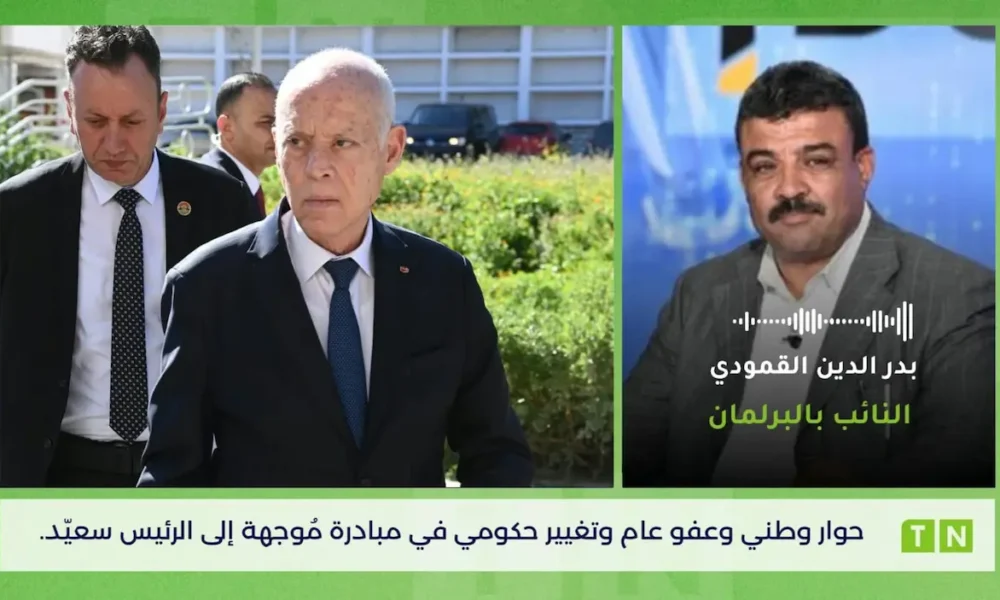
The deputy in the Assembly of the People’s Representatives, Badreddine Gammoudi, one of the signatories of an open letter addressed to the President of the Republic Kaïs Saïed and to public opinion, explained in an exclusive statement to Tunisia Digital that this initiative does not target a particular political or social component, but is addressed to all forces and sensitivities of Tunisian public opinion.
The stated objective is to push for the opening of a global process of national reform, through a series of political, economic, social, and institutional proposals.
The letter, dated September 6, 2026, says that Tunisia is going through, according to its authors, a phase marked by “political tension” as well as economic and social risks requiring urgent measures.
Six signatories
The document bears the signatures of Badreddine Gammoudi, Lassâad Dhaouadi, Moez Haj Mansour, Larbi Beji, Jamel Aouididi and Mehdi Barbouch.
According to Badreddine Gammoudi, the initiative also targets national figures, academics, representatives of the people in the various representative bodies, and components of civil society and politics.
It is, in his view, to allow these different parties to contribute, each from their position, to the search for solutions to the difficulties and challenges facing the country.
A proposed change of government
Politically, the letter notably proposes the departure of the government of Sarra Zaafrani Zenzri and its replacement by a government formed of political and administrative competencies with a “national reference,” according to the document’s terms.
The signatories also advocate changes at certain decision-making centers within administrations they describe as “sensitive.”
A general amnesty and a reform of penal policy
On the legal and judicial front, the authors call for a general amnesty that would include, according to the wording in the document, “prisoners of opinion and political prisoners” as well as ordinary detainees.
They, however, propose excluding from this measure those involved in terrorism cases and in serious crimes.
The letter also calls for a revision of penal policy and for greater use of alternative penalties.
Taxation, customs and criminal reconciliation
Economically, the signatories propose a tax, customs, and social amnesty, as well as a relief of the tax burden.
They also call to accelerate penal reconciliation procedures and to revise several laws, notably those concerning the fight against money laundering, foreign exchange, and customs.
The document also recommends integrating the informal economy more into the formal circuit and revising the authorization system as well as what the signatories call “rent mechanisms.”
Badreddine Gammoudi explained in this context that the initiative also aims at reforming the tax, penal, and financial systems, as well as a better management of financial resources and a strengthening of the principles of good governance.
Banks, interest rates and the Central Bank
The banking sector is also among the main facets of the letter.
The signatories call for restructuring the banking sector, lowering interest rates, and strengthening the oversight exercised over banking and financial institutions as well as over insurance companies.
They also propose replacing the Governor of the Central Bank, arguing, in their assessment, that he has not managed to change the existing situation.
Oil, gas, salt and phosphate
Regarding natural resources, the letter calls for opening and auditing the files related to oil, gas, salt, and phosphate.
It also proposes revising the Hydrocarbons Code and the Mining Code to guarantee, according to its authors, “the supreme national interest.”
The document also mentions measures concerning the management and exploitation of water resources as well as freshwater sources.
Gammoudi believes that the management of natural wealth and financial resources is one of the major axes of the reform process advocated by the initiative.
Irregular migration and the Nationality Code
The letter also addresses the migration issue.
The signatories propose tightening the measures related to irregular migration as well as a revision of the Nationality Code.
Badreddine Gammoudi, for his part, spoke of the need to adopt a balanced migration policy within an approach that takes into account, in his view, national interests and current challenges.
The economic relationship with the European Union in question
On the external economic front, the authors of the letter call for developing a new strategy for managing the association agreement between Tunisia and the European Union.
Among the options discussed are the revision of this agreement or a possible withdrawal, depending on the content of the letter.
The signatories also propose working towards the State reclaiming previously privatized public enterprises.
Such measures, if adopted, would however require specific legal, institutional, and economic procedures.
Reforming the administration and strengthening the fight against corruption
Public administration reform also occupies an important place in the document.
The signatories propose, in particular, the establishment of job descriptions for public servants, as well as the strengthening of control mechanisms, accountability, and the fight against corruption.
The letter also calls for the creation of an ombudsman institution and an organization tasked with fighting illicit enrichment.
It also advocates strengthening the protection of whistleblowers and implementing reward mechanisms in their favor.
Badreddine Gammoudi emphasized that the reform of the administration and the strengthening of governance are, according to the initiators, two pillars of the reform process sought.
“Deep and rapid” reforms in education and health
In the social sectors, the authors call for “deep and rapid” reforms in education and health.
The stated objective is to preserve these two sectors as public services accessible to citizens.
Gammoudi also considers that their development must be part of the priorities in order to respond to social challenges and improve the performance of public services.
A call for dialogue with national competencies
The letter also calls for establishing a process of consultation and dialogue between the President of the Republic, national competencies, and personalities that the signatories present as not involved in financial corruption cases.
According to Badreddine Gammoudi, the goal is to open a national dialogue involving different competencies and national forces to develop a common vision that, in his view, would preserve the sovereignty of the State, strengthen stability, and foster development and social justice.
Gammoudi: “It is premature to determine the presidency’s position”
Asked about a potential reaction from the Presidency of the Republic to this initiative, Badreddine Gammoudi said that the letter had, in his assessment, generated a wide echo among different components of public opinion.
He believes that this reaction signals a strong willingness to overcome the difficulties and challenges facing the country.
Regarding the Presidency, however, he stated that “it is premature to determine its position regarding this letter.”
The initiators therefore await to see whether decisions or measures will be taken in response to the issues and proposals they have formulated.
The September 6, 2026 letter presents all of these measures as a political, economic, and social vision aimed, according to its authors, at addressing the risks and challenges that Tunisia faces.