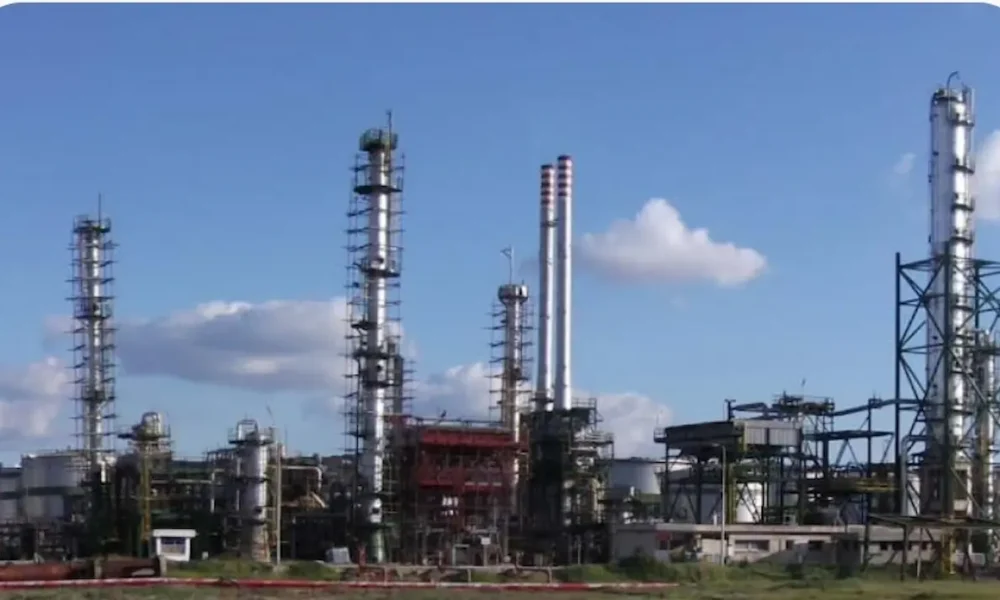
The country’s only refining unit, the refinery operated by the Tunisian Company for Refining Industries (STIR), constitutes the industrial backbone of the national oil value chain.
Located in Bizerte, it handles the processing of crude oil and supplies the domestic market with petroleum products in a context marked by the ongoing erosion of local production.
In 2024, the volumes of crude oil refined stood at 1.1 million tonnes, or about 21,000 barrels per day, a stable level compared with 2023, despite the shutdown of the atmospheric distillation unit for sixty days. This operational resilience comes as the national crude oil production fell by 13% year on year, to 28,500 barrels per day.
Growth in Refined Products Production
With a nominal capacity of 34,000 barrels per day, the refinery covers nearly 30% of the country’s needs for petroleum products. The balance is supplied by imports, underscoring the critical role of the refining tool in controlling the energy bill and securing supplies.
Despite the contraction of local resources, Tunisia recorded in 2024 a 9% increase in its production of petroleum products. The total volume reached 1.15 million tonnes compared with 1.06 million a year earlier.
This dynamic is mainly driven by the rise in diesel production, up 15% to 477,000 tonnes, and fuel oil, up 7% to 338,000 tonnes. Naphtha production also jumped 29% to 291,000 tonnes. By contrast, liquefied petroleum gas fell 19% to 21,000 tonnes, while white spirit rose 23% to 10,000 tonnes.
This industrial evolution occurs in a context of recovering domestic demand. National consumption of petroleum products rose 3% to reach 4.55 million tonnes. Demand for gasoline increased 9% to 870,000 tonnes, and diesel demand by 6% to over two million tonnes, reflecting the rebound in transport activities and the recovery of the services sector.
Increased Dependence on Crude Imports
The refinery’s operation relies almost exclusively on imported crude. In 2024, oil from Azerbaijan accounted for 74% of refined volumes, compared with 55% in 2023. The share of domestic crude was limited to 26%.
This concentration of supply sources increases the country’s exposure to geopolitical swings and tensions in international markets. It thus reinforces the urgency of consolidating national refining capacities to reduce energy vulnerability.
Tunisian imports of petroleum products reached 3.92 million tonnes in 2024, up 7% from 2023. Diesel dominates external purchases with 1.07 million tonnes, followed by gasoline at 899,000 tonnes, with a strong annual increase.
Meanwhile, petroleum product exports rose by 24% to stand at 612,000 tonnes. This performance reflects an improvement in the utilization rate of the facilities and the refinery’s ability to valorize potential surpluses when operating conditions allow.
Industrial Modernization and Skhira Project
In response to these challenges, the Tunisian Society of Refining Industries continues a modernization program of its units and upgrading of its safety systems and environmental compliance, in synergy with international refining standards. The objective is twofold: to improve energy efficiency and reduce operating costs while limiting the environmental footprint.
In parallel, Tunisian authorities plan the creation of a new refinery at Skhira. This structuring project aims to increase the national processing capacities, reduce reliance on imports of refined products, and rebalance the energy balance. Beyond the energy issue, the expected investment should stimulate employment and energize the logistical and industrial fabric in the south of the country.
In a context of persistent volatility in international prices and increasing pressure on public finances, refining appears as a key instrument of economic sovereignty. Strengthening the Bizerte refinery and the realization of the Skhira project constitute the two major axes of a national strategy aimed at sustainably securing supplies and controlling the energy bill.
The efforts undertaken by the authorities reflect a clear intention to reposition the refining sector at the heart of energy policy, with the aim of strengthening economic resilience and structurally reducing Tunisia’s external dependence.