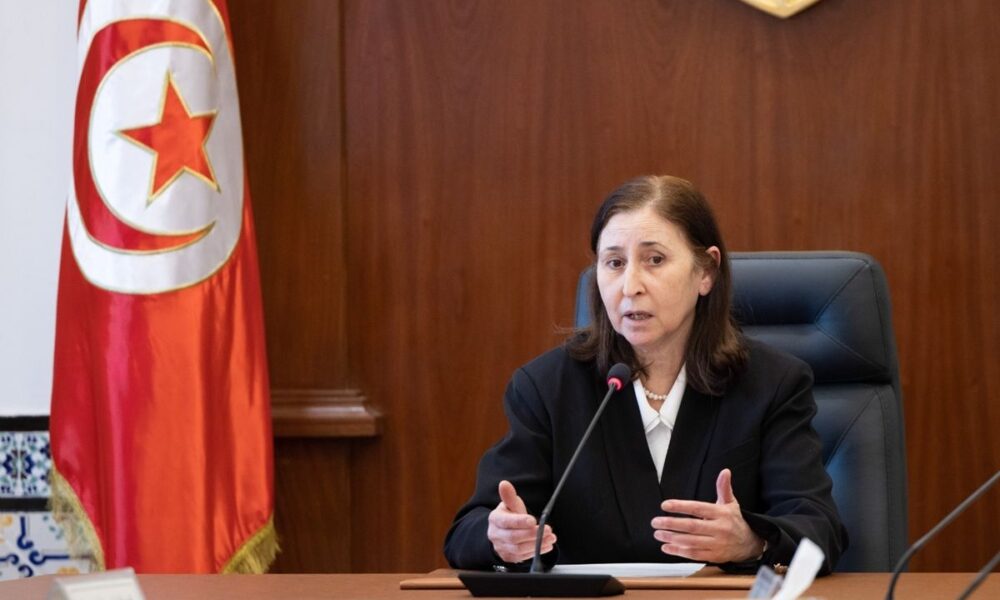
Gathered on Thursday, October 8, 2026 at La Kasbah, chaired by the head of government Sarra Zaafrani Zenzri, the Commission on Major Projects examined the progress of six structuring dossiers: the reconstruction of the El Menzah Olympic Stadium, the expansion of the Borj El Amri power plant, the protection of the Sidi Bou Said hill, the rehabilitation of Bir Ali Ben Khalifa regional hospital, the expansion of Tunis-Carthage airport, and the deep-water port with its logistics zone at Enfidha.
Beyond the announcements, the question now is the transition to procurement, to construction works and to commissioning. The six projects are not at the same stage, and public information does not yet provide, for each of them, a comparable level of physical progress.
The Essentials
• The Commission announced decisions regarding contract awards, notably for the reconstruction of El Menzah Stadium by a Chinese company and for the protection works on the Sidi Bou Said hill.
• At Borj El Amri, the electrical extension represents 250 to 400 MW more capacity for an estimated cost of 600 million dinars, with a target commissioning in summer 2027.
• Tunis-Carthage is projected to reach 18.5 million passengers per year, with an envisaged budget envelope of around 3 billion dinars.
• At Enfidha, the port and logistics complex covers 3,000 hectares and public documents indicate a potential of 52,000 jobs.
El Menzah: the dossier enters the works procurement phase
The reconstruction project of the El Menzah Olympic Stadium has been monitored for several months by the Commission on Major Projects. A memorandum of understanding had been concluded with the Chinese side for a complete reconstruction of the stadium, preserving its historic architecture and modernizing its main components: playing field, stands, track, electronic equipment and related infrastructures.
In February 2026, the Commission had also approved the award of a technical assistance mission to a multidisciplinary design office to accompany the project.
The 8 October press release marks a new step: the Commission indicates that it has made a decision regarding the award of the reconstruction works contract to a Chinese company. The name of the company, the final contractual amount and the detailed schedule of the project have, however, not been specified in the public release.
Borj El Amri: 600 million dinars and up to 400 MW extra
The Borj El Amri plant extension aims to strengthen the national electricity production capacity. The project notably involves installing a third gas turbine with a power output between 250 and 400 MW, as well as the necessary works to evacuate the produced electricity.
Its provisional cost is estimated at 600 million dinars, and the objective announced by the Presidency of the Government is to bring it into operation by summer 2027.
The project comes as national electricity demand grows, according to data presented to the government, by 4 to 5 % per year. A peak of 6,400 MW was recorded in July 2026, compared with 5,175 MW in 2025.
The schedule is therefore a central point of the dossier: if the summer 2027 target is maintained, the realization and equipment procedures will have to advance within particularly tight timelines.
Sidi Bou Said: a decision on the protection works contract
The protection of the Sidi Bou Said hill against landslides is also among the reviewed projects.
During 2026, a steering commission was set up to monitor the studies and the necessary interventions. Preparatory work focused notably on diagnosing the hill and identifying urgent operations.
The 8 October release indicates that the Commission on Major Projects has decided on the award of the protection works contract. However, the final cost, the duration of the works and the precise execution schedule were not published in this release.
Bir Ali Ben Khalifa: a hospital still under prioritized oversight
In Bir Ali Ben Khalifa, in the Sfax governorate, the dossier concerns the rehabilitation of the regional hospital.
The establishment has been the subject of public scrutiny for several years. A 12-bed field hospital was installed in particular to maintain certain services during the rehabilitation operations.
The Commission on Major Projects had already asked to accelerate the necessary procedures to enable full operation of the hospital. The 8 October release confirms that the dossier remains under government oversight, but it provides neither an updated physical progress rate, nor a consolidated cost, nor a new delivery date.
Tunis-Carthage: aiming for 18.5 million passengers
The Tunis-Carthage airport expansion project is among the heaviest on this list. The program aims to raise its capacity to 18.5 million passengers per year by 2031.
The announced scheme includes a new terminal with a capacity of about 11 million passengers per year, the renovation and partial extension of the existing terminal to reach about 7 million passengers, and the development of Terminal 2 to add about 500,000 passengers.
The projected total cost announced for the program is around 3 billion dinars. The project was included in the 2026 investment budget of the Office of Civil Aviation and Airports.
According to publicly available data, Tunis-Carthage handles more than 7.2 million travelers per year and accounts for around 60 % of traffic at Tunisian airports. The final capacity sought would therefore represent a major scale-up for the country’s main aviation hub.
Enfidha: 3,000 hectares for a port and a logistics zone
The Enfidha deep-water port project and its logistics services zone is an old project, but remains presented as one of the major projects capable of redefining Tunisia’s position in Mediterranean maritime flows.
The planned complex covers 3,000 hectares — 1,000 hectares for the port zone and 2,000 hectares for the economic and logistics zone.
The site has access to waters up to 19 meters deep. The updated scheme foresees a first phase including 2,000 meters of container terminal, followed by a second tranche of 400 meters, with a later extension linked to activity development.
Official documents project a potential of up to 52,000 direct and indirect jobs for the port and logistics complex. The project must also be connected to road, highway and rail networks.
The 8 October meeting confirms that the dossier remains included in the monitoring of major projects. The main point to monitor will now be the translation of procedures into an operational implementation timetable.
Six projects, but six different stages of advancement
El Menzah Stadium
Decision regarding the award of the construction contract to a Chinese company.
Borj El Amri
250 to 400 MW additional, 600 MD, objective of operation during summer 2027.
Sidi Bou Said
Decision regarding the protection works contract against landslides.
Bir Ali Ben Khalifa
Rehabilitation monitored at government level, without a detailed progression rate published on 8 October.
Tunis-Carthage
18.5 million passengers targeted and around 3 billion dinars of provisional investment.
Enfidha
3,000 hectares, container terminal in several phases and 52,000 potential jobs announced.
The real indicator will now be execution
The 8 October meeting provides procedural progress for El Menzah and Sidi Bou Said and keeps four other major projects under government monitoring. However, it still does not allow a uniform comparison of their progress.
To truly measure the announced acceleration, four pieces of information will be decisive for each dossier: the actual start date of the works, the final contract amount, the physical progress rate, and the commissioning date.
It is on these indicators, more than on the number of meetings or announcements, that the realization of these major public investments can be assessed in the coming months.