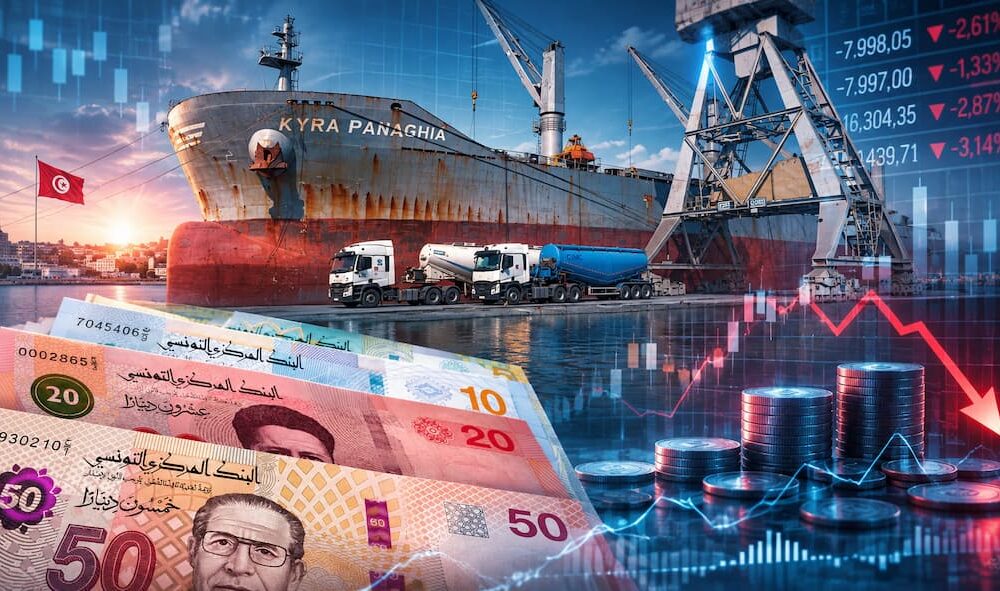
A single figure changed sign in the annex to the 2027 finance bill, and it says more than many speeches on public sector reform.
For the first time in the period observed, public enterprises owe the State more than it owes them. This reversal is less a bookkeeping victory than a revelation: it exposes how the public power and its operators lend to, owe to, and adjust with one another without ever truly settling accounts.
A financial relationship that reversed itself in two years
The annexed report to the 2027 finance bill covers a sample of 39 companies. Their debt to the State reaches 10,027.7 million dinars at the end of 2025, up 6.6% over one year and 28.5% since 2023. Over the same period, their receivables from the State shrink, from 12,435.9 million in 2023 to 9,598.9 million in 2025.
The scissors effect is striking. In 2023, these companies were net creditors of 4,634.2 million. The gap narrows to 2,486.6 million in 2024, then the line is crossed: they are now net debtors of 428.8 million. The movement thus does not come from a single side of the balance sheet. The State has more to recover and less to pay, or at least to acknowledge.
Three actors account for almost the entire story
Behind the average, concentration is striking. Fifteen companies account for about 90% of the debt. The National Pension and Social Welfare Fund bears 4,453.0 million, i.e., 44.4% of the total, against receivables of only 77.0 million. Its net balance, of 4,376.0 million, alone surpasses the sample’s overall balance. In other words, without the fund, the whole would be a net creditor of about 3,900 million.
On the other side sit STEG and STIR. The former holds 3,505.1 million in receivables for a debt of only 55.5 million, the latter 2,311.1 million in receivables for a debt of 130.1 million. Together, they concentrate more than 60% of the state’s receivables. A simple calculation shows that their combined net positions, close to 5,600 million, weigh more heavily than the fund’s net deficit. The final balance thus rests on a precarious equilibrium between a large debtor and two large creditors.