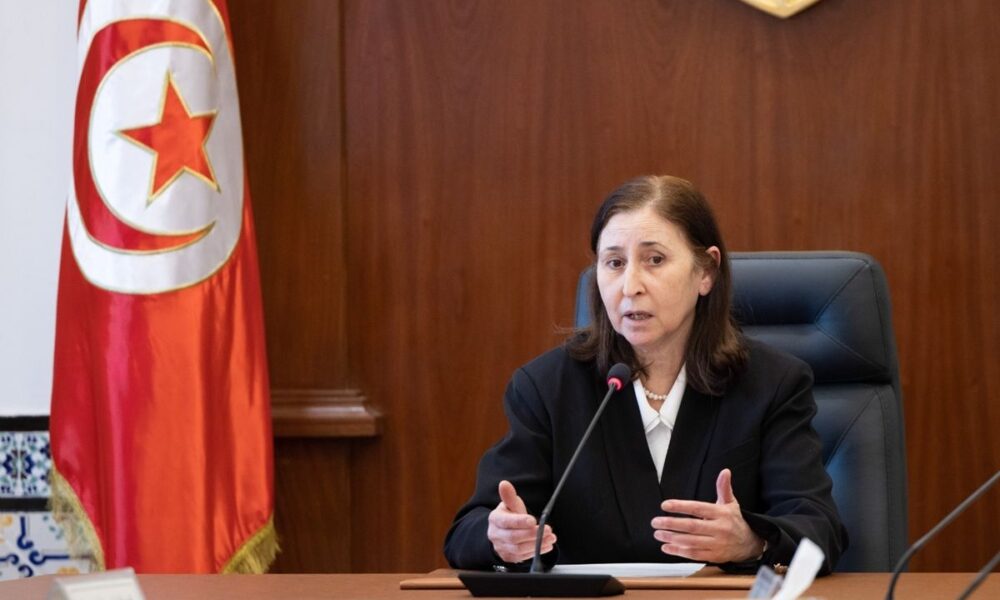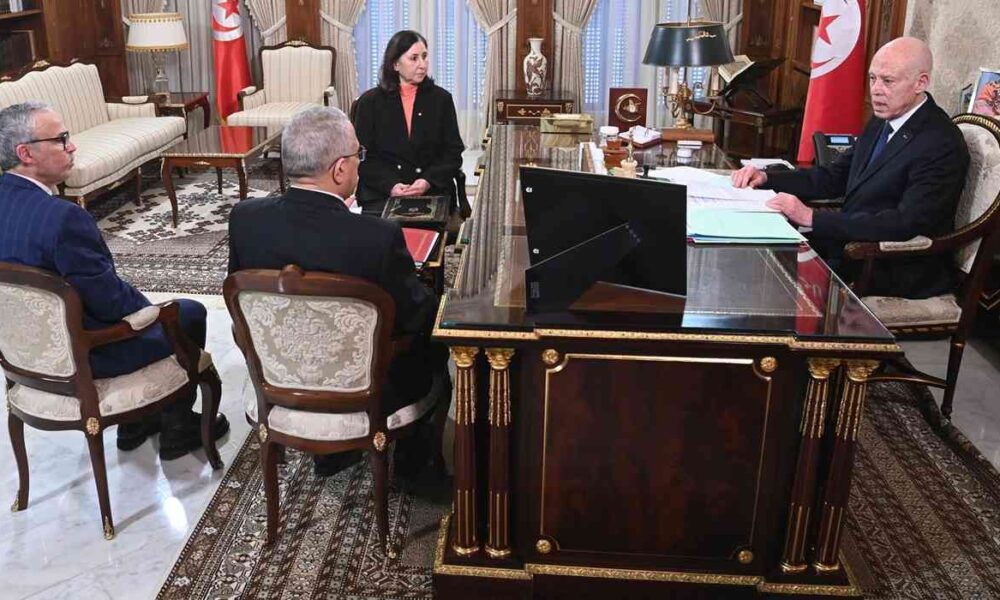
The President of the Republic, Kaïs Saïed, convened in the afternoon of March 25 at the Carthage Palace, the head of government Sarra Zaafrani Zenzri, the Minister of Health Mustapha Ferjani, and the Minister of Social Affairs Issam Lahmar, to take stock of the health sector’s situation and the growing difficulties faced by citizens in accessing care and medicines.
This meeting follows the visit by the Head of State to the clinic of the National Social Security Fund in El Omrane as well as to the central headquarters of the Centrale Pharmacy. During this visit, Kaïs Saïed became aware of the reality of health services and the obstacles faced by patients, notably in obtaining essential and specialized medicines.
The President of the Republic noted the shortage observed and the repeated stockouts of several medicines, a situation that imposes added burdens on patients and further complicates their care. He stated that these difficulties cannot be addressed through ad hoc or limited solutions, but require a new approach to social security and health coverage, grounded in greater justice and equity.
Kaïs Saïed also considered that public health structures are today themselves suffering, due to, in his view, blockages, degradations and accumulations inherited from the past. He thus advocated for a break with the causes of this situation and for the implementation of a vision of deep, coherent, and comprehensive reform, capable of restoring the public health service to its full capacity to meet the expectations of Tunisians.
In this context, the Head of State insisted on the necessity to firmly fight against all forms of corruption and mismanagement in the pharmaceutical sector, which he described as vital due to its direct link to the health of citizens. He called to strengthen control and inspection mechanisms, while betting on greater transparency through the generalization of digital systems enabling tracking of medicine distribution circuits and better framing their management.
The President of the Republic also gave instructions to immediately secure the financial credits necessary for the Centrale Pharmacy, so that it can restore a normal pace of market supply. He also stressed the importance of building a strategic stock of medicines, especially for vital and specialized products, to limit the risk of shortages in the future.
Beyond emergency management, Kaïs Saïed highlighted a broader issue: reducing Tunisia’s external dependence in the pharmaceutical sector. He recalled that the country possesses many competencies, capable not only of training but also of producing and exporting. For the Head of State, the development of the local pharmaceutical industry thus constitutes a strategic choice, likely to strengthen Tunisia’s international standing while meeting domestic market needs.
Through this meeting, the executive thus places the reform of the health system, the securing of medicine supplies, and the valorisation of Tunisian skills at the heart of its priorities, in a context where social expectations remain particularly strong.