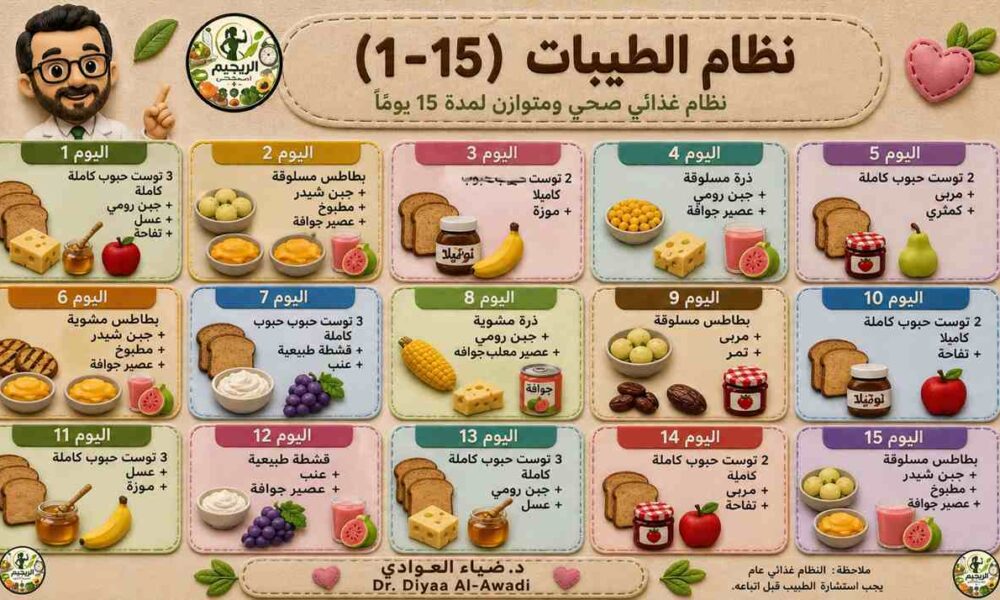
It begins like many contemporary phenomena: a simple promise, a convincing video, a word that reassures. Tayyibat. The “good things.” The term speaks to religious imagination, to the nostalgia for a purer diet, to the desire to take back control of a tired body.
Born in Egypt around the physician Dhia Al Aouadi, now deceased, the “Nidham Al-Tayyibat” has established itself on social media as a dietary method believed to purify the body, reduce inflammation, improve diabetes, relieve digestive disorders. It divides foods into “good” and “bad,” promises a return to more natural eating, and appeals precisely because it seems to offer a clear answer to complex sufferings.
But that’s often how deviations begin: not with an absurd idea, but with a seductive idea pushed too far.
Better eating is self-evident. Reducing industrial products, listening to one’s body, correcting eating excesses: no one can seriously oppose it.
The problem arises when this lifestyle becomes a doctrine, when a diet becomes a truth, when eating begins to replace medicine.
This drift is what doctors fear today.
In Tunisia, the cardiologist Dhaker Lahidheb reported a case that says it all. A patient arrives at the consultation with a blood sugar around 5 g/L and chest pains evocative of an angina pectoris. Her condition had previously been stabilized. In talking with her, the doctor discovers that she is following the “tayyibat” regime and that she has mainly stopped her insulin injections. She will be treated urgently and will need a coronary stent placement.
It is no longer a matter of opinion. It is no longer a quarrel between nutritionists. It is the precise moment when a dietary belief enters dangerous territory.
The danger of the “tayyibat” does not lie only in what it allows or forbids. It lies in the absolute confidence it installs. Some foods are sacralized. Others are diabolized. Entire categories may be excluded: eggs, dairy products, legumes, poultry, raw vegetables. Conversely, some fats or meats are rehabilitated with a confidence that medical literature does not always share.
But the real breaking point lies elsewhere: in the idea that a well-nourished body could do without essential medications.
For a diabetic patient, stopping insulin can be dramatic. For a kidney patient, refusing dialysis can be fatal. For a cardiac patient, a brutal change in diet or abandoning medical follow-up can accelerate the crisis that one thought to be avoided.
Why, then, do so many people believe in it?
Because modern medicine heals, but sometimes explains poorly. Because chronic patients are tired of their prescriptions, their tests, their side effects, their appointments. Because a cautious doctor says: “it depends.” And a viral discourse asserts: “here is the solution.”
Social networks love certainties. They prefer anecdote to study, a tale of recovery to nuance, a shock phrase to medical recommendation. A patient who says “I’m feeling better” becomes more convincing than a scientific protocol. A video shared a thousand times ends up resembling proof.
Religious framing adds a particular force. The word tayyibat gives the regime emotional depth. It speaks not only to the stomach, but to faith, to identity, to the need for purity. From then on, criticism becomes difficult. Questioning the regime may be wrongly seen as questioning a religious value. While it is simply a reminder of one simple thing: a sacred word does not transform a nutritional hypothesis into validated treatment.
This phenomenon also reveals a wider flaw in our societies. When trust in medical institutions falters, other authorities appear: influencers, videos, Facebook groups, family testimonies, charismatic figures. They speak more simply. They promise more. They do not require waiting for the results of a study. They offer hope immediately.
And that is precisely where the danger lies.
The “tayyibat” regime is not dangerous because it invites people to eat better. It becomes dangerous when it creates a substitute illusion: replacing the doctor with an influencer, treatment with a list of foods, caution with certainty, science with a promise.
For Tunisia, the signal is clear. What circulates in Cairo or Alexandria reaches Tunis, Sfax, or Sousse very quickly. Health borders are no longer geographical. They are digital. A dangerous medical advisory can cross country borders faster than an official alert.
So it is not about despising those who follow this regime. Many sincerely seek to get better. Many are exhausted. Many want to believe that there is a simpler, more natural path, less burdensome than chronic illness.
But compassion must not become complacency.
Eating better can accompany a treatment. It does not replace it. A balanced diet can help a diabetic. It does not miraculously remove their need for insulin. A healthy lifestyle can protect the heart. It does not dissolve a blocked artery.
The line is there. It is simple, but essential.
Health can listen to traditions, faith, experience, and nature. But when a life is at stake, it must remain tied to evidence, diagnosis, and medical follow-up.
The “tayyibat” promises to reconcile the body with what is good. One must not forget what saves.