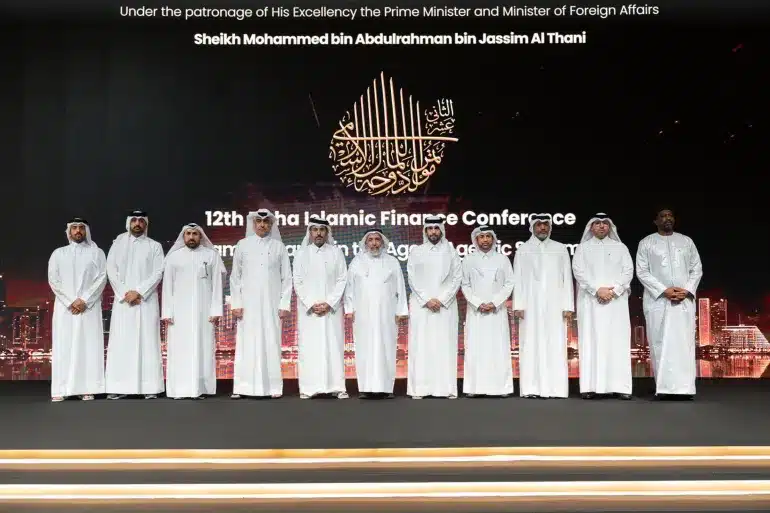
The 12th Doha Congress on Islamic Finance opened on Tuesday, June 16, 2026 around a question that is set to become central for banks, investors and supervisory authorities: how far can an artificial intelligence act on behalf of a financial institution, and who is responsible for its decisions when it makes a mistake?
Organized under the theme “Islamic Finance in the Age of Agentic Systems,” the gathering in Doha brings together jurists, Sharia experts, financial executives, regulators and researchers in artificial intelligence.
The program notably includes the legal and religious qualification of autonomous agents, smart contracts, sukuk, waqf management, zakat and the new responsibilities created by systems capable not only of analyzing data, but also of taking and executing certain decisions.
At the time of writing, no final detailed recommendations had yet been published by the organizers. The various legal qualifications mentioned in this briefing therefore correspond to questions submitted to the congress and the reflection tracks presented in its program, and not to definitive decisions already adopted.
A international meeting at the Sheraton Grand Doha
The congress takes place in the Al Majlis Hall of the Sheraton Grand Doha, under the patronage of the Prime Minister and Qatari Minister of Foreign Affairs, Sheikh Mohammed bin Abdulrahman bin Jassim Al-Thani.
It is organized by Bait Al-Mashura Financial Consultations, in strategic partnership with Dukhan Bank.
The event also enjoys the support of the Qatari Ministry of Commerce and Industry, the General Directorate of Waqfs at the Ministry of Religious Affairs, the Qatar Financial Centre and the Beema Islamic insurance company.
This institutional presence reflects the growing weight of technological topics in a sector seeking to combine innovation, operational efficiency and compliance with the principles of Islamic finance.
Launched in 2010 under the aegis of Bait Al-Mashura, the forum has gradually established itself as a venue for discussions on the regulatory, economic and technological transformations of the sector.
A growing industry expected to rise 5 to 10% in 2026
Khalid bin Ibrahim Al-Sulaiti, chairman of the organizing committee and vice-chairman of Bait Al-Mashura, placed the debates in the context of sustained growth in Islamic finance.
According to estimates from S&P Global Ratings cited by the organizer, the global Islamic finance industry is expected to grow by 5 to 10% in 2026, with a possible acceleration still in 2027.
Global assets of the sector reportedly reached around $4,400 billion in 2025, rising by 13.4% year over year, according to data from the Islamic Financial Services Board reported by the organizers.
Between 2020 and 2025, the sector is said to have posted an average annual growth rate of 10.3%, representing about $1,700 billion in additional assets.
This growth naturally attracts technology companies. But it also obliges players in Islamic finance to define their own rules before autonomous systems are adopted at scale.
What is agentic artificial intelligence?
A conventional generative artificial intelligence typically answers a question, writes a text, summarizes a document or produces a recommendation.
The so-called “agentic” AI goes further.
It can receive a general objective, break a mission into several steps, consult different sources, select an action, use external software and execute certain operations without waiting for a new human instruction at each step.
In a financial institution, a digital agent could for example:
- analyze a client’s situation;
- verify their eligibility for financing;
- compare several products;
- prepare a draft contract;
- monitor compliance with risk limits;
- trigger a pre-authorized operation;
- monitor the execution of a contract;
- alert a supervisor in case of an anomaly.
This relative autonomy changes the nature of the problem.
The question is no longer only whether a bank can use an algorithm. It is necessary to determine whether it can delegate to that algorithm part of its decision-making and execution power.
Can the digital agent be equated with a wakala?
Among the main questions submitted to the congress is the possibility of aligning agentic AI with the wakala.
In Islamic finance, the wakala is a contract of mandate: a person or an institution entrusts another party with the task of carrying out a determined operation on their behalf.
The analogy seems, at first glance, natural. A digital agent receives a mission, acts within a defined perimeter and executes instructions on behalf of a bank or a client.
But this comparison immediately raises several difficulties.
An artificial intelligence has neither moral will, nor consciousness, nor its own property. It cannot therefore be held responsible as a natural or legal person.
Responsibility should remain attached to the human and institutional actors who designed, parameterized, authorized or used it.
The qualification could also vary depending on the case.
A system that automatically transmits a payment order does not have the same role as an agent authorized to choose an investment, to negotiate a price or to modify a portfolio strategy.
The debate is therefore less about attributing legal personality to the machine than about the precise definition of its mandate and its limits.
How far can delegation go?
Several criteria will have to be examined to frame the action of an intelligent agent:
- the exact mission entrusted to it;
- the maximum amount it can commit to;
- the products to which it can access;
- decisions that require human validation;
- conditions under which an operation can be suspended;
- the possibility of reversing a decision;
- the traceability of executed actions;
- the responsibility in case of error or breach.
A bank could, for example, authorize an agent to draft a contract without allowing it to finalize it.
It could also entrust it with the execution of simple operations, while keeping human approval for major financings, disputes, restructurings or cases involving high risk.
The more autonomy granted to the machine, the stricter the governance rules must be.
Are smart contracts automatically compliant?
The congress must also examine the place of smart contracts, or smart contracts.
These programs automatically execute an operation when predetermined conditions are met.
A smart contract can, for example, distribute revenues, transfer an asset, trigger a payment or apply a penalty without manual intervention.
Technically, this automation can reduce delays, administrative errors and execution costs.
But technology alone does not guarantee compliance with Sharia.
A contract automated in this way can remain problematic if it rests on:
- an impermissible activity;
- an interest akin to riba;
- excessive uncertainty;
- disproportionate speculation;
- an unjust distribution of risks;
- unbalanced contractual terms.
The takeaway is this: technology can automate a contract; it does not automatically render it lawful.
The code must therefore faithfully reproduce a contract previously deemed compliant, and not substitute for legal and religious reasoning.
The intelligent sukuk among the main themes
The congress program places significant emphasis on intelligent sukuk and automated operations.
Sukuk are financial securities structured according to Islamic finance principles and typically backed by identifiable assets, revenues or projects.
The use of blockchain and artificial intelligence could enable:
- to automate certain steps of issuance;
- to facilitate investor registration;
- to track the use of funds;
- to automatically distribute revenues;
- to strengthen asset traceability;
- to reduce certain administrative fees;
- to broaden access to markets.
An agent could also monitor compliance with financial commitments, signal an anomaly or verify that funds remain allocated to the announced project.
But blockchain does not eliminate risks.
A transaction recorded transparently can remain legally or religiously contestable. The quality of the register does not guarantee the asset’s legitimacy, the contract’s fairness, or the sincerity of the economic structure.
Waqfs in the face of automation
The congress also dedicates a portion of its work to waqfs.
The waqf refers to an asset permanently dedicated to a religious, social, educational or public-interest purpose. Its revenues can, for example, fund a mosque, a school, a hospital, students or vulnerable families.
Agentic systems could contribute to:
- inventory assets;
- analyze their returns;
- control rents;
- anticipate maintenance needs;
- detect unusual expenditures;
- track beneficiaries;
- improve revenue distribution;
- verify compliance with conditions set by the founder.
Coupled with a blockchain, artificial intelligence could enhance the traceability of decisions and financial flows.
But a waqf often adheres to precise conditions set by its founder. Translating these into computer rules requires great caution.
A misinterpretation by the system could modify the allocation of revenues or unfairly exclude certain beneficiaries.
The nadhir, i.e., the human waqf administrator, should therefore remain at the heart of legal and religious responsibility.
Zakat and automated decisions
The program also contemplates discussions on zakat and sustainable development.
AI could be used to:
- analyze data of taxpayers or donors;
- identify potential beneficiaries;
- detect duplicates;
- improve distribution;
- measure social impact;
- automate certain verifications;
- enhance transparency of collected funds.
But zakat decisions directly affect the economic and social situation of people.
An algorithmic error could exclude an eligible household or, conversely, allocate resources to a beneficiary who does not meet the conditions.
Therefore, effectiveness cannot replace the right of appeal, human verification and consideration of particular situations that data do not always describe correctly.
Explainability, a condition of trust
One of the major challenges lies in the ability to explain the machine’s decisions.
A bank cannot simply tell a client: “the system refused your financing.”
It must be able to specify:
- which data were used;
- which criteria weighed in the decision;
- whether an error can be corrected;
- who can re-examine the file;
- which person or which institution bears the final responsibility.
This requirement is particularly important in Islamic finance, where compliance depends not only on the economic outcome but also on the contract’s structure, intention, risk sharing and the nature of the financed activity.
An AI that cannot be audited could therefore contradict the transparency and accountability requirements that the sector claims to defend.
The risk of a widespread error
Intelligent agents promise faster execution of operations.
This speed also represents their main danger.
A human error may affect a limited number of cases. An error embedded in an automated system can affect thousands of transactions within a few seconds.
Risks include notably:
- programming errors;
- incomplete or biased data;
- cyberattacks;
- external manipulations;
- unexplainable decisions;
- operations incompatible with religious rules;
- automatic execution of a poorly designed contract.
Safeguards must therefore be built in from the design: financial ceilings, graduated authorizations, logging of decisions, regular controls, alerts and immediate-stop mechanisms.
Koutoub Moustapha Sano and the complementarity between man and machine
Among the announced speakers is Koutoub Moustapha Sano — also rendered Qutb Mustafa Sano —, Secretary-General of the International Academy of Islamic Fiqh.
The debates in which he participates focus in particular on the religious rules applicable to intelligent agents and on the need to articulate technological innovation and human responsibility.
The central idea is one of complementarity.
Artificial intelligence can accelerate analysis, improve oversight and automate certain operations. It does not replace the judgment of the jurist, the regulator, the religious compliance committee or the bank officer.
Technical autonomy must not become an absence of responsibility.
What this could mean for Tunisian banks
For Tunisia, these debates are not theoretical.
Islamic banks and specialized windows could use agentic AI to:
- analyze financing dossiers more quickly;
- control Murabaha contracts;
- check schedules;
- detect anomalies;
- assist advisors;
- prepare responses for clients;
- monitor compliance of operations.
In a Murabaha operation, for instance, an agent could verify documents, the acquisition price, the disclosed margin, the due dates and the chronology of transfers.
But it should not be able to freely modify essential conditions or singly approve a complex arrangement without human oversight.
Takaful companies could also automate part of claims handling, fraud detection or file management.
Waqf managers could improve monitoring of assets, rents and beneficiaries.
Regulatory questions Tunisia will have to decide on
Before large-scale deployment, several questions will need to be clarified by the legislator, the Central Bank of Tunisia and the competent authorities:
- What is the legal value of a contract executed automatically?
- Who is responsible in case of an algorithm error?
- Can the client challenge an automated decision?
- What data can be used?
- How to protect bank secrecy?
- What role for religious compliance committees?
- How far can an institution delegate a decision to a machine?
- How to audit an agent developed by a foreign supplier?
- What happens when a technically correct decision is religiously contestable?
Tunisia cannot simply import software designed for other legal systems.
It will have to build rules compatible with its banking law, its data privacy legislation, its control mechanisms and the specifics of its market.
An opportunity to cut costs, but not to remove humans
Artificial intelligence can help Tunisian institutions speed up processing, reduce some repetitive tasks and improve the quality of control.
But its main benefit does not necessarily lie in eliminating jobs.
In a sector where trust, explainability and compliance are essential, the most credible model remains that of collaboration between the machine and the professional.
The agent can prepare, compare, verify and flag.
The human supervisor must continue to approve sensitive decisions, respond to the client and bear the consequences of the operation.
No final recommendations published yet
At the time of writing, the organizers had published the program, the congress objectives, the topics addressed and the names of several speakers.
No detailed final document had yet been released to confirm an official position on the qualification of agentic AI as wakala, the religious validity of smart contracts or the final distribution of responsibilities.
It is therefore important to distinguish clearly:
- the questions discussed during the congress;
- the analyses presented by the speakers;
- the final recommendations that may be published after the close.
This caution is particularly important when it comes to legal and religious rules that could influence the practices of banks and investors.
A question more important than the technology itself
The Doha Congress poses a question that goes beyond Islamic finance.
As systems become capable of acting, negotiating and executing operations, institutions must decide which responsibilities they are willing to entrust to them.
The real issue is therefore not to determine whether artificial intelligence can technically act on behalf of a bank.
It is to know how far it can act, under what rules, with what controls and under whose responsibility.
The answer will not come from code alone, nor from law alone, nor from religious jurisprudence alone.
It will require a durable dialogue between computer scientists, lawyers, regulators, finance professionals and Sharia specialists.