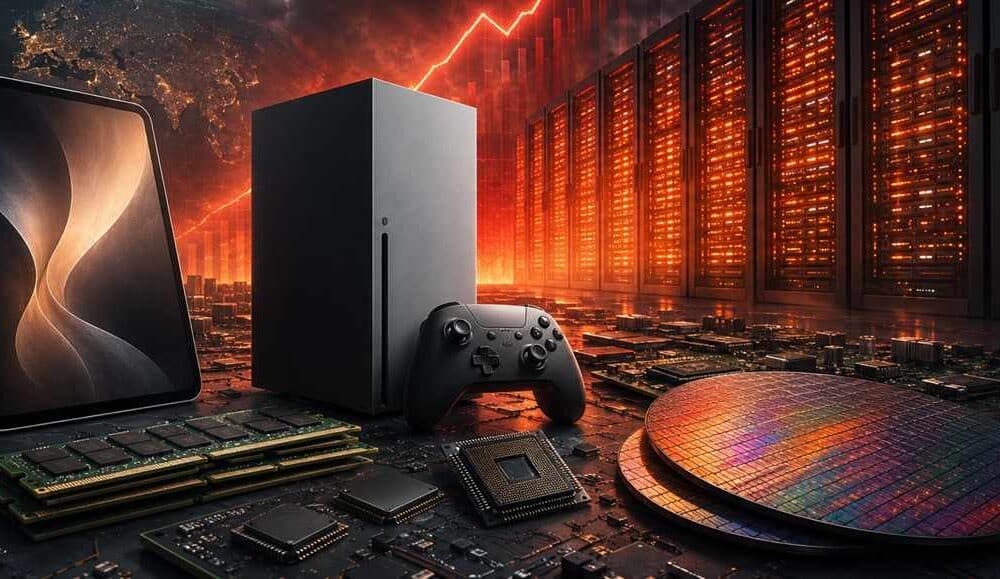
The global race for artificial intelligence is beginning to show directly on consumers’ wallets. After months of surging memory component prices, Apple and Microsoft have raised the prices of several flagship products, from iPads to Macs, including the Xbox consoles.
Behind these increases lies the same cause: the global shortage of memory and storage chips, fueled by the surge in demand from AI-dedicated data centers. Memory manufacturers, pressed by cloud giants and AI processor producers, are redirecting an increasing portion of their capacities toward the most profitable clients, at the expense of consumer electronics.
The result is now visible in stores: devices that had long benefited from a gradual decline in technological costs are becoming more expensive.
Apple raises prices on iPads and Macs
Apple kicked off by raising prices on several ranges, notably the iPads, the Macs, some home devices, and the Vision Pro headset. The iPhone, the Apple Watch, and the AirPods are for now spared, but several analysts believe the move could extend to other products at upcoming launches.
The base iPad thus moves from $349 to $449, a rise of $100. The iPad Pro increases by $200. The MacBook Air climbs from $1,099 to $1,299, while the 14-inch MacBook Pro goes from $1,699 to $1,999. In the high end, the Mac Studio M3 Ultra jumps from $3,999 to $5,299, a rise of $1,300, roughly 33%.
Apple says it can no longer absorb alone the explosion of memory and storage costs. The company says it has never faced such a rapid price increase for a strategic component. Its chief, Tim Cook, had already prepared minds by comparing the memory market situation to an exceptional shock for the industry.
Market reaction was immediate. Apple’s stock fell noticeably after the announcement, signaling that investors fear an impact on demand, especially in a context where consumers are already price-conscious for electronics.
Microsoft raises Xbox prices from August 1
A few hours after Apple, Microsoft announced a global price rise for its Xbox consoles, effective from August 1, 2026.
The 512 GB models will increase by $100, while the 1 TB models will add $150. Microsoft also announced the gradual discontinuation of its 2 TB model.
The group justifies this decision by a surge in memory and storage costs. According to Microsoft, these components now cost more than 2.5 times as much as before, and a new doubling is expected by autumn 2027.
The price hike is particularly noticeable for consoles, because this market operates with thinner margins than smartphones or computers. Consoles are often sold at a price close to, or even below, their manufacturing cost, with manufacturers recouping later through games, subscriptions, and services.
In this context, Microsoft believes it can no longer absorb the shock of components alone.
Memory becomes the nerve of the AI war
The heart of the crisis lies in volatile memory and storage. DRAM memory, indispensable to computers, smartphones, consoles, servers, and graphics cards, is experiencing a dramatic rise.
According to TrendForce, conventional DRAM contract prices surged by about 93 to 98% in the first quarter of 2026, quarter over quarter, with a new rise expected of 58 to 63% in the current quarter.
This pressure is explained by the rise of AI data centers. AI models require massive volumes of high-performance memory, notably HBM, used alongside Nvidia processors and other specialized accelerators.
The major global memory suppliers — Micron, Samsung Electronics, and SK Hynix — are now prioritizing AI customers, more profitable and ready to sign long-term contracts to secure their supplies.
Micron confirms a lasting crisis
Micron’s recent results confirm the scale of the phenomenon. The American group, the only major memory maker based in the United States, benefits directly from this AI-oriented demand surge.
Micron announced it had secured $22 billion in customer commitments to guarantee memory chip deliveries. These deals, with 16 strategic customers spanning data centers, consumer electronics, and automotive, provide firm purchase commitments, cash deposits, and floor prices; for fourteen of them, they represent a minimum guaranteed revenue of about $100 billion over the duration of the contracts.
Its CEO, Sanjay Mehrotra, estimates that supply tensions are likely to persist beyond 2027, driven by AI-induced demand and structural production constraints.
In other words, the current crisis is not merely a temporary imbalance. It could mark a durable reconfiguration of the global memory market.
Smaller manufacturers more exposed
Apple and Microsoft possess considerable negotiating power and substantial financial reserves. But not all electronics manufacturers can absorb such cost increases.
The more fragile companies, particularly in cameras, connected devices, computer accessories, or specialized equipment, are far more exposed. GoPro’s case illustrates this vulnerability: the action camera maker warned that the brutal rise in memory costs, estimated between 80% and 115%, posed a significant risk to its ability to continue normal operations.
The memory chip crisis therefore does not only affect tech giants. It also threatens an entire ecosystem of smaller manufacturers, already weakened by competition and by declining demand in some segments.
An AI bill presented to consumers
For two years, artificial intelligence has been presented as a promise of productivity and innovation. This crisis reveals the other side: a massive pressure on infrastructures, energy, data centers, and components. The companies building AI are buying increasing quantities of memory, servers, and processors, drawing a share of global production and pushing up prices for all other sectors.
For decades, tech had habituated consumers to a simple logic: more power and storage, at a stable or decreasing price for the same performance. The current crisis reverses this trend. The rise of iPads and Xboxes is therefore not a mere commercial adjustment: it signals that AI is not only transforming software and usages, it is redesigning global industrial supply chains. For households as for businesses — PC fleets, mobile terminals, professional hardware — upcoming electronics purchases could cost more.
Until now, this battle was fought among industries. Now, the bill is no longer kept within data centers: it arrives on store shelves.