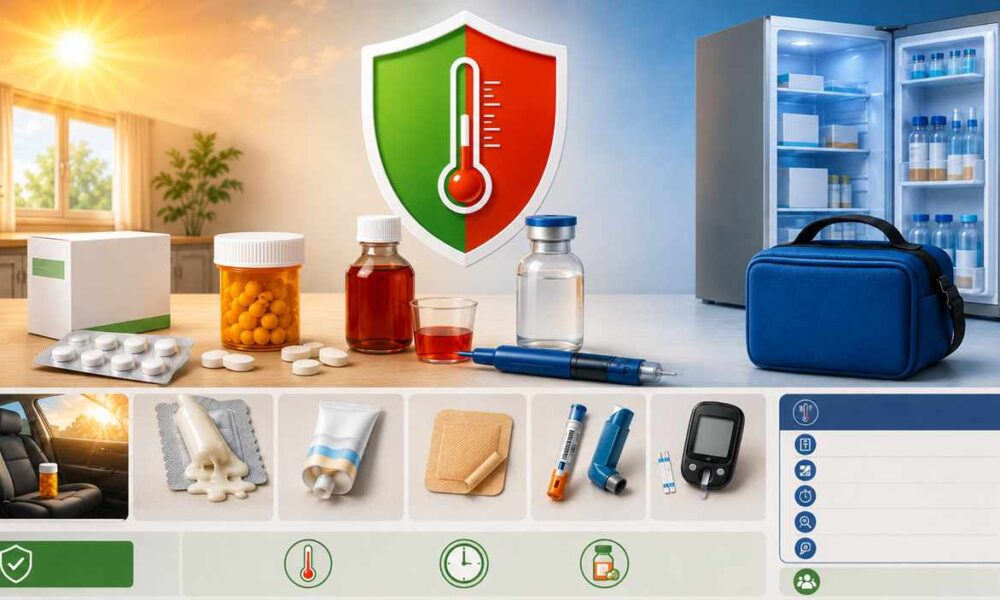
When the thermometer rises above 40 °C, the same questions reappear in homes: are my medicines still usable? Should I throw away a box left in a overheated room, insulin taken out of the refrigerator, or a treatment left forgotten in the car?
In most cases, there is no need to discard medicines immediately. Tablets and capsules that are properly stored generally withstand a temporary rise in temperature better than one might think. Vigilance is mainly needed for refrigerated products, liquids, injectables, medicines whose appearance has changed, and certain medical devices.
The essentials in two minutes
Do not throw everything out as a precaution, but do not continue to use blindly a product exposed to heat either. Keep the packaging, note the approximate temperature and duration of exposure, then seek advice from the pharmacist if in doubt.
What generally withstands heat best: tablets and capsules kept in their original packaging, in a closed cabinet, away from sunlight and in the coolest room of the home.
What requires particular vigilance:
- medicines that must be kept between 2 and 8 °C, including certain insulins, certain vaccines and injectable biologics;
- liquids, oral solutions, drops, syrups, vials and injectable products;
- products whose appearance has changed: melted suppositories, separated creams or cloudy solutions;
- epinephrine auto-injectors, pressurized inhalers, test strips and glucose meters;
- some medical patches, as heat can increase the amount of medicine absorbed rather than decrease its effect.
The number one trap is the car exposed to the sun. The cabin and the trunk can become much hotter than a room. No medicine should be left there during the summer.
During a power outage, keep the refrigerator door closed, do not place medicines directly against ice, note the start and end times of the outage, and do not discard a vital treatment before obtaining professional advice or a replacement solution.
The four checks to perform
- the exact name of the medicine;
- the storage conditions listed on the box or the leaflet;
- the approximate temperature reached;
- the duration of exposure.
A plain tablet kept two days in a shaded cupboard is not equivalent to insulin or an injectable biologic left in full sun. The following sections detail the product-by-product differences.
“Store at below 25 °C” does not mean danger at 27 °C
This label does not mean that a tablet automatically becomes unusable as soon as the room reaches 27 or 30 °C. A temporary rise in temperature over a few days, or even a few weeks, generally does not alter unopened medicines stored under normal domestic conditions.
Stability testing of these products may include prolonged exposure to temperatures close to 40 °C. This tolerance should not automatically be extended to opened products, refrigerated medicines, or those left in a car, behind a windshield, on a sunny balcony, or near a heat source.
The correct interpretation
The temperature printed on the packaging is a storage guideline, not an instant destruction threshold. The duration, intensity, and conditions of exposure all matter.
The cold chain: the most sensitive category
Medicines labeled “store between 2 and 8 °C” require the greatest vigilance. Depending on the product, this category may include unopened insulin, vaccines, injectable hormones, biologic treatments for inflammatory diseases, certain anticancer therapies, fertility products, and some reconstituted antibiotic suspensions.
These products must stay in the refrigerator, not touching the freezing compartment, the coldest wall, or a cold pack, as freezing can also damage them.
There is no single rule valid for all refrigerated medicines. Some tolerate several hours or days outside the refrigerator, while others have much stricter limits. It is therefore necessary to check the exact product name, the temperature reached and the duration of exposure in the leaflet or with the pharmacist.
Insulin: the treatment to monitor as a priority
Unopened insulin is generally stored between 2 and 8 °C. After opening or use, many insulins can be kept out of the refrigerator for a limited period, often up to 25 or 30 °C. This duration varies depending on the insulin, the pen, and the manufacturer.
Excessive heat can gradually reduce its effectiveness. A blood glucose level that remains abnormally high despite usual doses should prompt closer monitoring and seeking advice.
Insulin that should be clear but becomes cloudy, colored, or contains particles should not be used. Altered insulin can, however, still appear normal: appearance alone does not prove that it remains fully effective.
Do not throw away a vital insulin without a replacement solution
In an emergency, an indispensable supply of insulin may have to be used temporarily until a replacement properly stored is obtained. Monitoring should be intensified and professional advice sought quickly.
Products whose appearance has changed
Heat can visibly alter certain pharmaceutical forms:
- melted or deformed suppositories;
- softened vaginal suppositories;
- creams in which oil and water have separated;
- creams that have become grainy;
- gels whose texture or color has changed.
A visibly modified product should not simply be returned to the refrigerator and used as usual. A melted suppository may resolidify irregularly, and the active substance may no longer be evenly distributed.
Liquids warm up faster than tablets
Oral solutions, drops, syrups, vials and injectable products reach room temperature more quickly than solids. Uncontrolled exposure to temperatures above 40 °C is therefore especially concerning for liquids and medicines that must stay below 25 °C.
A bottle of tablets left in a hot room does not carry the same level of risk as an injectable solution left for several hours in a car heated by the sun.
Three special cases to know
Medication patches: heat can increase the amount absorbed
With certain transdermal patches, heat does not reduce effectiveness: it can increase the passage of the medicine through the skin. This precaution is particularly important with fentanyl patches and also applies to certain buprenorphine patches.
Hot water bottles, heating pads, electric blankets, saunas, steam rooms, very hot baths, and prolonged direct sunshine on the patch should be avoided. Never apply a second patch to compensate for poor adhesion without medical advice.
The epinephrine auto-injector: to be used in an emergency
Epinephrine auto-injectors should not be left in a hot car or exposed to direct sunlight. If the solution becomes abnormally colored or cloudy, a replacement should be requested.
However, in the event of a severe allergic reaction, the injection should not be delayed due to doubt about prior heat exposure. Use the available device and call emergency services immediately.
The pressurized inhaler: the medicine and the container are sensitive
Heat can degrade the product or its delivery mechanism and increase the pressure inside the canister. An inhaler that has become very hot, damaged, deformed or delivering an unusual dose should be shown to the pharmacist.
A person with asthma should not remain without rescue treatment while awaiting a replacement.
Glycemia equipment: the result may become unreliable
Test strips, control solutions and glucose meters are not medicines, but improper storage can lead to poor therapeutic decisions. Sunlight, heat, humidity and large temperature fluctuations can disrupt their operation.
If a result seems inconsistent with symptoms, re-measure with properly stored equipment before adjusting an insulin dose, or seek confirmation from a pharmacist, a laboratory or a health professional.
Excessive sweating can also reduce the adhesion of continuous glucose monitoring sensors.
Medicines and the sun: the risk of photosensitivity
Heat is not the only summer risk. Some medicines make the skin more sensitive to sunlight. Gels containing ketoprofen can cause serious skin reactions when treated areas are exposed to sun, even if shaded, or to ultraviolet rays.
The treated area should remain covered for the entire treatment and for two weeks after stopping it. Other medicines, including certain antibiotics and anti-inflammatories, can also cause photosensitivity. Consult the package insert in the section on precautions.
Do not confuse an altered medicine with a medicine that worsens the effects of heat
A medicine can be perfectly stored and still become harder to tolerate during a heatwave. Diuretics, laxatives and some antiepileptics can promote dehydration or electrolyte imbalances. Anti-inflammatories, certain antihypertensive treatments and some diabetes medications can increase kidney risk when a person is dehydrated.
This never justifies stopping a prescribed treatment without professional advice. Any adjustment should be decided by a doctor or a pharmacist.
A suspicion of heat stroke is a medical emergency
A very high body temperature, confusion, seizures or loss of consciousness require calling emergency services. Paracetamol (acetaminophen), aspirin and non-steroidal anti-inflammatory drugs do not treat heat stroke and should not replace urgent medical care.
What to do during a power outage?
- keep the refrigerator door closed as much as possible;
- do not place medicines directly against ice or a frozen pack;
- note the approximate start and end times of the outage;
- check the refrigerator temperature if a thermometer is available;
- consult the leaflet or the pharmacist with the exact product name;
- do not discard a vital treatment before arranging its replacement.
There is no universal number of hours beyond which all refrigerated medicines must be discarded. The decision depends not only on the duration of the outage, but also on the product involved, the reached temperature and its specific storage guidelines.
Signs that should lead to stopping and seeking advice
- a change in color;
- a solution that has become cloudy when it should be clear;
- the appearance of particles or crystals;
- a cream or suspension whose components have separated;
- a melted and deformed suppository or ovule;
- a swollen, cracked or damaged packaging;
- a deformed inhaler or a malfunctioning mechanism;
- an abnormally high blood glucose despite usual insulin doses;
- a meter reading that does not match the symptoms.
A lack of visible change does not always guarantee that effectiveness remains intact, especially for insulin, biologics and injectable solutions.
The right decision in case of doubt
The right reflex is neither to continue blindly nor to throw everything away. Keep the packaging, note the exposure conditions, and ask the pharmacist, who can check the product’s stability data or contact the manufacturer.
For a vital treatment, you should arrange replacement before discarding the existing stock.
What to remember
A heatwave does not automatically render medicines unusable.
Tablets and capsules that are properly stored are generally the most resistant.
Refrigerated products, liquids, injectables, altered creams and suppositories, epinephrine auto-injectors, pressurized inhalers, medication patches, and glycemia equipment require more vigilance.
The best reflex is to keep the packaging, note the temperature and duration of exposure, then seek advice from the pharmacist before discarding a medicine.
Important : this article provides general information and does not replace individualized medical or pharmacist advice. Do not stop or modify a prescribed treatment without professional advice.