« Screen time that’s good for health» : the CEO of Nex Playground, a gaming console mainly intended for children and very popular across the Atlantic, now wants to attract a European market increasingly sensitive to the screen time of the youngest.
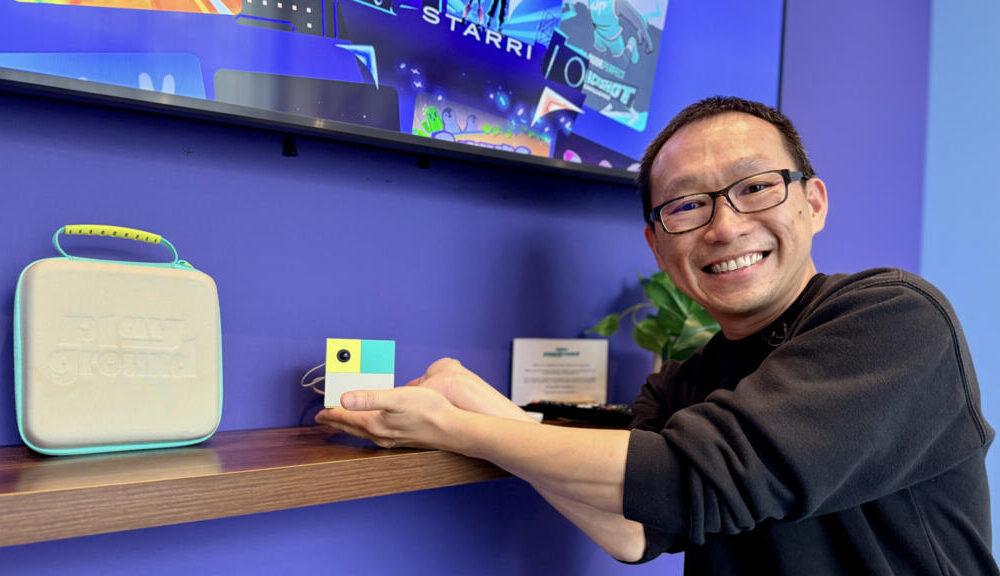
While in Cologne, Germany this week for Gamescom, the largest European video game trade show, the boss and cofounder of the California-based company, David Lee, came to present his creation: a small yellow and blue plastic cube, equipped with a camera that uses artificial intelligence and devoid of controllers.
The player interacts with the console by moving and waving the arms and legs, slicing virtual fruits with a flick of the hand or reproducing dance steps.
Dubbed “motion gaming,” this technology enjoyed a heyday in the early 2010s on Microsoft’s Xbox with Kinect, a similar device that sold tens of millions of units and has since fallen into disuse.
But “not all screen time is the same,” says to AFP this former Apple employee who left to found his own company in 2017.
With its console, he claims to offer “active screen time that is good for health.”
Launched in 2023 in the United States, Nex Playground sold 5,000 units in its first year, then 150,000 units the following year.
In November 2025, it caused a surprise by briefly surpassing Microsoft’s Xbox Series sales in the United States, one of the three giants in the sector alongside Sony and Nintendo, establishing itself as one of the flagship toys of the holiday season in North America.
Less powerful and cheaper – initially sold for $250 before tax, its price has since risen to $299 due to the higher RAM memory price – this console has since crossed the one-million sales mark.
For its launch in the United Kingdom and Ireland in June, the company, which employs around 200 people, signed several partnerships, notably with the BBC, to develop titles around animated series such as Bluey and Peppa Pig.
But to reach non-English-speaking markets, the company must translate games and the interface into the country’s language, the console being primarily aimed at families with children aged 3 to 12.
That is why it will not reach the German market until the end of the year, then “potentially next year” in France.
Many European countries are seeking to reduce young people’s exposure to screens. A 2024 report thus recommends strongly limiting access to screens for children under six, while a committee of experts must deliver its conclusions by the end of the year on the potential risks of video games for minors.
The company also notes that the console, which also offers a subscription service to access around sixty games, contains no advertising, no micro-transactions, nor online chat.