On the 196th day of the war between the United States and Iran, and 87 days after the signing of the memorandum of understanding between Washington and Tehran, no crisis exit strategy is in sight. Donald Trump rules out the prospect of a rapid diplomatic breakthrough, while a regional meeting is due on Monday in Oman to try to secure navigation in the Strait of Hormuz.
In the markets, Brent ended the week at $104.61 a barrel and the effects of the conflict are now directly affecting American drivers: gasoline hovers around $4.30 per gallon and diesel has just surpassed a historic high above $6.
Diplomacy nonetheless regains a central place around the Hormuz Strait. Tehran has announced for Monday a meeting in Oman with Iraq and the other Gulf littoral states to examine the results of the Iran-Oman discussions devoted to establishing secure navigation routes for commercial ships.
According to the Financial Times, the meeting should take place in Salalah, in the Sultanate of Oman, between the Iranian foreign minister and his Gulf counterparts. The objective would be to obtain a regional agreement around a temporary mechanism allowing to improve the flow of trade through the strait. Reuters notes, however, that it could not independently verify all the modalities of the meeting on Friday morning.
Hormuz: a very limited compromise attempt
The project discussed by Iran and Oman would notably consist of defining secure passages using Iranian and Omani waters.
But the difficulty remains political as much as maritime. Tehran insists that the strait cannot return to normal operation as long as the United States continues its blockade of Iranian ports and its military operations. Washington, for its part, refuses that Iran could impose unilateral control over an international maritime route essential to world trade.
On Friday, the spokesman for the Iranian Foreign Ministry, Esmaïl Baghaei, stated that his country remained « committed to ensuring the safety of navigation in the strait », while presenting the American economic and maritime blockade as a hostile act.
The contrast with the ground remains considerable. On Thursday, only seven ships had crossed Hormuz, compared with an average of 15 over the previous ten days and around 125 large commercial ships per day before the start of the war. These statistics, however, do not include vessels navigating with AIS location systems turned off.
The United States now organizes passage slots
Washington itself has adapted its military posture to this situation.
According to the Financial Times, the United States now asks oil carriers wishing to benefit most from American military protection to pass through Hormuz during specific time slots.
Since May, ships could request from the U.S. Maritime Coordination Center the coordinates of a route passing near the Omani coast, mainly during a broad nighttime time window.
In early September, this arrangement would have been tightened around two slots per day, with precise departure times, for example around 9 a.m. The shift to these times is not mandatory, but it is recommended to receive the best defensive coverage available.
The goal is simple: rather than scattering over twelve hours aircraft, surveillance assets, and air defense systems, the American forces can concentrate their capabilities around a limited number of convoys.
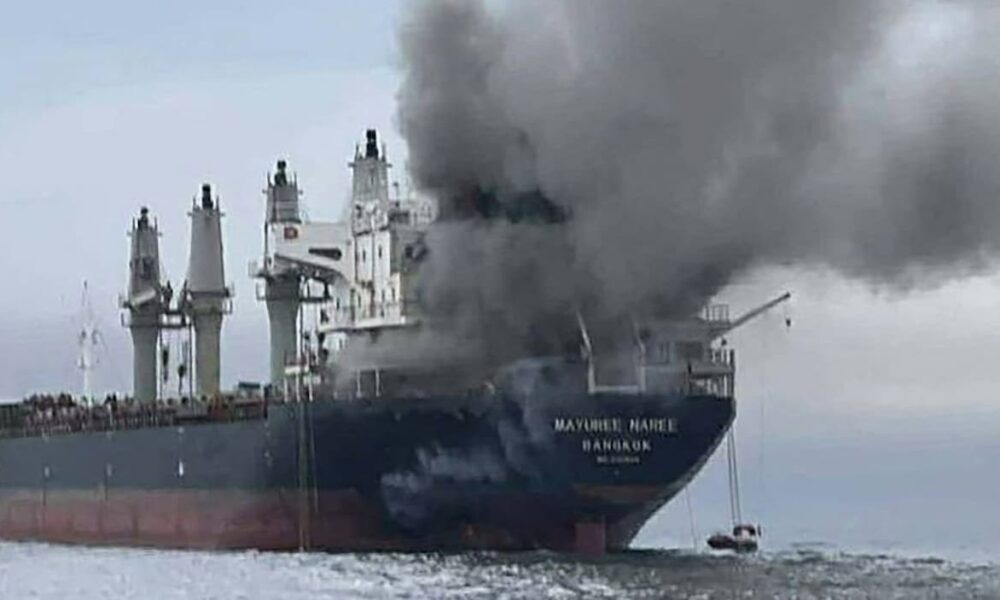
More than 70 commercial ships have nonetheless been attacked since the start of the conflict on February 28, according to the Financial Times.
99 ships redirected by the American blockade
The blockade imposed by Washington on Iranian ports constitutes the other side of this maritime battle.
CENTCOM said on Friday that American forces had redirected 99 commercial ships since the resumption of the blockade on July 14, to prevent them from entering or leaving Iranian ports.
This figure should be distinguished from the first phase of the blockade, applied from April 13 to June 18. During this period, CENTCOM says it redirected more than 140 ships, neutralized nine vessels refusing to comply, and allowed the passage of more than 50 ships carrying humanitarian aid.
Tehran presents the measures it is taking in the strait as a defensive response to this blockade.
The Guards have thus claimed this week an attack on an unmanned American vessel at the entry to Hormuz, stating that they hit a vessel bearing the number 5838 and thwarted what they call a “hostile mission.” The damages claimed by Iran have not been independently confirmed.
Trump does not regret the war
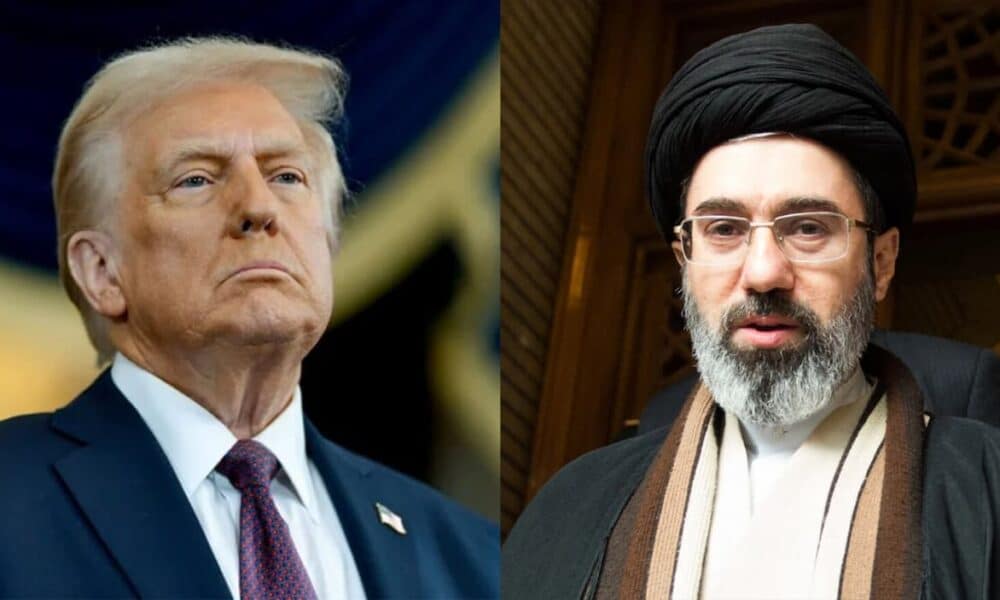
Donald Trump, for his part, ruled out the idea of a rapid pivot and stated that he does not regret his decision to involve the United States in the conflict.
Asked by Fox News, the American president said he would make the same decision “exactly” if he had to start again. He continues to justify the intervention by the need to prevent Iran from obtaining nuclear weapons. Tehran says that its nuclear program pursues peaceful objectives.
Trump had also suggested that the war might end after the U.S. midterm elections in November, while accusing Iran of trying to influence the American vote.
On the occasion of the 25th anniversary of the September 11 attacks, Donald Trump and Defense Secretary Pete Hegseth also publicly linked the campaign against Iran to the American fight against terrorism.
Washington accuses Chinese entities of aiding Iran
Another dimension of the conflict now concerns Iran’s targeting capabilities.
According to the Wall Street Journal, American officials believe that Iran obtained from non-governmental Chinese entities high-resolution satellite imagery of the Muwaffaq Salti air base in Jordan prior to the Iranian strike on July 17.
That strike killed three American service members and wounded four others, according to officials cited by the paper. Washington believes the images may have helped Iran select its targets and assess the results of its strikes.
American officials, however, do not say that the Chinese government directly participated in the operation. Beijing has asked Washington to produce evidence and rejects American accusations against Chinese companies.
Pentagon concerns now also extend to American military assets: according to officials questioned by the Wall Street Journal, Iran’s capabilities to locate and target moving targets may have improved over the summer.
Brent finishes at $104.61 after brushing $110
The main economic barometer of the crisis remains oil.
On Friday, Brent settled at $104.61 per barrel, down 2.8% on the session, while U.S. WTI finished at $100.05, down 2.4%.
This retreat came after the announcement of diplomatic initiatives around Hormuz. It should not mask the scale of the recent rise: Brent gained 8.7% for the week and WTI 9.4%.
Friday morning, Brent even reached $109.97, its highest level in four months, before slipping back following news about regional talks.
The problem is no longer limited to the price of crude oil. Hormuz disruptions, attacks on Saudi infrastructure, and tensions around Bab el-Mandeb have also driven up the costs of maritime transport.
The charter rate for a Very Large Crude Carrier between the Gulf of Oman and China reached approximately $11.50 per barrel transported, a record for this route since the introduction of this pricing benchmark.
In other words, even when a barrel is available, the cost of moving it rises sharply.
In the United States, gasoline nears $4.30 per gallon
The rise is now very visible to American consumers.
According to the AAA, the national average price for a gallon of regular gasoline stood at $4.295 on September 11.
A week earlier, it was $4.147. A month earlier, it stood at $4.012, and a year earlier at only $3.195.
In one year, gasoline has thus risen by about 34%.
This evolution is all the more unusual as American fuel prices have typically tended to ease after the summer period. The AAA instead notes a 13-cent increase in a week, directly linked to oil’s return to around $100.
The energy shock is also beginning to show up in inflation statistics: U.S. consumer prices rose by 0.4% in August, with a sharp rebound in the cost of gasoline. The annual inflation rate remained at 3.4%.
U.S. diesel crosses the $6 mark for the first time
The situation is even more spectacular for diesel.
According to the AAA, the national average price reached $6.0556 per gallon on September 11, versus $5.85 a week earlier, $5.32 a month earlier and $3.71 a year ago.
This is the highest average level ever recorded by the AAA, surpassing the previous record. Over a year, diesel has risen by more than 63%.
This rise goes far beyond the question of filling up a single vehicle. In the United States, diesel fuels many trucks, agricultural machinery, and industrial equipment. Its higher price can therefore transmit to transportation costs, to agriculture, and then to the prices of goods.
The White House considers an exceptional measure for refineries
Facing this pressure, the Trump administration is studying an unusual intervention.
According to Reuters, the White House is examining the possibility of using the Defense Production Act, a law allowing the federal government to mobilize industrial capacities deemed essential to national security, in order to increase American refining capabilities.
The idea would be mainly to improve throughput and expand existing facilities rather than rapidly building new refineries, a process that would take several years.
But the room for maneuver is limited: American refineries are currently operating at around 98% of their capacity, according to Reuters.
The diesel spike precisely illustrates this difference between crude oil and fuels: having crude is not enough. There must also be sufficient capacity to transform it into gasoline, diesel, jet fuel, or heavy fuel oil.
Why the Oman meeting is watched by the markets
The pullback in oil on Friday shows how sensitive markets are now to the slightest diplomatic signal.
The meeting planned for Monday in Oman is not, at this stage, a peace negotiation between Washington and Tehran. Its objective appears far more limited: to make commercial passage through Hormuz less dangerous and more predictable.
But even a technical agreement would have a significant economic impact.
Before the war, about one-fifth of world oil passed through the strait. Today, traffic there represents only a fraction of its usual levels.
For Tunisia, a net energy importer, the stake is directly economic. A Brent price sustainably above 100 dollars, added to high freight costs, can increase the energy bill and raise some transport and import costs.
The question in the coming days will thus be less about whether Oman can end the war than about whether it can rebuild enough trust in Hormuz to move more ships and ease energy price pressures