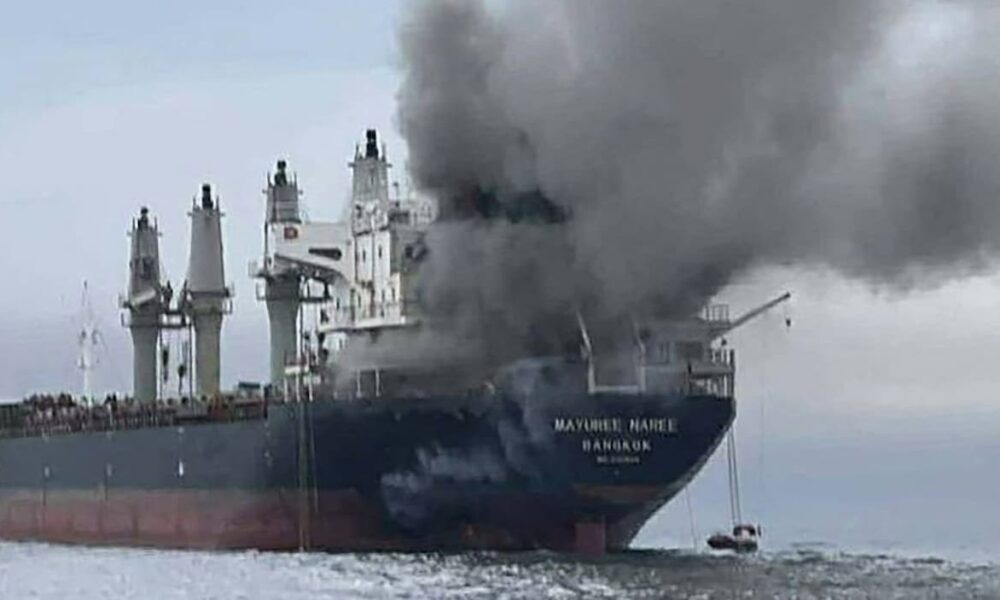
Saudi Arabia has temporarily closed its East-West pipeline after several drone attacks on Thursday, September 10. The incident hits precisely the main infrastructure allowing the kingdom to export several million barrels per day without passing through the Strait of Hormuz.
As Brent closed Friday at $104.61, the issue is not only the amount of oil temporarily blocked: the Gulf’s fallback routes are becoming, one after another, more vulnerable.
The Saudi East-West pipeline, also known as Petroline, runs across Saudi Arabia for about 1,200 kilometers. It transports crude from the eastern production regions to Yanbu, on the Red Sea.
Its function has become strategic since traffic through the Strait of Hormuz collapsed: it allows Riyadh to move its oil to a maritime frontage on the other side of the Arabian Peninsula, without passing through the strait.
In recent months, between 4 and 5 million barrels per day were transiting via this route, equivalent to about 4–5% of the world oil supply.
The attacks occurred on Thursday, the shutdown was announced on Friday
The Saudi Ministry of Energy specified that the pipeline had suffered several attacks in the morning of Thursday, September 10, in the Riyadh and Medina regions.
People were injured and the facility was halted as a precaution. Emergency teams and specialized technicians were sent to secure the sites and assess the condition of the installations.
The Saudi government has not provided a timetable for restoration.
According to information from the Wall Street Journal, several pumping stations may also have been damaged. This point is important: the duration of an outage depends not only on the state of the pipeline itself but also on the equipment needed to maintain pressure and circulate millions of barrels daily.
Riyadh says the drones that targeted the pipeline originated from Iraqi territory. No group had claimed responsibility for the attack at the time of the latest available information.
On Saturday, September 12, while speaking to journalists in Dublin, Donald Trump said he believed Iran was “probably” responsible. This is at this stage an accusation by the U.S. president, not an independently established attribution.
This was not a secondary route: it was the main Saudi bypass of Hormuz
The importance of Petroline becomes apparent when looking at Gulf geography.
The major oil terminals in eastern Saudi Arabia normally discharge into the Gulf. To reach global markets via this route, tankers must pass through Hormuz.
Before the war, the strait accounted for about a fifth of global oil flows. Since the onset of the conflict in late February, its functioning has been deeply disorganized. On Thursday, only seven ships had been recorded in transit, compared with about 125 large commercial ships per day before the war.
For Saudi Arabia, the East-West pipeline was therefore no longer simply a diversification infrastructure. It had become the main land route to bypass Hormuz and to deliver crude directly to the Red Sea.
Its closure deprives the kingdom of a crucial part of this substitution capacity at a moment when the traditional Gulf route remains heavily constrained.
Yanbu does not solve everything: another risky zone must be crossed
Getting the oil to Yanbu is only the first leg of the journey.
For shipments destined for Europe, the port’s position on the Red Sea allows routing north through the Suez Canal or using, depending on cargo configuration, the Egyptian SUMED system.
For Asian buyers, the natural route from Yanbu heads south through Bab el-Mandeb. Yet this second chokepoint has also become riskier due to Houthi operations in Yemen.
Lloyd’s List Intelligence already describes patterns that are far less efficient: some very large tankers partially load at Yanbu, head to Egypt, then complete their cargo at Sidi Kerir. These detours lengthen voyages and keep ships under way for longer.
The problem is particularly visible for cargoes bound for Asia: avoiding Bab el-Mandeb after loading at Yanbu requires a much longer and far more expensive route.
Bab el-Mandeb: a route that had never fully recovered
The Red Sea was already fragile well before this week’s events.
At the peak of the crisis triggered by the Houthi attacks from late 2023, traffic through Bab el-Mandeb had fallen by about 60% relative to its normal level.
A recovery had been sketched in 2026, notably because Saudi Arabia redirected more oil to Yanbu to escape Hormuz difficulties. But this recovery remained incomplete and the new threats from the Houthis have weighed on passages once again.
At the end of August, a very large tanker owned by Bahri, the Saudi shipping group, was notably struck by a projectile off Yanbu.
The Houthis’ recent advances toward Mokha and the strategic island of Perim, or Mayun, located in Bab el-Mandeb, now strengthen the uncertainty around this second maritime artery.
The problem in one sentence
Hormuz is heavily constrained; the pipeline that allowed bypassing it is halted; and the Red Sea to which this pipeline leads is itself exposed to attacks. These are the backup options that are gradually disappearing.
Why oil nonetheless fell on Friday
This accumulation of risks did not prevent prices from retreating in the last session of the week.
On Friday, the Brent closed at $104.61 per barrel, down 2.8% on the day. U.S. WTI finished at $100.05, down 2.4%.
For the week as a whole, the trend remains clearly higher: +8.7% for Brent and +9.4% for WTI.
Friday’s decline stems in particular from the emergence of a diplomatic outlook on the dossier that weighs heaviest on the market: the Strait of Hormuz.
Iran announced a regional meeting scheduled for Monday in Oman. The foreign ministers of the Gulf Cooperation Council countries are to meet their Iranian counterpart to discuss, in particular, a temporary arrangement to secure the passage of commercial ships.
According to available information, Oman and Iran have been working for several weeks on a circulation mechanism using passages in Iranian and Omani waters.
The variable to watch on Monday
A concrete breakthrough in Oman could lower the risk premium by allowing more passages through Hormuz. Conversely, a failure of discussions, combined with a prolonged Petroline shutdown, could revive concerns about supply as markets reopen.
A powerful counterweight: global demand is cooling
However, it would be excessive to conclude that all factors are now pushing oil in the same direction.
The International Energy Agency (IEA) has sharply cut its forecasts and now estimates that global oil demand should fall by 2.5 million barrels per day in 2026.
That would be one of the largest annual contractions since the major recent economic crises. High fuel prices, trade disruptions, and shortages of certain refined products are already beginning to erode some of the demand.
OPEC is less pessimistic. It still expects a rise in global demand in 2026 but has trimmed its forecast to only 380,000 barrels per day. This marks its fifth downward revision in a row.
The market is thus caught between two opposing forces: an output made more fragile by war and bottlenecks, and a demand that weakens under the very effect of higher prices.
This demand weakness can cap another surge in crude. It does not, however, eliminate the risk of sharp spikes in case of further infrastructure or flux losses.
Transportation costs are also rising significantly
The price per barrel tells only part of the energy shock.
The cost to charter a very large tanker between the Gulf of Oman and China reached about $11.50 per barrel transported, a record for this route since the creation of this benchmark.
In addition to military risks, there is the scarcity of available ships, detours, longer travel times, and the cost of hedging against war risks.
Even when oil exists physically, the necessary cost to bring it to the final customer rises sharply.
Why the pipeline shutdown truly changes the game
The Petroline shutdown does not mean the global market automatically loses 5 million barrels per day. Saudi Arabia has not announced the closure of all its production, and the pipeline is officially halted on a temporary basis.
The problem lies elsewhere.
A oil market can absorb a disruption when it has other routes, unused capacities, stocks, and available ships. These safety margins are precisely shrinking.
Hormuz is operating at a fraction of its usual level. Petroline, the main Saudi bypass, is shut. Bab el-Mandeb has returned to a high-tension zone. Freight costs are rising. And the IEA notes that global oil stocks have already fallen by 507 million barrels since February, i.e. an average drop of 2.8 million barrels per day.
It is this accumulation, rather than the shutdown of a single pipeline, that keeps the risk premium in oil prices.
Tunisia: Brent is $41 above the budget assumption
For Tunisia, this crisis concerns not only international markets.
The state budget for 2026 was built on an assumption of Brent at $63.3 per barrel.
At Friday’s close, at $104.61, the gap stood at $41.31 per barrel.
Wael Chouchane, the Secretary of State for Energy Transition, had said in March that each additional dollar to the average price of the barrel over a year represents about 164 million dinars of extra charges for the Tunisian budget.
This last figure is not an expense already borne by the state. It is an extrapolation to measure budget sensitivity. What matters for public finances is the actual average price observed over the year, as well as the evolution of the dinar, the imported volumes, and refined products.
The initial planning assumed around 4.993 billion dinars of energy compensation needs. In a scenario published previously, IACE estimated that an average Brent of $100 could lift these needs to about 10.85 billion dinars, i.e. nearly 5.86 billion dinars additional. Again, this is a scenario, not an actual expense yet recorded.
For Tunisia, the essential question is therefore not whether Brent will be $104 for one or two days. It is the duration for which oil stays well above the $63.3 budget assumption that will determine the real magnitude of the shock.
The meeting scheduled for Monday in Oman is thus almost as important for Tunis as for Riyadh: if it gradually reopens the circulation through Hormuz, pressure could ease. If it fails and Petroline remains immobilized, the oil market will head into a new week with even fewer backup routes.