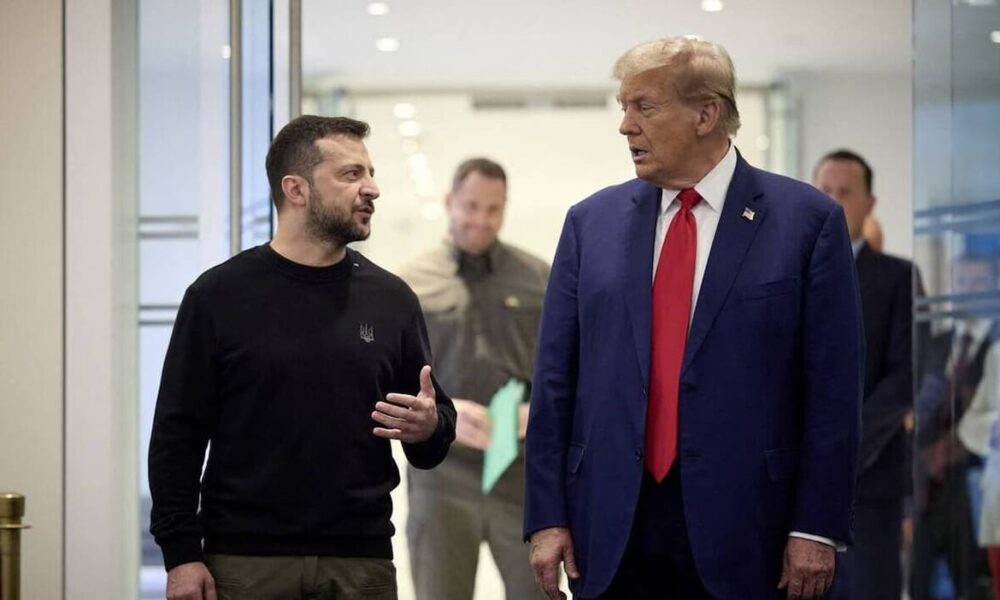
On Friday, Donald Trump signed into law a bill imposing new sanctions on Russia. The text targets in particular the Russian energy sector as well as Vladimir Putin and allows imposing tariffs on the five main countries importing Russian gas and oil.
The text constitutes the first major action by Congress against Moscow since the return to power of the American president. It bears the name of its principal promoter, the Republican senator Lindsey Graham, who died in July, a fierce defender of Ukraine and scourge of Russia and Iran. The law also has the ardent support of Ukrainian President Volodymyr Zelensky.
This new legislative arsenal targets for the first time the Russian ghost fleet, and also aims at President Vladimir Putin, as well as other senior Russian officials.
It gives in particular to Donald Trump, who has so far largely kept Moscow at bay, the power to impose tariffs of up to 100% on the five leading countries importing Russian gas and oil, including China and India.
A particular diplomatic context
The enactment of the law comes one week before a meeting between Donald Trump and Xi Jinping in Washington. The law had been passed Thursday by the House of Representatives, after having already passed the Senate, the other chamber of the American Congress, in August.
Trump signed the text shortly after, at least outwardly, restarting dialogue with Kiev and Moscow, where his emissaries Steve Witkoff and Jared Kushner recently visited.
The enacted law represents “an extremely powerful tool capable of bringing this terrorist war to an end and pushing Russia to make peace,” reacted Volodymyr Zelensky on X. “The sanctions must be severe so that all efforts toward peace — including our diplomatic efforts jointly with the United States, Europe, and our other allies — can bear fruit,” added the Ukrainian president.
In another development, the United States approved Friday a possible sale of $2.7 billion worth of air defense equipment to Ukraine, as Moscow intensifies its attacks against its opponent.
The sale would include missiles, missile launchers, anti-drone radars, and other armaments, the State Department said in a statement.