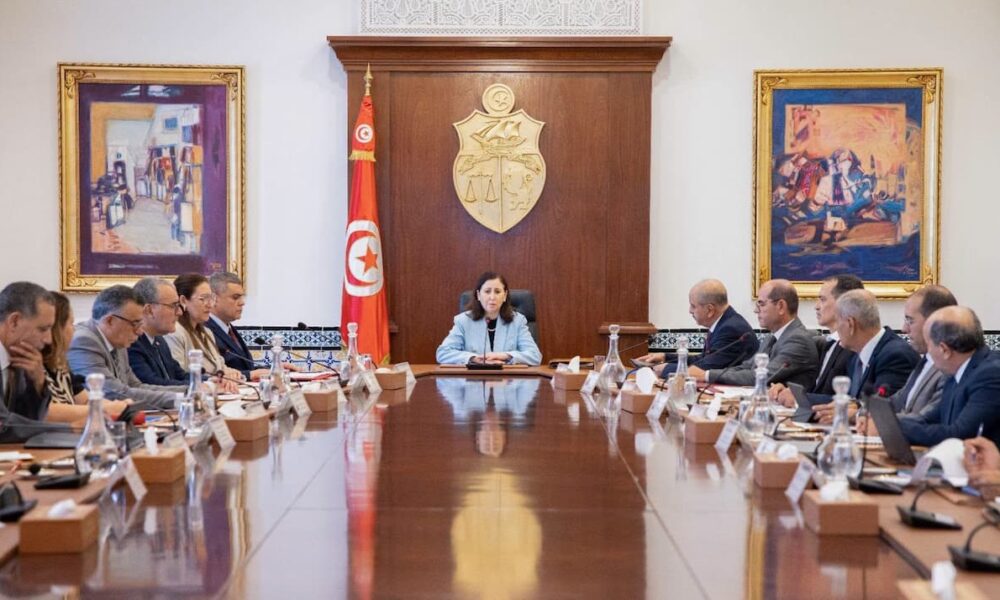
The head of government, Sarra Zaafrani Zenzri, presided, this Friday, October 9, 2026, over a restricted ministerial council dedicated to monitoring the operational action plan for energy projects in the short, medium and long term, arising from the national strategy in the energy sector.
At the opening of the proceedings, the head of government stressed that achieving energy security constitutes an absolute priority for the State, in accordance with the directions of the President of the Republic, Kaïs Saïed.
She specified that this objective aims to guarantee the continuity of electricity supply, to improve production efficiency, to reduce the energy deficit as well as production costs, while strengthening the competitiveness of the national economy.
It also aims to meet the needs of individuals and businesses in a context marked by growing demand, climate challenges and geopolitical fluctuations on energy markets.
An Integrated Plan to Strengthen Electrical Capacities
During this meeting, the Minister of Equipment and Housing, charged with managing the Ministry of Industry, Mines and Energy, Salah Zouari, presented the operational action plan for energy projects.
This plan is based on an integrated approach combining the mobilization of additional production capacities, the recovery of existing capacities, the development of renewable energies and electricity storage systems.
It also provides for strengthening measures to rationalize consumption and activating demand management mechanisms, in order to contribute to the balance between supply and demand, especially during periods of high consumption.
This strategy, deployed in the short, medium and long term, includes several measures aimed at improving the efficiency of available electrical capacities.
The Main Projects Presented by STEG
Following the exchanges devoted to this plan, the CEO of the Tunisian Electricity and Gas Company (STEG), as well as its Deputy General Manager, presented the main projects listed in the short-term operational plan.
These projects include notably:
– Improving the performance of existing production units by installing air cooling systems at the turbine inlets, enabling an additional capacity estimated at nearly 250 megawatts (MW).
– Installing a battery energy storage system with a power of 300 MW and a storage capacity of 600 megawatt-hours (MWh).
– The acquisition and installation of gas-fueled engines, for a total power of 200 MW.
– The acquisition and commissioning of a third gas turbine at the Borj El Amri plant, with a capacity of 300 MW.
– The recovery of full production capacity of the Kchabta and Metline plants, estimated at about 190 MW.
– The integration of around 300 MW from renewable energy projects before the summer of 2027, as well as an additional 40 MW under the fifth cycle of the authorization regime.
– The expansion of the Sidi Daoud wind farm, enabling the integration of an additional capacity of about 30 MW.
– The construction of a 50 MW photovoltaic plant at Beni Mhira, accompanied by a storage system with a capacity of 20 MWh.
– The construction of a 200 MW photovoltaic plant in Tataouine, equipped with a storage system of 100 MWh capacity.
– The management of electricity demand, in order to reduce pressure on the grid during peak periods, with a target to reduce demand by 300 MW.
– The improvement of the electrical load shedding mechanism, intended to alleviate the load on the grid.
2030 Objective: to raise the share of renewable energy in electricity production to 35%
Following the council, the head of government stressed the need to accelerate the realization of all the projects presented by STEG, while ensuring field monitoring to guarantee the achievement of the set objectives.
She also called for speeding up the implementation of renewable energy electricity production projects, through the various available mechanisms, notably self-production, the regime of authorizations and that of concessions.
She recalled that the development of renewable energies constitutes a strategic choice to strengthen energy security and ensure the sustainability of electricity supply.
In this context, she reaffirmed the national goal of raising the share of renewable energy in electricity production to 35% by 2030.
Electrical Grids, Smart Meters and Demand Management
The head of government also emphasized the need to modernize the electrical grid, deploy smart meters, increase electricity storage capacity, and strengthen energy efficiency across various economic sectors.
These measures aim to improve the autonomy and resilience of the electrical system in the face of consumption peaks and climate challenges, while ensuring the country’s energy needs are met.
Finally, she highlighted the importance of citizen and business participation in the national programs to rationalize electricity consumption, particularly during peak hours, in order to strengthen the capacities of the national electrical system.