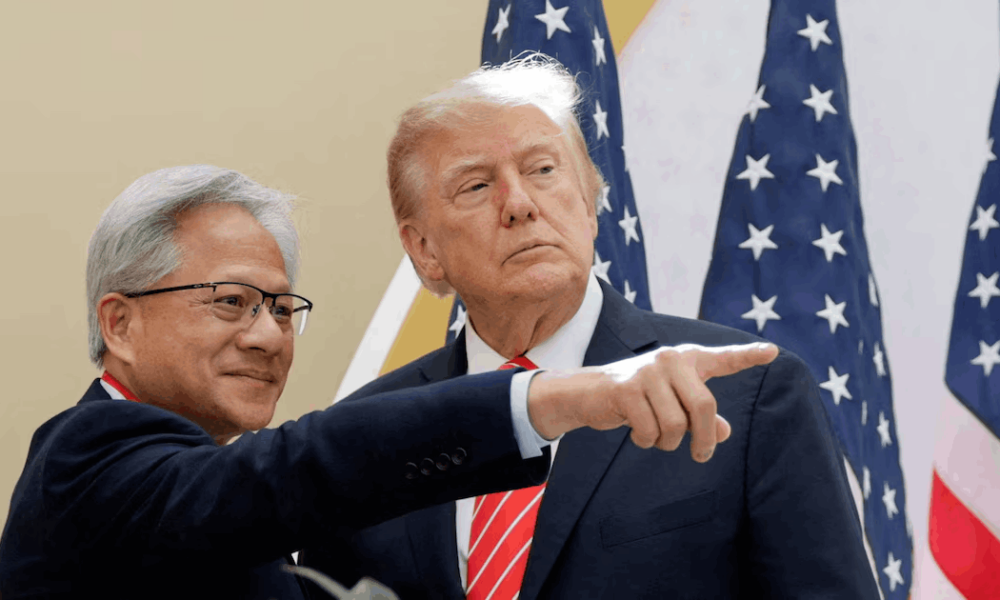
Eleven days after his resignation amid a personal scandal and suspicions of Chinese espionage, Jensen Huang has returned to his post as Nvidia’s CEO, thanks in large part to the intervention of Donald Trump. Wall Street immediately welcomed his return: Nvidia, the AI chip giant, saw its stock jump 31.5% on Monday, November 23, 2026, restoring roughly $1 trillion in market value to the company. A spectacular demonstration of the power of a single individual in the global AI industry.
A Scandal That Forces Nvidia’s Chief Executive to Depart
On November 12, Jensen Huang, cofounder and longtime leader of Nvidia, resigns after revelations concerning several extramarital affairs.
One of these, involving a Chinese businesswoman suspected by U.S. authorities of maintaining ties with Beijing’s intelligence services, triggers a crisis that goes beyond the boundaries of private life.
Questions arise about the security of Nvidia’s strategic information, a company whose processors lie at the heart of the technology competition between the United States and China.
These suspicions, however, do not constitute proof of the transmission of industrial secrets by Huang.
The board launches investigations and initially refuses to consider reinstating him. On November 17, its chairman Harvey Jones states that the company does not intend to recall its former chief.
Trump Personally Intervenes to Secure His Return
It is then that Donald Trump steps directly onto the scene.
The American president, who sees Nvidia as a strategic company for the U.S. economy and technological power, makes several interventions in Huang’s favor.
On November 20, Trump reveals that he discussed the executive with Chinese President Xi Jinping during their meeting in China.
Two days later, he publicly urges Nvidia’s board to rehire him, arguing that his return would serve the interests of the company and the United States.
According to the The Washington Post, Trump also spoke directly with directors to reassure them on national security questions.
On November 23, Nvidia finally announces Jensen Huang’s reinstatement as chairman and chief executive, following an unanimous vote by the board.
The company explicitly acknowledges having received information from senior U.S. government officials that contributed to its decision.
Trump immediately greets this reversal, lauding Huang as a great patriot and a national treasure.
Nearly $1 Trillion Recovered in a Single Session
The reaction of the financial markets is dramatic.
On Monday, November 23, Nvidia’s stock closes up by 31.5%, one of the strongest daily increases in its recent history.
This surge adds about $950 billion to the company’s market capitalization, bringing its valuation to around $4 trillion.
The movement extends beyond Nvidia: the Nasdaq climbs 6.5% and the S&P 500 4.7%, in a broad rebound session for U.S. technology stocks.
For investors, Huang’s return sharply reduces the uncertainty surrounding the company’s leadership, even though other factors also contributed to the market rebound.
Nevertheless, Nvidia’s shares remain below their pre-crisis level.
Jensen Huang, the Man Worth $1 Trillion?
The premise may seem almost unbelievable, but the numbers explain why it could take hold.
In a single session, the announcement of Jensen Huang’s return coincided with an increase in Nvidia’s valuation of nearly $1 trillion.
However, it would be incorrect to claim that his personal worth reaches that amount, or that the entire rise is exclusively attributable to him.
What Wall Street values is notably his leadership, his industry know-how, and his ability to keep Nvidia at the center of the global development of artificial intelligence.
This episode also reveals a form of dependence: despite its gigantic size, Nvidia remains closely tied to the personality of its founder.
A Spectacular Return That Sparks Controversy
The intervention by Trump and the board’s reversal now raise governance questions.
Democratic lawmakers, including Elizabeth Warren, are demanding explanations about the assurances provided by the U.S. administration.
Republican lawmakers likewise express concerns regarding national security risks.
Investigations into the circumstances of the scandal and adherence to U.S. export restrictions on chips to China remain open.
Thus, Huang’s return does not constitute a closing of investigations nor a blanket exemption from responsibility.
But the episode already illustrates two phenomena: the direct influence Donald Trump can exert over major American strategic companies and the extraordinary prominence Jensen Huang holds in the AI economy.
Can a leader truly be worth $1 trillion? Not in the financial sense. But Jensen Huang’s return shows that investors are ready to reprice a company by nearly that amount when they regain confidence in the person who leads it.