After investing in a national satellite network for its military communications, Canada is looking to strengthen its digital independence with a direct Internet link to Europe, bypassing the United States. The Leif Erikson submarine cable project, estimated at more than 620 million US dollars, could connect Norway to Canada across the North Atlantic. This initiative fits into a strategic rapprochement between Ottawa and Brussels, which want to reduce their dependence on American digital infrastructure.
A Transatlantic Cable That Bypasses the United States
The Leif Erikson project is being developed by the Norwegian company Bulk Infrastructure, specialized in optical fiber networks and data centers.
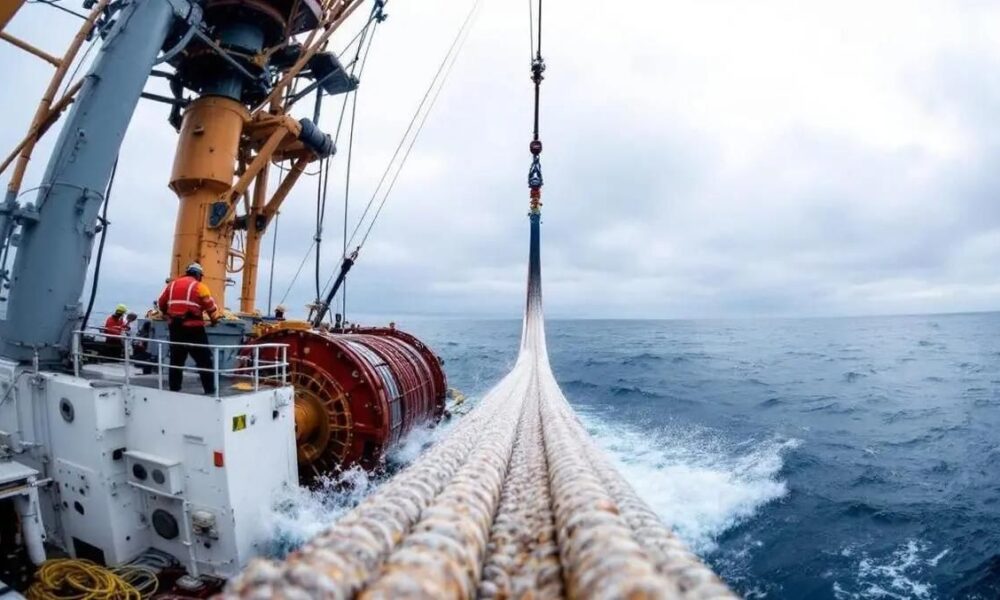
Its route envisions a submarine link of about 4,600 kilometers between Kristiansand, in southern Norway, and Happy Valley-Goose Bay, in the Canadian province of Newfoundland and Labrador.
From there, a land extension of about 1,900 kilometers would traverse Quebec to reach Montreal.
The aim is to create a data transmission route independent of the main transatlantic circuits passing through the United States.
According to information reported by Bloomberg, Bulk is seeking a Canadian partner who could take a majority stake in the future network.
The cost of the project is estimated at more than 620 million US dollars. Financing is not yet secured, and the technical studies, permits, and commercial commitments remain to be finalized.
Leif Erikson thus does not constitute an infrastructure already under construction. It represents a concrete possibility to diversify digital routes between Canada and Europe.
Why Is Ottawa Seeking to Reduce Its Digital Dependence?
Canada maintains particularly close economic and technological relations with the United States.
A large part of its international Internet traffic travels via American infrastructures, notably for exchanges with Europe and other regions of the world.
A direct link would provide an additional route, useful in case of failure, cyberattack, sabotage, or political disruption.
The issue has become more sensitive with the tensions between Ottawa and Washington since Donald Trump’s return to the White House.
For Canadian authorities, preserving national sovereignty also means having communication infrastructures capable of operating without relying on mandatory passage through American territory.
Bulk’s Chief Executive, Peder Nærbø, also defends the idea of a cable system placed under Canadian control.
Digital sovereignty does not mean cutting technological ties with the United States. It instead means having other routes and suppliers to prevent a single infrastructure from becoming indispensable.
After Starlink, Canada Bets 2.3 Billion on Telesat
The cable project aligns with another Canadian priority: the development of autonomous military satellite communications.
On August 4, 2026, the Canadian government awarded Telesat an initial contract of 2.3 billion Canadian dollars to strengthen the secure communications of its armed forces.
The agreement concerns the Telesat Lightspeed program and plans to extend the constellation to 225 satellites in low Earth orbit.
The future network is intended to improve military communications in the Arctic, a region essential to Canadian sovereignty and the defense of the North American continent.
The rollout of the relevant capabilities is planned from 2028.
This contract does not constitute a spontaneous response to the recent controversies surrounding Elon Musk. The Lightspeed development had been underway for several years.
But the tensions surrounding the use of Starlink and its military offshoot Starshield in Ukraine have reinforced the strategic interest in having multiple independent networks.
Canada is thus pursuing two complementary approaches: developing its national satellite capabilities and diversifying its terrestrial and submarine connections with the rest of the world.
Europe Also Preparing a New Digital Route Through the Arctic
On October 20, 2026, the European Commission presented a new strategy focused on the Arctic.
Brussels aims in particular to support a secure submarine cable network linking Greenland directly to Europe.
The project, named Pan-Arctic Cable, could then be extended to Canada and, in the longer term, to Japan.
The European Union says it has already mobilized 107 million euros to improve Greenland’s digital infrastructure and support its Arctic connectivity vision.
Feasibility studies remain necessary to define the full route, cost, and timeline for implementation.
The Pan-Arctic Cable and Leif Erikson are two distinct initiatives. Their development, however, responds to a common concern: multiplying secure digital routes between partners and reducing the vulnerabilities linked to the concentration of infrastructures.
The Arctic thus becomes a strategic space for telecommunications, on par with transportation, natural resources, and defense.
The Canada–EU Summit Could Accelerate Projects
The digital rapprochement between Ottawa and Brussels should feature among the topics of the Canada–European Union Summit scheduled for October 29-30, 2026 in Montreal.
The two partners seek to strengthen their cooperation in technologies, critical infrastructures, and economic security.
According to Bloomberg, the summit’s preparations include discussions on new submarine links between Europe, Canada, and Asia.
The meeting could foster studies and the search for financial partners.
But no definitive decision on construction or financing of the Leif Erikson cable has yet been announced.
The project’s realization will also depend on commercial demand and the necessary permissions for the passage of the infrastructures through the concerned territories.
A New Step in the Quest for Technological Autonomy
Canada is not alone in this approach.
Europe is developing its own constellation of secure communications, IRIS², while several major operators, including Orange, Deutsche Telekom, Telefónica, and Vodafone, have announced cooperation in satellite mobile services.
The concerns now focus on control of infrastructures, data security, continuity of communications, and dependence on foreign suppliers.
Submarine cables and satellites do not fulfill the same functions.
The former transport large quantities of data between continents. The latter enable connecting isolated areas and maintaining communications when terrestrial infrastructures are unavailable.
By combining the two, states seek to strengthen the resilience of their networks.
What About Tunisia?
The diversification of international communications also concerns Mediterranean countries, including Tunisia.
Submarine cables play a crucial role in international digital exchanges, cloud services, financial transactions, and the activity of technology companies.
Security and diversification of links are therefore important challenges for countries developing their digital activities and exported services.
The Canadian project does not announce a new direct connection with Tunisia. It nevertheless illustrates a global trend: states are increasingly attaching strategic value to the routes through which their data travels.
After satellites, submarine cables become a new instrument of sovereignty. Canada and Europe are not seeking to cut themselves off from the United States but to be able to continue communicating without relying exclusively on their infrastructures.
The realization of Leif Erikson remains conditioned on financing and authorizations, but the political and economic objective is already visible: diversifying the routes of the global network to reduce the risks of excessive dependence.