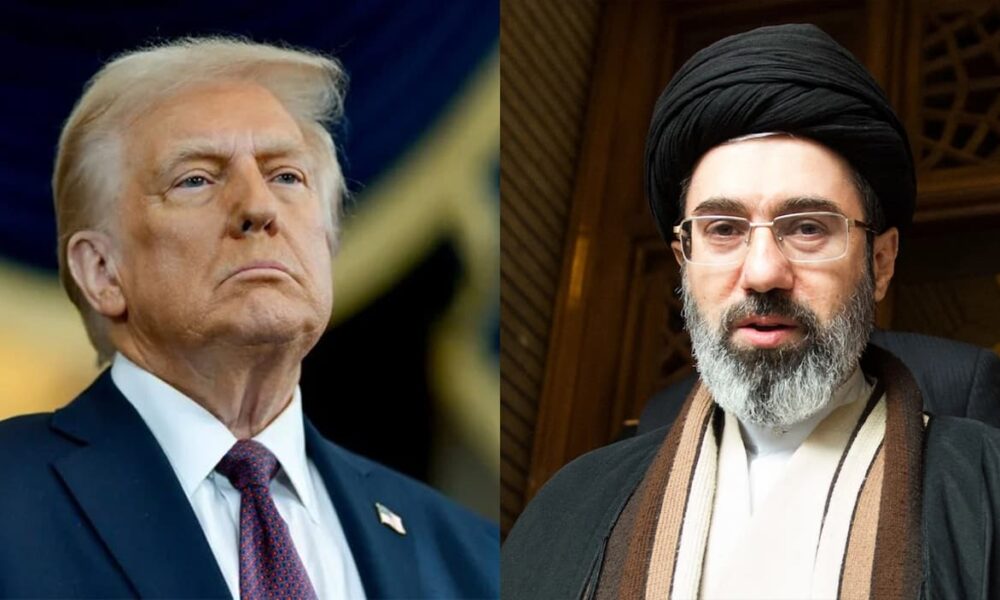
Donald Trump is studying new strikes against Iran, possibly after the U.S. elections on November 3. Meanwhile, Tehran claims that seven ships were damaged near the Strait of Hormuz.
In the United Arab Emirates, a petroleum spill led to the closure of all beaches in one emirate.
The crisis continues to weigh on the global energy market, with possible repercussions on Tunisia’s economic balances.
Environmental alert in the Emirates: all beaches in Umm al-Quwain closed
The United Arab Emirates’ Ministry of Climate Change and Environment confirmed, on Friday, October 23, marine pollution caused by an oil spill from a tanker. The pollution reached the shores of the Emirate of Umm Al-Quwain, where all beaches and coastal areas have been temporarily closed.
Containment, cleanup and assessment operations are underway. Fishermen have been urged to avoid the affected areas. According to the ministry, the odors reported in Sharjah, Ajman and Umm Al-Quwain pose no health risk to residents. The vessel responsible for the spill and the exact circumstances of the incident have not been officially identified. No direct link to the seven ships mentioned by Iran has been established at this stage.
A fresh campaign of strikes considered after November 3
Eleven days before the midterm elections scheduled for November 3, 2026, several American media outlets report military preparations for a possible resumption of strikes against Iran. Donald Trump envisions an intensive campaign, limited to a few days, which could begin after the vote. No final decision has, however, been announced.
The targets under consideration would include Iran’s nuclear facilities, energy infrastructure, as well as remaining missile and drone capabilities. The options being considered included the use of the U.S. conventional bomb GBU-43/B, nicknamed the “Mother of All Bombs,” notably against nuclear sites. These are scenarios under study, not orders to attack.
Plans coordinated between Washington and Israel, targeting in particular nuclear facilities and petrochemical facilities, are also being examined. The White House told the network that the United States would not strike Iran before the midterm elections. This statement is not a confirmation of attacks after the vote. According to sources cited by ABC, civilian power plants would not be among the plan’s objectives.
Donald Trump, for his part, accuses Iran of seeking to keep oil prices high ahead of the American vote, without providing public evidence of such a strategy in his statements. Israeli Prime Minister Benjamin Netanyahu, for his part, warned that any Iranian attempt to disrupt the electoral process would trigger an unusually intense response. These threats also come as Israeli elections are announced for October 27.
Seven ships reported hit and threats against American bases
The Iranian Revolutionary Guards announced on Thursday, October 22, that three ships had caught fire after hitting sea mines in the western part of the Strait of Hormuz. They also claimed damage to four other ships carrying out oil transfers ship-to-ship in the northern Gulf. These claims, i.e., seven ships in total, could not be independently verified and the available information does not allow a full accounting of casualties. There were 28 attacks reported in October, the most active month since the war began in late February.
Tehran warns that continuing to escort commercial vessels by American forces could widen the fighting to American bases in the region. The Iranian command says it has prepared for an asymmetric war. According to the Wall Street Journal, Iran has also told intermediaries that a new wave of American strikes could trigger a broader retaliation against economic facilities in Gulf countries. The newspaper further reports a limited resumption of ballistic missile production in underground facilities, according to anonymously cited officials.
In Washington, the U.S. Central Command (CENTCOM) says that the maritime blockade resumed on July 14 has prevented Iran from exporting at least $25 billion worth of oil. This figure is an estimate claimed by the U.S. military, not a revenue figure certified by an independent audit. American authorities present the blockade as a financial lever aimed at pressuring Tehran to negotiate.
A confrontation that remains diplomatic and regional
In an interview with the Financial Times, the American ambassador to the United Nations, Mike Waltz, said Washington was ready to support a prolonged confrontation. He linked the achievement of American objectives to the handling of highly enriched Iranian nuclear material and to a deal on enrichment. He also spoke in favor of ending the UNIFIL mission in Lebanon, while mentioning talks on what might replace it.
UNIFIL is to, according to Security Council Resolution 2790, cease its operations on December 31, 2026, before a phased withdrawal. The Lebanese dossier remains fragile: a correspondent from Al Jazeera also reported an Israeli drone strike on the town of Nabatieh al-Faouqa, in southern Lebanon.
Iranian Foreign Minister Abbas Araghchi also accuses Washington of having spent $11 billion in three years on missile defense systems benefiting Israel. This figure is presented as a statement by Iran’s top diplomat rather than an amount certified by American budget accounts. Democratic Senator Chris Murphy, meanwhile, rebukes Donald Trump for waging war without adequate protection for U.S. military personnel, diplomats and bases.
Oil near 113 dollars: the economic cost of instability
The Brent price stood at $112.96 per barrel on Friday, October 23 at 00:30 GMT, after a sharp rise the day before. The tensions no longer concern only Hormuz: attacks on Saudi facilities and clashes near the Bab el-Mandeb Strait raise the risk for oil routes.
The October report from the International Energy Agency (IEA) measures the magnitude of the shock: oil flows through the Strait of Hormuz reached 10.9 million barrels per day in September, after a partial rebound, compared with around 20 million barrels per day before the conflict. Bypass exports stood at 5.6 million barrels per day in September. These data describe September, not the exact traffic on October 23.
The IEA also notes that in September, shipments of refined petroleum products from the Middle East were limited to 1.9 million barrels per day, versus 4.7 million before the war. Diesel remains particularly tight, while higher transport and insurance costs complicate refinery supply. In its October projections, the U.S. Energy Information Administration (EIA) anticipated an average Brent of $84 in 2027, but highlighted the high degree of uncertainty surrounding these forecasts.
Tunisia: an energy bill already heavy and a 2027 budget under scrutiny
10.48 billion dinars : Tunisia’s energy trade deficit for the first nine months of 2026, compared with 8.1064 billion in the same period in 2025, a rise of 29.3% (INS).
80 dollars : assumed average annual Brent price used in the Tunisian budget proposal for 2027.
7.09 billion dinars : amount of subsidies planned for hydrocarbons and electricity in 2027, out of 11.846 billion in total subsidies.
According to official figures from the National Institute of Statistics, the energy deficit represents nearly half of Tunisia’s total trade deficit, estimated at 20.997 billion dinars by the end of September 2026. The energy bill thus provides a tangible channel for transmitting international tensions to the domestic economy.
The 2027 budget proposal allocates 3.676 billion dinars in support to the Tunisian Electricity and Gas Company (STEG) and 3.414 billion to the Tunisian Refining Industries Company (STIR), totaling 7.09 billion, based notably on an average Brent price of 80 dollars and an expected 2% growth in energy consumption.
By comparison, the spot price of $112.96 is higher by $32.96, or 41.2%, than the budget assumption of 80 dollars. This comparison is not a forecast of higher costs for 2027: the budget will depend on the average price observed during the year, the imported volumes, the exchange rate and public measures. A persistence of high prices could nevertheless amplify pressure on the import bill, subsidies, transportation and some production costs.
Donald Trump also asserts that the war will soon end and that fuel prices will quickly fall. But between the prospect of new strikes, Iranian threats against Gulf infrastructure and the environmental consequences already observed, the trajectory of energy prices remains uncertain.
For Tunisia, the real indicator to watch will be less the daily oil price than the duration of market disruption and its effect on the average cost of imports.